Advertisements
Chapters
▶ *: The Wit that Won Hearts
*: A Concrete Example
*: Wisdom Paves the Way
Unit 2: Values and Dispositions
*: A Tale of Valour: Major Somnath Sharma and the Battle of Badgam
*: Somebody’s Mother
*: Verghese Kurien - I Too Had A Dream
Unit 3: Mystery and Magic
*: The Case of the Fifth Word
*: The Magic Brush of Dreams
*: Spectacular Wonders
Unit 4: Environment
*: The Cherry Tree
*: Harvest Hymn
*: Waiting for the Rain
Unit 5: Science and Curiosity
*: Feathered Friend
*: Magnifying Glass
*: Bibha Chowdhuri: The Beam of Light that Lit the Path for Women in Indian Science
Advertisements
Solutions for Chapter *: The Wit that Won Hearts
Below listed, you can find solutions for Chapter * of CBSE NCERT for इंग्लिश पूर्वी इयत्ता ८.
NCERT solutions for इंग्लिश पूर्वी इयत्ता ८ * The Wit that Won Hearts Intex Questions [Pages 1 - 2]
Let us do these activities before we read.
Select qualities of a person who uses wit from the box given below.
| wise | serious | clever | powerful | humorous |
| stubborn | courageous | observant | charming | creative |
| punctual | confident | energetic |
Now, discuss reasons for your choice of qualities.
Work in pairs and answer the riddles that are given below. Share the answers with your classmates and teacher.
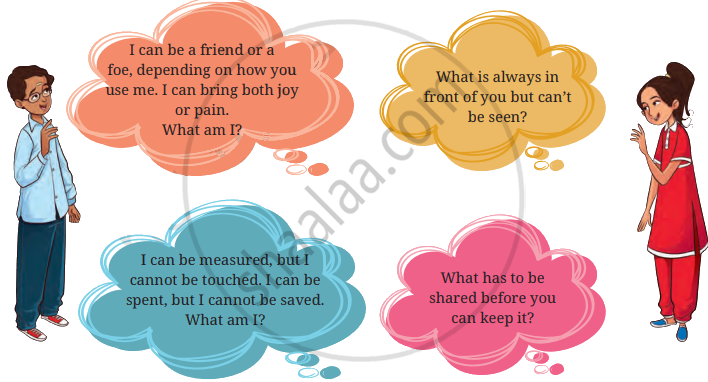
Discuss in pairs.
Why are qualities like humour and wit important in a person?
Why do you think kings and queens preferred to have witty people among their courtiers?
If you were asked to solve a disagreement between two people, what approach would you take?
Have you ever been in a situation where a small misunderstanding led to a big problem? How was it resolved?
NCERT solutions for इंग्लिश पूर्वी इयत्ता ८ * The Wit that Won Hearts Exercise [Pages 7 - 16]
Let us discuss:
Rectify the following false statement from the text.
The queen insulted the king by speaking against the quality of his poem.
Rectify the following false statement from the text.
Tenali Rama immediately went to the king and convinced him to talk to the queen.
Rectify the following false statement from the text.
The courtiers admired the king’s poem and praised his literary talent.
Rectify the following false statement from the text.
The ministers in the court were eager to hear Tenali Rama’s idea about paddy cultivation.
Rectify the following false statement from the text.
The king never realised his mistake and continued to stay angry with the queen.
Let us think and reflect:
Read the extract and answer the questions that follow.
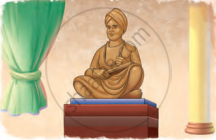
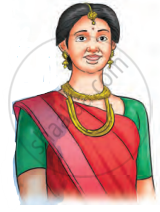
| “... The king thought I was disrespecting his poem and stormed off. Since then, he has not spoken to me. If I had known this would happen I would have chosen another day. Help me, please, Rama. Only you can help the king understand.” Rama nodded thoughtfully. “If you like, I will try my best to resolve this matter, Your Highness. But this needs a well-planned approach and I may need time to find the right strategy.” |
(i) Why does the queen believe that only Tenali Rama can help the king understand?
(ii) What does the queen’s statement, “If I had known this would happen, I would have chosen another day”, suggest about her feelings?
- She is angry at the king for overreacting.
- She regrets the unintended misunderstanding.
- She believes the poem was not worth listening to.
- She is worried that the king might punish her.
(iii) How does Tenali Rama’s response reflect his wisdom and problem-solving skills?
(iv) Fill in the blank by choosing the correct option from those given in the brackets.
The king’s reaction shows that he is sensitive and ______ (has a lot of faith/takes great pride) in his poetry.
Read the extract and answer the questions that follow.
| That evening, the king approached the queen with a softened expression. “Thirumalambal”, he began, his voice gentle, “I have been foolish. I see now that I overreacted. I let my pride blind me. I’m so sorry.” The queen, who had longed for this moment, smiled and replied, “If you like, we can leave this quarrel behind us. I would very much like to listen to your poem.” |
(i) Complete the following with a suitable explanation.
When the king said, “I let my pride blind me”, he means that ______.
(ii) Why does the queen say, “If you like, we can leave this quarrel behind us”?
(iii) Fill in the blank by choosing the correct option from those given in the brackets.
The king acknowledges that his pride clouded his judgement, which shows ______. (intelligence and courage/maturity and self-awareness)
(iv) State any one characteristic that the queen’s response to the king’s apology shows about her.
Answer the following questions.
Why was the Vijayanagara Empire considered to be in its ‘Golden Era’ during Krishnadeva Raya’s reign?
How did Tenali Ramakrishna gain a special place in the king’s court?
How did the quarrel between the king and the queen affect the palace?
What strategy did Tenali Rama use to make the king realise his mistake?
What was the reaction of the courtiers when Tenali Rama introduced his ‘special’ paddy seeds?
How does the story conclude, and what lesson can be learnt from it?
Let us learn:
Fill in the blanks and complete the paragraph by choosing suitable expressions from the box given below.
| cast a shadow | murmur swept through the room | hush fell over |
| mind raced back | stormed off | rippled through |
My mother is quite witty, and her sense of humour always lightens stressful moments. Once, at a family dinner, an argument began over a minor issue, and 1. ______, making everyone feel uncomfortable. Just as things were getting serious, she made a clever remark and laughter 2. ______ the gathering, making everyone relaxed. The person who started the argument 3. ______. Everyone disapproved of the action and a 4. ______. My 5. ______ to how my mother had saved other situations like this. Without her, such moments would have 6. ______ over the gatherings. I hope that I grow up to be as witty as my mother.
The writer uses words like ‘roared’, ‘murmur’ in the text to indicate the sound produced. Fill in the blanks with suitable sound words from the box given below. You may refer to a dictionary.
| murmur | sighed | mumble | gasped |
| snickers | thud | groan | rattle |
| roared | whispered |
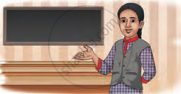
- As the teacher began the riddle challenge, a ______ of excitement spread through the classroom.
- Anaya ______ in relief-she loved riddles more than solving Mathematics problems.
- ‘Think carefully,’ the teacher began to ______, as she wrote a riddle on the board.
- When the question was revealed, a few students ______, realising it wasn’t as easy as they had expected.
- Some exchanged ______, wondering if anyone at all would be able to solve it.
- Just then, Anaya tapped her book on the desk with a small ______, deep in thought.
- ‘Ah, I see it now!’ she said stretching with a ______, as if it had taken her great effort.
- A small breeze made the windows ______, adding to the suspense of the moment.
- ‘So, what’s the answer?’ the students ______, their voices filled with playful enthusiasm.
- Leaning forward with a smile, Anaya ______, ‘Sometimes, the trickiest questions have the simplest answers.’
Create new compound words by matching words in Column 1 with those in Column 2.
| Column 1 | Column 2 |
|---|---|
| (i) quick | A. hall |
| (ii) soft | B. tempered |
| (iii) common | C. spoken |
| (iv) house | D. blue |
| (v) book | E. store |
| (vi) ill | F. sense |
| (vii) sky | G. witted |
| (viii) dance | H. hold |
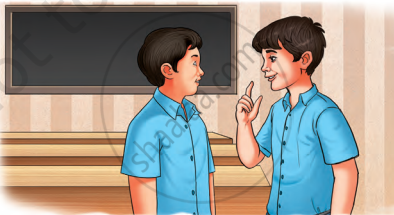
Fill in the blanks with the words created in the previous question.
Ravi was (i) ______, always speaking calmly even in arguments. He grew up in a lively (ii) ______, where he learned to handle different personalities. His friend Arun, however, was (iii) ______ and often lost his patience. Despite this, Arun admired Ravi’s (iv) ______ thinking. One evening, as they passed a (v) ______, they saw some performers rushing out. Ravi noticed that one of them dropped a (vi) ______ book on the ground. “Is this yours?” he asked. “Oh thank you, young man!” the performer smiled. “It’s a recent purchase from the (vii) ______ round the corner.” True to his nature Arun promptly said to Ravi, “ It’s (viii) ______ that it’s not from a bakery but bookshop!” Ravi smiled and they walked on.
Read the sentences from the text and their explanation given in the table below.
| Sentences from the Text | Tenses | Explanation |
|---|---|---|
| 1. If you like, I will try my best to resolve this matter. | Simple Present + Present Modal | The condition in the ‘if’ clause may or may not be fulfilled. The present tense refers only to a possible future action. |
| 2. If, by chance something were to go wrong, our farmers would suffer. | Simple Past + Past Modal | The condition in the ‘if’ clause expresses a hypothetical or imaginary situation. |
| 3. If I had known this would happen, I would have chosen another day. | Past Perfect + would have + Past Participle | The condition in the ‘if’ clause describes what the speaker would have done (differently) if the past situation had been different and it is impossible to rectify it in the present. |
In sentence 1 ‘if you like’ is the subordinate clause (if clause) and ‘I will try my best to resolve this matter’ is the main clause.
Identify the subordinate and main clauses in sentences 2 and 3.
Match the subordinate clauses (if clauses) in Column 1 with the appropriate main clauses in Column 2 to make complete sentences.
| Column 1 | Column 2 |
|---|---|
| (i) If I had a magic wand, | A. We will go to the theatre. |
| (ii) If it rains tomorrow, | B. I would sneak into the secret room. |
| (iii) If you had listened carefully, | C. I would give myself wings. |
| (iv) If you finish your homework, | D. The boys would have woken up on time. |
| (v) If I were invisible, | E. We will stay indoors and play board games. |
| (vi) If the alarm had rung, | F. You would have solved the puzzle. |
Complete the following sentence appropriately with either the main clause or the subordinate clause (if clause).
Your teacher will be unhappy if ______.
Complete the following sentence appropriately with either the main clause or the subordinate clause (if clause).
They would have caught the train if ______.
Complete the following sentence appropriately with either the main clause or the subordinate clause (if clause).
______ if you continue to stay up late every night.
Complete the following sentence appropriately with either the main clause or the subordinate clause (if clause).
If she knew the answer, ______.
Complete the following sentence appropriately with either the main clause or the subordinate clause (if clause).
______ if she had studied harder.
Complete the following sentence appropriately with either the main clause or the subordinate clause (if clause).
If I had a million rupees, ______.
Complete the following sentences.
If I were a tree, ______.
If I were the Head Teacher of my school, ______.
If I were a bird, ______.
If I were a magician, ______.
If I had studied harder, ______.
Let us listen:
You will listen to a woman narrating a story. As you listen, fill in the blanks in the following sentence by selecting the correct option. (Transcript for teacher on page 46)
The rope tying the bundle of sticks was ______.
loose
thick
short
You will listen to a woman narrating a story. As you listen, fill in the blanks in the following sentence by selecting the correct option. (Transcript for teacher on page 46)
The scholar is finally referred to as ______.
irritable
mischievous
arrogant
You will once again listen to the story. As you listen, number the events of the story in the correct order of occurrence.
- The great scholar was ashamed because he did not know what to say.
- Rama accepted the challenge thrown by the visitor.
- Rama had a bundle tied in silk when he came to the palace.
- The king laughed at the explanation given by Rama.
- The visitor wanted to show his superiority over others in the palace.
- Rama showed the work to be a bundle of sticks tied together by a rope.
- The king wanted to know more about the work mentioned by Rama.
- The court scholars were afraid of the king’s anger.
Let us speak:
Work in pairs and mark the intonation in the question given below. Take turns to practise by saying them aloud with the correct intonation.
Is this your cat?
Work in pairs and mark the intonation in the question given below. Take turns to practise by saying them aloud with the correct intonation.
What is the name of your cat?
Work in pairs and mark the intonation in the question given below. Take turns to practise by saying them aloud with the correct intonation.
Will you be going to your village?
Work in pairs and mark the intonation in the question given below. Take turns to practise by saying them aloud with the correct intonation.
Why are you going to your village?
Work in pairs and mark the intonation in the question given below. Take turns to practise by saying them aloud with the correct intonation.
Is this where you live?
Work in pairs and mark the intonation in the question given below. Take turns to practise by saying them aloud with the correct intonation.
Where do you live?
Work in pairs and mark the intonation in the question given below. Take turns to practise by saying them aloud with the correct intonation.
Can I meet your parents?
Work in pairs and mark the intonation in the question given below. Take turns to practise by saying them aloud with the correct intonation.
How are your parents?
Work in pairs and mark the intonation in the question given below. Take turns to practise by saying them aloud with the correct intonation.
Do you have any plans for tomorrow?
Work in pairs and mark the intonation in the question given below. Take turns to practise by saying them aloud with the correct intonation.
What are you going to do tomorrow?
Work in pairs and take turns to ask and answer questions about a trip that you are planning. Remember to use the correct intonation while asking these questions.
Here are some prompts for you.
- The destination (Where...)
- Purpose (Why...)
- Mode of transport (How...)
- Duration (When...)
- Travel companions (Who...)
- Activities (What...)
Work in pairs and take turns to ask and answer the questions about witty characters in folktales or stories you have read. Use the correct intonation while asking questions.
For example: Your favourite character in the folktale (Who...?)
Who is your favourite character in the folktale?
- The name of the witty character (Who...?)
- The reason for her/his wit being important in the story (Why...?)
- The most famous trick or clever idea she/he used (What...?)
- The time period or setting of the folktale/story (When...?)
- The way she/he used her/his intelligence to solve a problem (How...?)
- The location where the story takes place (Where...?)
Let us write: Anarrative essayiswrittenonapersonal experience or an imagined experience.
Read the narrative essay given below.
|
A Lesson in Responsibility One bright Monday morning, I woke up to the sounds of birds chirping loudly. For once, I wasn’t late for school. My uniform was neatly laid out, and my homework was already packed in my bag. I felt proud of myself for being so organised. But little did I know, the day would still teach me an important lesson. During the morning assembly, our teacher, Mrs. Rao, announced a surprise Science quiz. My heart skipped a beat. I had studied the chapter a week ago, but I had forgotten to revise it over the weekend. As I sat at my desk with the question paper in front of me, I froze. The questions looked familiar, yet I couldn’t recall the answers clearly. I tried my best to focus, but it wasn’t enough. Later, when the results were announced, I scored much lower than I expected. Disappointed, I spoke to Mrs. Rao after the class. She smiled and said, “It’s not about how much you know but how consistently you prepare. Small efforts add up every day.” Her words stayed with me. From that day on, I made it a habitto revise my lessons regularly, even if there wasn’t an immediate test. Responsibility isn’t just about being on time or finishing tasks,it’s about being ready for what’s unexpected. |
Now, work in pairs and check (✓) if the following features are present in the narrative essay.
1. Introduction
- The essay begins with a clear and engaging opening.
- The introduction sets the context for the narrative.
- The central idea or purpose is clear.
2. Body of the essay
- Events are narrated in a logical sequence.
- Descriptive details are used.
- Characters and settings are clearly described.
- The narrator’s emotions or thoughts are shared.
- The essay includes a challenge or a problem or a turning point.
3. Conclusion
- The essay ends with an outcome.
- A lesson or a message is clearly stated.
4. Writing Style
- The tone is personal and engaging.
- First person narration is used (for example, ‘I,’ ‘my’).
5. Language
- The essay uses simple and clear language.
- Grammar, punctuation, and spellings are correctly used.
Write a narrative essay based on the situation given below.
The Day I Learnt the Value of Teamwork
Write a narrative essay based on the situation given below.
A Small Act of Kindness that Made a Difference
Let us explore:
Limericks are poems in five lines that have a twist in the last line. Read and enjoy the following limericks and create one on your own.
Raju flew his kite in the sky so wide,
It soared with grace, full of pride.
But a crow came along,
Singing its song,
And now it’s the crow on a joyride!
Go to the library and read a story of your choice. Share its theme and the interesting parts of the story with your classmates and teacher.
You must have read stories of wit, humour, and wisdom in your own language or English. Make a list of these stories that you have read on a chart paper. Each student should read at least one new story from the list.
Solutions for *: The Wit that Won Hearts
NCERT solutions for इंग्लिश पूर्वी इयत्ता ८ chapter * - The Wit that Won Hearts
Shaalaa.com has the CBSE Mathematics इंग्लिश पूर्वी इयत्ता ८ CBSE solutions in a manner that help students grasp basic concepts better and faster. The detailed, step-by-step solutions will help you understand the concepts better and clarify any confusion. NCERT solutions for Mathematics इंग्लिश पूर्वी इयत्ता ८ CBSE * (The Wit that Won Hearts) include all questions with answers and detailed explanations. This will clear students' doubts about questions and improve their application skills while preparing for board exams.
Further, we at Shaalaa.com provide such solutions so students can prepare for written exams. NCERT textbook solutions can be a core help for self-study and provide excellent self-help guidance for students.
Concepts covered in इंग्लिश पूर्वी इयत्ता ८ chapter * The Wit that Won Hearts are Grammar, English Compositon.
Using NCERT इंग्लिश पूर्वी इयत्ता ८ solutions The Wit that Won Hearts exercise by students is an easy way to prepare for the exams, as they involve solutions arranged chapter-wise and also page-wise. The questions involved in NCERT Solutions are essential questions that can be asked in the final exam. Maximum CBSE इंग्लिश पूर्वी इयत्ता ८ students prefer NCERT Textbook Solutions to score more in exams.
Get the free view of Chapter *, The Wit that Won Hearts इंग्लिश पूर्वी इयत्ता ८ additional questions for Mathematics इंग्लिश पूर्वी इयत्ता ८ CBSE, and you can use Shaalaa.com to keep it handy for your exam preparation.
