Advertisements
Chapters
![NCERT Exemplar solutions for Mathematics [English] Class 7 chapter 5 - Lines and Angles - Shaalaa.com](/images/mathematics-english-class-7_6:5f2b1b2038084cf381bfa42c826a928c.jpg "NCERT Exemplar solutions for Mathematics [English] Class 7 chapter 5 - Lines and Angles")
Advertisements
Solutions for Chapter 5: Lines and Angles
Below listed, you can find solutions for Chapter 5 of CBSE NCERT Exemplar for Mathematics [English] Class 7.
NCERT Exemplar solutions for Mathematics [English] Class 7 5 Lines and Angles Exercise [Pages 128 - 150]
Choose the correct alternative:
The angles between North and West and South and East are ______.
complementary
supplementary
both are acute
both are obtuse
Angles between South and West and South and East are ______.
vertically opposite angles
complementary angles
making a linear pair
adjacent but not supplementary
In the following figure, PQ is a mirror, AB is the incident ray and BC is the reflected ray. If ∠ABC = 46°, then ∠ABP is equal to ______.

44°
67°
13°
62°
If the complement of an angle is 79°, then the angle will be of ______.
1°
11°
79°
101°
Angles which are both supplementary and vertically opposite are ______.
95°, 85°
90°, 90°
100°, 80°
45°, 45°
The angle which makes a linear pair with an angle of 61° is of ______.
29°
61°
122°
119°
The angles x and 90° – x are ______.
supplementary
complementary
vertically opposite
making a linear pair
The angles x – 10° and 190° – x are ______.
interior angles on the same side of the transversal
making a linear pair
complementary
supplementary
In the following figure, the value of x is ______.
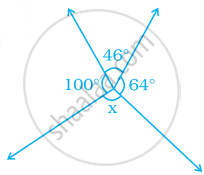
110°
46°
64°
150°
In the following figure, if AB || CD, ∠APQ = 50° and ∠PRD = 130°, then ∠QPR is ______.

130°
50°
80°
30°
In the following figure, lines l and m intersect each other at a point. Which of the following is false?

∠a = ∠b
∠d = ∠c
∠a + ∠d = 180°
∠a = ∠d
If angle P and angle Q are supplementary and the measure of angle P is 60°, then the measure of angle Q is ______.
120°
60°
30°
20°
In the following figure, POR is a line. The value of a is ______.
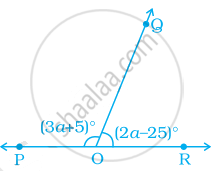
40°
45°
55°
60°
In the following figure, POQ is a line. If x = 30°, then ∠QOR is ______.
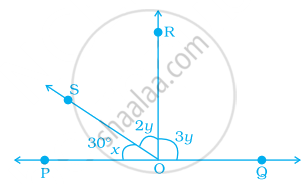
90°
30°
150°
60°
The measure of an angle which is four times its supplement is ______.
36°
144°
16°
64°
In the following figure, the value of y is ______.
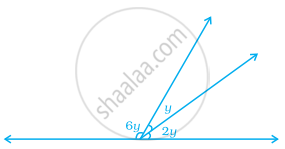
30°
15°
20°
22.5°
In the following figure, PA || BC || DT and AB || DC. Then, the values of a and b are respectively.

60°, 120°
50°, 130°
70°, 110°
80°, 100°
The difference of two complementary angles is 30°. Then, the angles are ______.
60°, 30°
70°, 40°
20°, 50°
105°, 75°
In the following figure, PQ || SR and SP || RQ. Then, angles a and b are respectively.

20°, 50°
50°, 20°
30°, 50°
45°, 35°
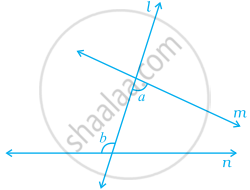
In the following figure, a and b are ______.
alternate exterior angles
corresponding angles
alternate interior angles
vertically opposite angles
If two supplementary angles are in the ratio 1 : 2, then the bigger angle is ______.
120°
125°
110°
90°
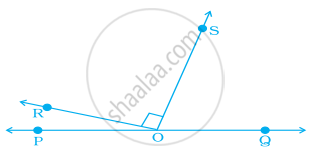
In the following figure, ∠ROS is a right angle and ∠POR and ∠QOS are in the ratio 1 : 5. Then, ∠QOS measures ______.
150°
75°
45°
60°
Statements a and b are as given below:
a: If two lines intersect, then the vertically opposite angles are equal.
b: If a transversal intersects, two other lines, then the sum of two interior angles on the same side of the transversal is 180°.
Then ______.
both a and b are true
a is true and b is false
a is false and b is true
both a and b are false
For the following figure, statements p and q are given below:
p: a and b are forming a linear pair.
q: a and b are forming a pair of adjacent angles.
Then ______.

both p and q are true
p is true and q is false
p is false and q is true
both p and q are false
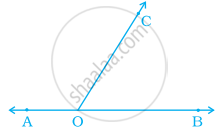
In the following figure, ∠AOC and ∠BOC form a pair of ______.
vertically opposite angles
complementary angles
alternate interior angles
supplementary angles
In the following figure, the value of a is ______.

20°
15°
5°
10°
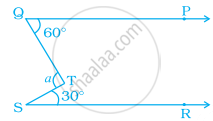
In the following figure, if QP || SR, the value of a is ______.
40°
30°
90°
80°
In which of the following figures, a and b are forming a pair of adjacent angles?
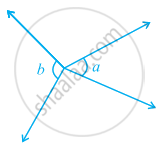
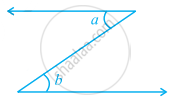
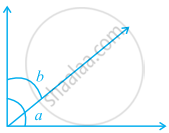
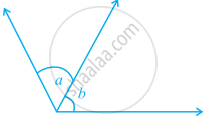
In a pair of adjacent angles,
- vertex is always common,
- one arm is always common, and
- uncommon arms are always opposite rays
Then ______.
All (i), (ii) and (iii) are true
(iii) is false
(i) is false but (ii) and (iii) are true
(ii) is false
In the following figure, lines PQ and ST intersect at O. If ∠POR = 90° and x : y = 3 : 2, then z is equal to ______.
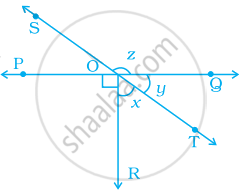
126°
144°
136°
154°
In the following figure, POQ is a line, then a is ______.
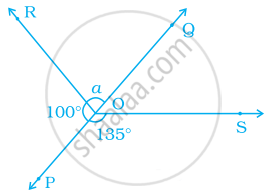
35°
100°
80°
135°
Vertically opposite angles are always ______.
supplementary
complementary
adjacent
equal
In the following figure, a = 40°. The value of b is ______.
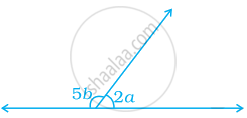
20°
24°
36°
120°
If an angle is 60° less than two times of its supplement, then the greater angle is ______.
100°
80°
60°
120°
In the following figure, PQ || RS. If ∠1 = (2a + b)° and ∠6 = (3a – b)°, then the measure of ∠2 in terms of b is ______.
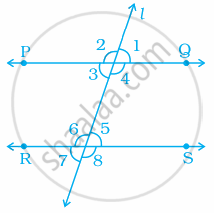
(2 + b)°
(3 – b)°
(108 – b)°
(180 – b)°
In the following figure, PQ || RS and a : b = 3 : 2. Then, f is equal to ______.
36°
108°
72°
144°
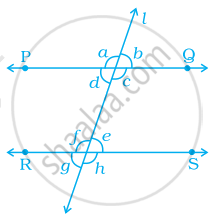
In the following figure, line l intersects two parallel lines PQ and RS. Then, which one of the following is not true?

∠1 = ∠3
∠2 = ∠4
∠6 = ∠7
∠4 = ∠8
In the following figure, which one of the following is not true?
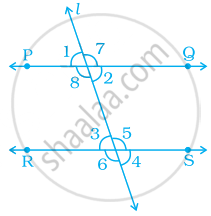
∠1 + ∠5 = 180°
∠2 + ∠5 = 180°
∠3 + ∠8 = 180°
∠2 + ∠3 = 180°
In the following figure, which of the following is true?
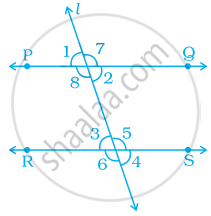
∠1 = ∠5
∠4 = ∠8
∠5 = ∠8
∠3 = ∠7
In the following figure, PQ || ST. Then, the value of x + y is ______.
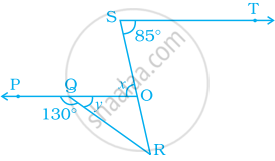
125°
135°
145°
120°
In the following figure, if PQ || RS and QR || TS, then the value a is ______.

95°
90°
85°
75°
Fill in the blanks:
If sum of measures of two angles is 90°, then the angles are ______.
If the sum of measures of two angles is 180°, then they are ______.
A transversal intersects two or more than two lines at ______ points.
If a transversal intersects two parallel lines, then sum of interior angles on the same side of a transversal is ______.
If a transversal intersects two parallel lines, then alternate interior angles have one common ______.
If a transversal intersects two parallel lines, then corresponding angles are on the ______ side of the transversal.
If a transversal intersects two parallel lines, then alternate interior angles are on the ______ side of the transversal.
Two lines in a plane which do not meet at a point anywhere are called ______ lines.
Two angles forming a ______ pair are supplementary.
The supplement of an acute is always ______ angle.
The supplement of a right angle is always ______ angle.
The supplement of an obtuse angle is always ______ angle.
In a pair of complementary angles, each angle cannot be more than ______ .
An angle is 45°. Its complementary angle will be ______.
An angle which is half of its supplement is of ______.
State whether the statements is True or False.
Two right angles are complementary to each other.
True
False
One obtuse angle and one acute angle can make a pair of complementary angles.
True
False
Two supplementary angles are always obtuse angles.
True
False
Two right angles are always supplementary to each other.
True
False
One obtuse angle and one acute angle can make a pair of supplementary angles.
True
False
Both angles of a pair of supplementary angles can never be acute angles.
True
False
Two supplementary angles always form a linear pair.
True
False
Two angles making a linear pair are always supplementary.
True
False
Two angles making a linear pair are always adjacent angles.
True
False
Vertically opposite angles form a linear pair.
True
False
Interior angles on the same side of a transversal with two distinct parallel lines are complementary angles.
True
False
Vertically opposite angles are either both acute angles or both obtuse angles.
True
False
A linear pair may have two acute angles.
True
False
An angle is more than 45°. Its complementary angle must be less than 45°.
True
False
Two adjacent angles always form a linear pair.
True
False
Write down the pair of adjacent angles shown in the following figure:
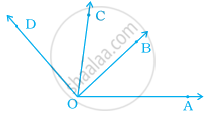
Write down the pair of adjacent angles shown in the following figure:

Write down the pair of adjacent angles shown in the following figure:

Write down the pair of adjacent angles shown in the following figure:

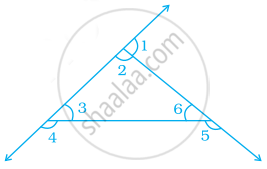
In the following figure, write, if any, (i) each pair of vertically opposite angles, and (ii) each linear pair.

In the following figure, write, if any, (i) each pair of vertically opposite angles, and (ii) each linear pair.

In the following figure, write, if any, (i) each pair of vertically opposite angles, and (ii) each linear pair.

In the following figure, write, if any, (i) each pair of vertically opposite angles, and (ii) each linear pair.

Name the pairs of supplementary angles in the following figure:

Name the pairs of supplementary angles in the following figure:
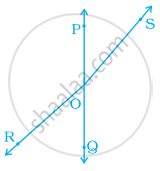
Name the pairs of supplementary angles in the following figure:
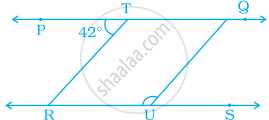
In the following figure, PQ || RS, TR || QU and ∠PTR = 42°. Find ∠QUR.
The drawings below (Figure), show angles formed by the goalposts at different positions of a football player. The greater the angle, the better chance the player has of scoring a goal. For example, the player has a better chance of scoring a goal from Position A than from Position B.


In Parts (a) and (b) given below it may help to trace the diagrams and draw and measure angles.
- Seven football players are practising their kicks. They are lined up in a straight line in front of the goalpost [Figure]. Which player has the best (the greatest) kicking angle?
- Now the players are lined up as shown in figure. Which player has the best kicking angle?
- Estimate atleast two situations such that the angles formed by different positions of two players are complement to each other.
The sum of two vertically opposite angles is 166°. Find each of the angles.
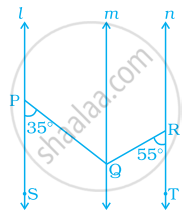
In the following figure, l || m || n. ∠QPS = 35° and ∠QRT = 55°. Find ∠PQR.
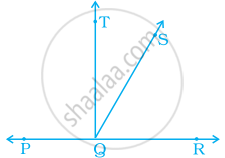
In the following figure, P, Q and R are collinear points and TQ ⊥ PR, name; pair of complementary angles.
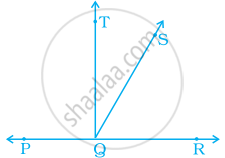
In the following figure, P, Q and R are collinear points and TQ ⊥ PR, name; two pairs of supplementary angles.
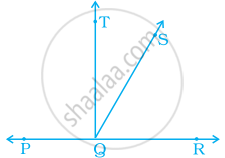
In the following figure, P, Q and R are collinear points and TQ ⊥ PR, name; four pairs of adjacent angles.
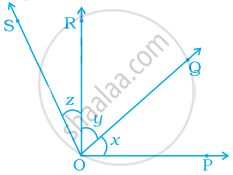
In the following figure, OR ⊥ OP. Name all the pairs of adjacent angles.
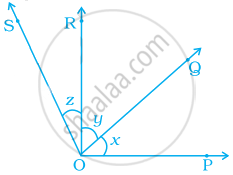
In the following figure, OR ⊥ OP. Name all the pairs of complementary angles.
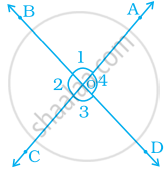
If two angles have a common vertex and their arms form opposite rays (Figure), Then, how many angles are formed?

If two angles have a common vertex and their arms form opposite rays (Figure), Then, how many types of angles are formed?
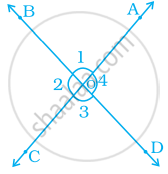
If two angles have a common vertex and their arms form opposite rays (Figure), Then, write all the pairs of vertically opposite angles.
In the following figure are the following pairs of angles adjacent? Justify your answer.
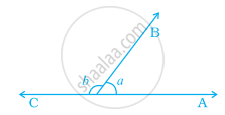
In the following figure, are the following pairs of angles adjacent? Justify your answer.

In the following figure, are the following pairs of angles adjacent? Justify your answer.
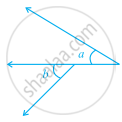
In the following figure, are the following pairs of angles adjacent? Justify your answer.
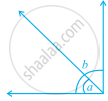
In the following figure, write all the pairs of supplementary angles.
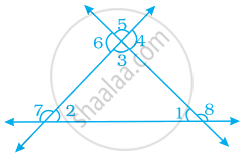
What is the type of other angle of a linear pair if one of its angle is acute?
What is the type of other angle of a linear pair if one of its angles is obtuse?
What is the type of other angle of a linear pair if one of its angles is right?
Can two acute angles form a pair of supplementary angles? Give reason in support of your answer.
Two lines AB and CD intersect at O (see the figure). Write all the pairs of adjacent angles by taking angles 1, 2, 3, and 4 only.

If the complement of an angle is 62°, then find its supplement.
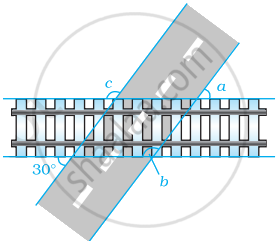
A road crosses a railway line at an angle of 30° as shown in the following. Find the values of a, b and c.
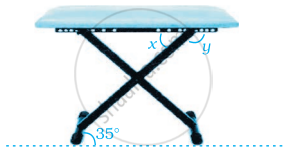
The legs of a stool make an angle of 35° with the floor as shown in the following figure. Find the angles x and y.
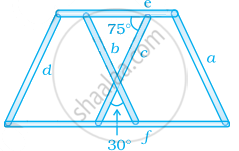
Iron rods a, b, c, d, e and f are making a design in a bridge as shown in the following figure, in which a || b, c || d, e || f. Find the marked angles between
- b and c
- d and e
- d and f
- c and f
Amisha makes a star with the help of line segments a, b, c, d, e and f, in which a || d, b || e and c || f. Chhaya marks an angle as 120° as shown in the following figure and asks Amisha to find the ∠x, ∠y and ∠z. Help Amisha in finding the angles.

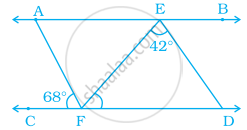
In the following figure, AB || CD, AF || ED, ∠AFC = 68° and ∠FED = 42°. Find ∠EFD.
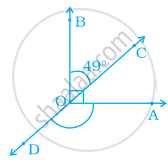
In the following figure, OB is perpendicular to OA and ∠BOC = 49°. Find ∠AOD.
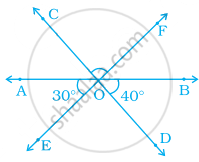
Three lines AB, CD and EF intersect each other at O. If ∠AOE = 30° and ∠DOB = 40° (Figure), find ∠COF.
Measures (in degrees) of two complementary angles are two consecutive even integers. Find the angles.
If a transversal intersects two parallel lines, and the difference of two interior angles on the same side of a transversal is 20°, find the angles.
Two angles are making a linear pair. If one of them is one-third of the other, find the angles.
Measures (in degrees) of two supplementary angles are consecutive odd integers. Find the angles.
In the following figure, AE || GF || BD, AB || CG || DF and ∠CHE = 120°. Find ∠ABC and ∠CDE.

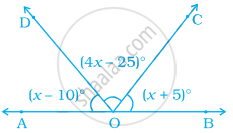
In the following figure, find the value of ∠BOC, if points A, O and B are collinear.
In the following figure, if l || m, find the values of a and b.
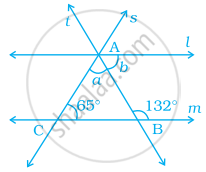
In the following figure, l || m and a line t intersects these lines at P and Q, respectively. Find the sum 2a + b.
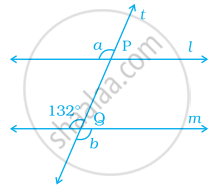
In the following figure, QP || RS. Find the values of a and b.

In the following figure, PQ || RT. Find the value of a + b.

In the following figure, PQ, RS and UT are parallel lines. If c = 57° and `a = c/3`, find the value of d.
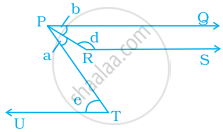
In the following figure, PQ, RS and UT are parallel lines. If c = 75° and `a = 2/5 c`, find b.
In the following figure, AB || CD. Find the reflex ∠EFG.
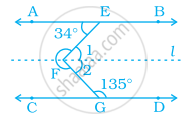
In the following figure, two parallel lines l and m are cut by two transversals n and p. Find the values of x and y.
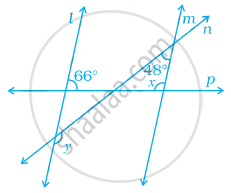
In the following figure, l, m and n are parallel lines, and the lines p and q are also parallel. Find the values of a, b and c.

In the following figure, state which pair of lines are parallel. Give reason.

In the following figure, examine whether the following pairs of lines are parallel or not:
EF and GH
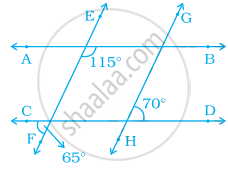
In the following figure, examine whether the following pairs of lines are parallel or not:
AB and CD
In the following figure, find out which pair of lines are parallel:

In the following figure, show that
- AB || CD
- EF || GH

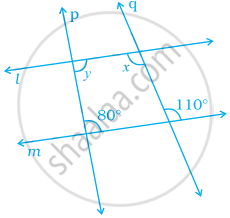
In the following figure, two parallel lines l and m are cut by two transversals p and q. Determine the values of x and y.
Solutions for 5: Lines and Angles
NCERT Exemplar solutions for Mathematics [English] Class 7 chapter 5 - Lines and Angles
Shaalaa.com has the CBSE Mathematics Mathematics [English] Class 7 CBSE solutions in a manner that help students grasp basic concepts better and faster. The detailed, step-by-step solutions will help you understand the concepts better and clarify any confusion. NCERT Exemplar solutions for Mathematics Mathematics [English] Class 7 CBSE 5 (Lines and Angles) include all questions with answers and detailed explanations. This will clear students' doubts about questions and improve their application skills while preparing for board exams.
Further, we at Shaalaa.com provide such solutions so students can prepare for written exams. NCERT Exemplar textbook solutions can be a core help for self-study and provide excellent self-help guidance for students.
Concepts covered in Mathematics [English] Class 7 chapter 5 Lines and Angles are Trigonometrical Ratios of Complementary Angles, Concept of Linear Pair, Concept of Pairs of Angles, Concept of Points, Concept of Lines, Line Segments, Supplementary Angles, Intersecting Lines, Parallel Lines, Concept of Transversal Lines, Concept of Angle.
Using NCERT Exemplar Mathematics [English] Class 7 solutions Lines and Angles exercise by students is an easy way to prepare for the exams, as they involve solutions arranged chapter-wise and also page-wise. The questions involved in NCERT Exemplar Solutions are essential questions that can be asked in the final exam. Maximum CBSE Mathematics [English] Class 7 students prefer NCERT Exemplar Textbook Solutions to score more in exams.
Get the free view of Chapter 5, Lines and Angles Mathematics [English] Class 7 additional questions for Mathematics Mathematics [English] Class 7 CBSE, and you can use Shaalaa.com to keep it handy for your exam preparation.
