Advertisements
Chapters
1: Interpretation of Topographical Maps
2: Contours
3: Scales and Direction
4: Map Reading and Interpretation
5: Map of India
PART II - GEOGRAPHY OF INDIA
6: Climate
7: Soil Resources
8: Natural Vegetation
9: Water Resources
10: Mineral Resources
11: Conventional Sources of Energy
12: Non-Conventional Sources of Energy
13: Agriculture - I
14: Agriculture - II: Food Crops
15: Agriculture - III: Cash Crops (1)
16: Agriculture - IV: Cash Crops (2)
17: Manufacturing Industries (Agro-Based)
18: Mineral Based Industry
19: Transport
▶ 20: Waste Management - I: Impact of Waste Accumulation
21: Waste Management - II: Safe Disposal of Waste
![Morning Star solutions for टोटल जियोग्राफी वॉल्यूम १ [इंग्रजी] इयत्ता १० आयसीएसई chapter 20 - Waste Management - I: Impact of Waste Accumulation - Shaalaa.com](/images/total-geography-volume-1-english-class-10-icse_6:1360961034ba453ca5adb591ff5e5f94.jpg "Morning Star solutions for टोटल जियोग्राफी वॉल्यूम १ [इंग्रजी] इयत्ता १० आयसीएसई chapter 20 - Waste Management - I: Impact of Waste Accumulation")
Advertisements
Solutions for Chapter 20: Waste Management - I: Impact of Waste Accumulation
Below listed, you can find solutions for Chapter 20 of CISCE Morning Star for टोटल जियोग्राफी वॉल्यूम १ [इंग्रजी] इयत्ता १० आयसीएसई.
Morning Star solutions for टोटल जियोग्राफी वॉल्यूम १ [इंग्रजी] इयत्ता १० आयसीएसई 20 Waste Management - I: Impact of Waste Accumulation EXERCISES [Pages 255 - 258]
Choose the correct option:
Any material that is discarded after it has served its purpose and is no longer useful is called ______.
compost
waste
manure
pathogen
Assertion (A): The use-and-throw concept is a significant cause of waste accumulation.
Reason (R): With development in technology today, waste generation is increasing.
Both A and R are true, and R is the correct explanation of A.
Both A and R are true, but R does not explain A.
A is true, but R is false.
A is false, but R is true.
Waste generated as a result of demolition or construction of buildings is called ______.
industrial waste
domestic waste
construction waste
mining waste
Assertion (A): Agricultural wastes cause environmental problems.
Reason (R): They become a breeding ground for pathogens.
Both A and R are true, and R is the correct explanation of A.
Both A and R are true, but R does not explain A.
A is true, but R is false.
A is false, but R is true.
Which of the following is NOT a toxic substances present in e-waste?
Cadmium
Lead
Mercury
Methane
Assertion (A): E-waste is one of the fastest-growing wastes.
Reason (R): With advancement in Information Technology, there is an increase in volume of obsolete electronic products.
Both A and R are true, and R is the correct explanation of A.
Both A and R are true, but R does not explain A.
A is true, but R is false.
A is false, but R is true.
The process of depletion of oxygen from water bodies occurring either naturally or due to human activities is called ______.
Biomagnification
Oxygenation
Eutrophication
Acid rain
Bioaccumulation
Pollution
Wastes that pose a serious threat to human and environmental health are called ______.
Industrial waste
Chemical waste
Toxic waste
Commercial waste
Assertion (A): Large-scale epidemics, increased healthcare access, home-based healthcare have contributed to a rise in biomedical waste.
Reason (R): Biomedical wastes require sophisticated processing plants, incineration and disassembly centres for proper disposal.
Both A and R are true, and R is the correct explanation of A.
Both A and R are true, but R does not explain A.
A is true, but R is false.
A is false, but R is true.
Agricultural waste, being organic in nature, undergoes ______ and creates conditions favourable for the growth of pathogens.
fermentation
nitrification
magnification
oxygenation
What is the increase in the concentration of various toxic substances along the food chain called?
Eutrophication
Bio-accumulation
Biomagnification
Demagnification
Pollution
Name the phenomenon of concentrated toxic deposition at the higher trophic level.
Bio-accumulation
Biomagnification
Eutrophication
Biodegradation
The accumulation of toxins will be higher in which of the following?
Water
Algae
Small fish
Big fish
The warming up of the atmosphere due to the increased concentration of GHG is known as ______.
Global Warming
Climate change
Acid rain
Radiation
Assertion (A): Climate change is a result of increased GHG emissions.
Reason (R): Use of fossil fuels, population growth and reduced green cover result in GHG emissions.
Both A and R are true and R is the correct explanation of A.
Both A and R are true but R does not explain A.
A is true but R is false.
A is false but R is true.
In 2023 China was the largest contributor of Global greenhouse gas (GHG) emissions equal to the combined emissions of the US, India, European Union and Russia together. These five economies accounted for 60% of GHG emissions. What can be inferred?
India’s GHG emission are lower than China’s.
The Indian government’s initiatives towards sustainability are effective.
India is one of the major polluters in the world.
All of the above.
Answer the following questions:
Name two sources of waste.
How is the 'use and throw' concept responsible for the increase in waste generation?
What is acid rain?
State the impact of acid rain on the environment.
What is meant by Ozone layer depletion?
Write the harmful effects of ozone depletion.
Why is E-waste difficult to manage?
Explain briefly how does the industrial waste reach the human beings and affect their health.
Give a reason for the following:
Poor waste management causes soil depletion.
Give a reason for the following:
Covid-19 pandemic increased waste production.
Give a reason for the following:
E-waste is rapidly increasing.
Give two differences between toxic and non-toxic waste.
Explain how eutrophication affects aquatic life.
What harm is done by dumping of waste near waterbodies?
Give a reason for the following:
Marine animals and turtles are found dead in many coastal areas.
Why is radioactive pollution more harmful than other types of pollution?
Give a reason for the following:
Uncontrolled burning of waste causes air pollution.
What is biomagnification?
What can be biomagnification effects on humans?
Name three diseases which occur because of waste accumulation on land.
Name two common diseases caused as a result of gaseous pollution.
Name the following:
Any three water-borne disease
Explain briefly the need for management of waste.
| Currently, Mumbai generates close to 6,300 metric tonnes (MT) of waste, out of which more than 60% of daily solid waste is sent to Kanjurmarg landfill which gets scientifically processed. The remaining waste is sent to Deonar dumping ground, which remains untreated. |
What can Mumbai do to reduce its waste?
Name the gas produced by the decomposition of accumulated waste. Why is this gas harmful?
Give a reason for the following:
'Use and throw' concept generates more waste.
Give a reason for the following:
Run off from fields leads to death in adjacent waterbodies
Give a reason for the following:
Birds feeding on agricultural waste are at the brink of extinction.
What is global warming?
Name the following:
Name three greenhouse gases.
|
Delhi has a massive municipal solid waste management problem, with the massive landfills at Ghazipur, Okhla and Bhalswa at the centre of the issue. Delhi generates 11,332 tonnes of solid waste every day according to the latest estimate by the Municipal Corporation of Delhi (MCD), even as the civic body said that 4,360 tonnes of this garbage ends up at the city's three landfill sites. , Hindustan Times, 22 February, 2023 |
- What is the cause for the issue mentioned above?
- Mention the three different methods of treating waste of the given type?
- How can an individual reduce waste generation?
- How can Delhi manage its waste following the example of Indore?
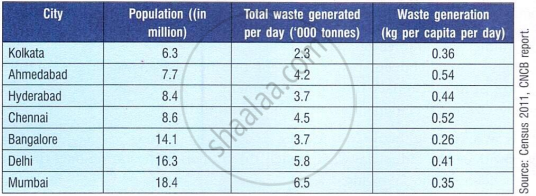
- The chart given above gives details of waste generation in big cities. According to a study conducted by IIT Kanpur, 15% of this waste can be collected by rag pickers. Write a note on the importance of rag pickers in reducing wastes.
- How can schools and educational institutions aid in reduction of waste?
- What can be the cause of lower per capita waste generation in
- Bengaluru
- Mumbai
- As a student of geography, explain why the per capita generation of waste in Ahmedabad and Chennai is high.
What is thermal pollution?
How does cold water cause thermal pollution?
Thermal pollution may have natural causes. List the natural causes for thermal pollution. But in some cases, thermal pollution due to natural causes results from human activities. Explain.
Suggest any three measures to reduce thermal pollution.
Thinking Skills
According to a World Bank Report, global waste will increase by 70 per cent by 2050 unless urgent action is taken. Suggest five measures to reduce accumulation of waste.
Waste accumulation is the most visible form of pollution, which creates global environmental challenges. State any three such challenges and their probable remedies.
Solutions for 20: Waste Management - I: Impact of Waste Accumulation
Morning Star solutions for टोटल जियोग्राफी वॉल्यूम १ [इंग्रजी] इयत्ता १० आयसीएसई chapter 20 - Waste Management - I: Impact of Waste Accumulation
Shaalaa.com has the CISCE Mathematics टोटल जियोग्राफी वॉल्यूम १ [इंग्रजी] इयत्ता १० आयसीएसई CISCE solutions in a manner that help students grasp basic concepts better and faster. The detailed, step-by-step solutions will help you understand the concepts better and clarify any confusion. Morning Star solutions for Mathematics टोटल जियोग्राफी वॉल्यूम १ [इंग्रजी] इयत्ता १० आयसीएसई CISCE 20 (Waste Management - I: Impact of Waste Accumulation) include all questions with answers and detailed explanations. This will clear students' doubts about questions and improve their application skills while preparing for board exams.
Further, we at Shaalaa.com provide such solutions so students can prepare for written exams. Morning Star textbook solutions can be a core help for self-study and provide excellent self-help guidance for students.
Concepts covered in टोटल जियोग्राफी वॉल्यूम १ [इंग्रजी] इयत्ता १० आयसीएसई chapter 20 Waste Management - I: Impact of Waste Accumulation are Concept of Waste, Sources of Waste, Impact of Accumulated Waste > Spoilage of Landscape, Impact of Accumulated Waste > Pollution, Health Hazards, Need for Management of Waste, Types of Pollution, Greenhouse Effect and Global Warming, Overview of Waste Management Part I - Impact of Waste Accumulation, Concept of Waste, Sources of Waste, Impact of Accumulated Waste > Spoilage of Landscape, Impact of Accumulated Waste > Pollution, Health Hazards, Need for Management of Waste, Types of Pollution, Greenhouse Effect and Global Warming, Overview of Waste Management Part I - Impact of Waste Accumulation, Concept of Waste, Sources of Waste, Impact of Accumulated Waste > Spoilage of Landscape, Impact of Accumulated Waste > Pollution, Health Hazards, Need for Management of Waste, Types of Pollution, Greenhouse Effect and Global Warming, Overview of Waste Management Part I - Impact of Waste Accumulation.
Using Morning Star टोटल जियोग्राफी वॉल्यूम १ [इंग्रजी] इयत्ता १० आयसीएसई solutions Waste Management - I: Impact of Waste Accumulation exercise by students is an easy way to prepare for the exams, as they involve solutions arranged chapter-wise and also page-wise. The questions involved in Morning Star Solutions are essential questions that can be asked in the final exam. Maximum CISCE टोटल जियोग्राफी वॉल्यूम १ [इंग्रजी] इयत्ता १० आयसीएसई students prefer Morning Star Textbook Solutions to score more in exams.
Get the free view of Chapter 20, Waste Management - I: Impact of Waste Accumulation टोटल जियोग्राफी वॉल्यूम १ [इंग्रजी] इयत्ता १० आयसीएसई additional questions for Mathematics टोटल जियोग्राफी वॉल्यूम १ [इंग्रजी] इयत्ता १० आयसीएसई CISCE, and you can use Shaalaa.com to keep it handy for your exam preparation.
