Advertisements
Online Mock Tests
Chapters
1: Forces: Turning Forces and Uniform Circular Motion
2: Work, Power and Energy
3: Machines
(B) Light
4: Refraction of Light
5: Electromagnetic Waves and Spectrum
(C) Sound
6: Sound
(D) Electricity and Magnetism
7: Electric Circuits, Resistance and Ohm's Law
8: Electric Energy, Power and Household Circuits
9: 1. Electromagnetism 2. Magnetic Effects of Electric Current 3. Electromagnetic Induction
(E) Heat
10: Calorimetry
(F) Modern Physics
▶ 11: Radioactivity
Advertisements
Solutions for Chapter 11: Radioactivity
Below listed, you can find solutions for Chapter 11 of CISCE Goyal Brothers Prakashan for अ न्यू अप्रोच टू आईसीएसई [इंग्रजी] इयत्ता १०.
Goyal Brothers Prakashan solutions for अ न्यू अप्रोच टू आईसीएसई [इंग्रजी] इयत्ता १० 11 Radioactivity EXERCISE [Pages 266 - 270]
What do you understand by the term radioactivity?
Name two radioactive substances.
Which part of an atom is involved during radioactive emission?
Diagram alongside shows a lead cube containing radioactive substance ‘R’. A magnetic field is applied, perpendicular to the path of nuclear radiation by a powerful horse-shoe magnet, P and Q beings its poles. The nuclear radiations split into three distinct parts X, Y and Z.
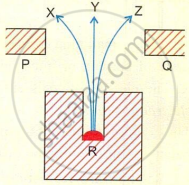
(a) (i) Identify X and state its mass and charge.
(ii) Identify Y and state its nature.
(iii) Identify Z and state its mass and charge.
(b) Identify the magnetic polarity of (i) P and (ii) Q.
(c) Which law helped you to find the polarity of the magnet? State the law.
- What do you understand by the term 𝛼-particles as applied to radioactivity?
- Why are these particles called helium nuclei?
Answer the following question about α-particles.
What is its mass number and electric charge in a.m.u.?
Answer the following question about α-particles.
How many times is it more ionising than γ-radiations?
Answer the following question about α-particles.
How many times is it less penetrating than β-particles?
Answer the following question about α-particles.
What is the range of penetration in air?
During alpha emission of a radioactive element, how do the following change?
- Atomic number of the radioactive element.
- Mass number of the radioactive element.
Why are γ-radiations emitted during α-emission?
How do the chemical properties of new element compare with the original element, after the emission of alpha particle?
Answer the following question about γ-emission:
From which part of an atom this emission is given out?
Answer the following question about γ-emission:
What is its range of penetration in air?
Answer the following question about γ-emission:
What is the effect of an electric or magnetic field on this radiation?
Answer the following question about γ-emission:
Why are these radiations considered harmful?
Answer the following question about γ-emission:
State one particular use of this radiation.
Answer the following question about β-radiation.
Is it a radiation or a particle?
Answer the following question about β-radiation.
What is its mass in a.m.u.?
Answer the following question about β-radiation.
What is its charge in coulombs?
Answer the following question about β-radiation.
From which part of an atom it is emitted?
Answer the following question about β-radiation.
Is there any difference between electrons and β-particles?
An element \[{ }_{\mathrm{z}} \mathrm{X}^{\mathrm{A}}\] decays to \({ }_{88} \mathrm{Y}^{222}\) after emitting two alpha particles and one beta particle. What are the values of atomic mass A and atomic number Z in element X?
A radioactive substance is oxidized. Will there be any change in the nature its radioactivity? Give a reason for your answer
Represent the change in the nucleus of a radioactive element when a β particle is emitted.
What is the name given to elements with the same mass number and different atomic number?
Under which conditions does the nucleus of an atom tend to radioactive?
Arrange the α, β and γ radiations in ascending order of their penetrating power.
Arrange alpha (α), beta (β) and gamma (γ) radiation in the:
Descending order of ionising power.
Arrange the α, β, and γ radiation in ascending order of their biological damage. Give reason.
- Name the radiation that is emitted during the decay of a nucleus that has the highest penetrating power.
- Does the emission of the above-mentioned radiation result in a change in the mass number?
(a) \({ }_{92} \mathrm{X}^{238} \xrightarrow{-\beta} \mathrm{X}_{1}^{-} \xrightarrow{-\alpha} \mathrm{X}_{2}^{-} \xrightarrow{-\alpha} \mathrm{X}_{3}^{-} \xrightarrow{-\beta} \mathrm{X}_{4}^{-} \xrightarrow{-\alpha} \mathrm{X}_{5}^{-} \xrightarrow{-\alpha} \mathrm{X}_{6}^{-}\)
Study the decay of \({ }_{92} \mathrm{X}^{238}\) carefully and complete the chain of mutations by writing the mass number and atomic number from X1 to X6.
(b) From the above transformations, identify.
- Isotopes
- Isobars
State giving reasons, whether the following nuclear mutation is possible or not. (Star indicates an excited state)
\({ }_{\mathrm{Z}} \mathrm{X}^{* \mathrm{~A}} \longrightarrow{ }_{\mathrm{Z}} \mathrm{X}^{\mathrm{A}}+\mathrm{Y}\)
State giving reasons, whether the following nuclear mutation is possible or not. (Star indicates an excited state)
\({ }_{\mathrm{Z}} \mathrm{X}^{\mathrm{A}} \longrightarrow{ }_{\mathrm{Z}-2} \mathrm{X}_{1}{ }^{\mathrm{A}-4}+{ }_{2} \mathrm{He}^{4}\)
An atomic nucleus A is composed of 84 protons and 128 neutrons.
- The nucleus A emits a beta particle and is transformed into nucleus B. What is the composition of nucleus of B?
- The nucleus B emits an α-particle and is transformed into nucleus C. What is the composition of nucleus C?
- Does the composition of nucleus C change if it emits a γ-radiation?
A nucleus `""_11^24Na` emits a beta particle to change into Magnesium (Mg).
- Write the symbolic equation for the process.
- What are numbers 24 and 11 called?
- What is the general name of `""_12^24Mg `with respect to `""_11^24Na`?
The graph illustrates the correlation between the number of protons (x-axis) and the number of neutrons (y-axis) for elements A, B, C, D, and E in the periodic table. These elements are denoted by the letters rather than their conventional symbols.

- Identify the radioactive radiation emitted when element C decays into element E. Represent this using a nuclear reaction. (1)
- What is the special name given to elements D and E? (1)
- If element C transforms into element B by emitting a radioactive ray, how will this ray behave in an electric field? (2)
Define nuclear fission.
Name two radioactive materials which are commonly used in nuclear reactors.
Why is the energy produced by nuclear reactors considered as hazard?
Complete the following nuclear equation.
\[\ {}_{11}\mathrm{Na}^{24} \xrightarrow{- \beta} {}_{\ldots\ldots}\mathrm{Mg}^{\ldots\ldots} \]
Complete the following nuclear equation.
\[ \ {}_{92}\mathrm{U}^{235} + {}_{0}\mathrm{n}^{1} \longrightarrow {}_{\ldots\ldots}\mathrm{Ba}^{141} + {}_{36}\mathrm{Kr}^{\ldots\ldots} + 3 \ {}_{0}\mathrm{n}^{1} + \text{Energy} \]
Complete the following nuclear equation.
\[ \ {}_{92}\mathrm{U}^{236} \longrightarrow {}_{51}\mathrm{Sb}^{\ldots\ldots} + {}_{\ldots\ldots}\mathrm{Nb}^{99} + 4 \ {}_{0}\mathrm{n}^{1} + \text{Energy} \]
Define nuclear fusion.
Why nuclear fusion is not possible for commercial purposes?
Name two places in the universe where nuclear fusion takes place.
Complete the following nuclear fusion equation:
\[\ {}_{1}\mathrm{H}^{2} + {}_{1}\mathrm{H}^{2} \longrightarrow {}_{\ldots\ldots}\mathrm{H}^{\ldots\ldots} + {}_{1}\mathrm{H}^{1} + \text{Energy}\]
Complete the following nuclear fusion equation:
\[ \ {}_{1}\mathrm{H}^{3} + {}_{1}\mathrm{H}^{2} \longrightarrow {}_{\ldots\ldots}\mathrm{He}^{\ldots\ldots} + {}_{0}\mathrm{n}^{\ldots\ldots} + \text{Energy} \]
MULTIPLE CHOICE QUESTIONS Choose the most appropriate option.
The atoms of same element having same atomic number, but different atomic masses are called:
isotopes
isobars
isotones
both isotopes and isobars
When an element gives out high energy radiations on its own, the change which takes place is:
physical change
chemical change
nuclear change
none of these
The atoms of different elements having the same mass number, but different atomic numbers are called:
isotopes
isotones
isobars
none of these
The radiations given out by radioactive elements:
affect photographic plates
ionise the gases
are affected by electrostatic and magnetic fields
all of these
A radioactive substance emits:
simultaneously α, β particles and γ radiations
α-radiations or β-radiations
in the order of α, β particles and γ radiations
X-rays and γ-rays
During α-emission:
the mass number and atomic number of an atom decrease by 2 amu.
the mass number decreases by 4 amu and atomic number decreases by 2 amu.
the mass number remains unchanged, but atomic number decreases by 2 amu.
the mass number decreases by 4 amu and atomic number remains unchanged.
A nucleus of an atom consists of 146 neutrons and 95 protons. It decays after emitting an alpha particle. How many protons and neutrons are left in the nucleus after an alpha emission?
protons = 93, neutrons = 142
protons = 95, neutrons = 144
protons = 93, neutrons = 144
protons = 95, neutrons = 142
During β-emission an electron is ejected from the atom of radioactive substance. The electron is ejected from:
the outermost orbit of atom
the innermost orbit of atom
the nucleus of the atom
none of these
Which of the following radiation is most ionising?
α-particles
β-particles
γ-radiation
X-rays
Which of the following radiation is most penetrating?
α-particles
β-particles
γ-radiation
X-rays
Which of the following radiation gets deflected most in electric or magnetic field?
α-particles
β-particles
γ-radiation
X-rays
Atoms of different elements having the same number of neutrons, but different atomic numbers are called:
isotopes
isobars
isotones
none of these
Which is a pair of isotones?
11Na23 and 12Mg24
7N15 and 7N14
17Cl35 and 17C137
20Ca40 and 18Ar40
Which is a pair of isobars?
\({ }_{20}^{40} \mathrm{Ca}\) and \({ }_{18}^{40} \mathrm{Ar}\)
\({ }_{1}^{1} \mathrm{H}\) and \({ }_{1}^{3} \mathrm{H}\)
\[ {}^{16}_{\phantom{1}8}\mathrm{O} \text{ and } {}^{17}_{\phantom{1}8}\mathrm{O} \]
\({ }_{11}^{23} \mathrm{Na}\) and \({ }_{11}^{24} \mathrm{Na}\)
Which one is/are pair of isotopes?
\[ {}^{12}_{\phantom{1}6}\mathrm{C} \text{ and } {}^{14}_{\phantom{1}6}\mathrm{C} \]
\({ }_{11}^{24} \mathrm{Na}\) and \({ }_{12}^{24} \mathrm{Mg}\)
\[ {}^{17}_{\phantom{1}8}\mathrm{O} \text{ and } {}^{16}_{\phantom{1}8}\mathrm{O} \]
both \[({}^{12}_{\phantom{1}6}\mathrm{C}, {}^{14}_{\phantom{1}6}\mathrm{C})\] and \[( {}^{17}_{\phantom{1}8}\mathrm{O}, {}^{16}_{\phantom{1}8}\mathrm{O})\]
Which one of the following has least ionising power?
γ-rays
X-rays
beta particles
alpha particles
Which one of the following has least penetrating power?
beta particles
alpha particles
γ-rays
none of these
Which one is not deflected by electric or magnetic fields?
alpha particles
γ-rays
X-rays
both γ-rays and X-rays
An alpha particle gains two electrons. In doing so, it changes to:
deuterium
tritium
helium
none of these
A beam of alpha particles is subjected to a strong magnetic field. The alpha particles are:
strongly deflected towards north pole
weakly deflected towards north pole
weakly deflected towards south pole
not deflected at all
A beam of beta particles is subjected to a strong magnetic field. The beta particles are:
strongly deflected towards south pole
weakly deflected towards south pole
weakly deflected towards north pole
not deflected at all
Nuclear radiations are consisting of alpha, beta and γ-radiation is subjected to strong magnetic field:
alpha radiation are slightly deflected towards north pole
beta radiation are deflected towards south pole
gamma radiations are not deflected by magnetic field.
all of these.
\({ }_{11} \mathrm{Na}^{24} \longrightarrow{ }_{\mathrm{Q}} \mathrm{Mg}^{\mathrm{P}}+{ }_{-1} \mathrm{e}^{0}\)
In the above equation, the values of P and Q are:
P = 25, Q = 12
P = 24, Q = 10
P = 24, Q = 12
none of these
\[ {}_{86}\mathrm{Rn}^{222} \longrightarrow {}_{\mathrm{y}}\mathrm{Po}^{\mathrm{x}} + {}^{\phantom{+}4}_{+2}\mathrm{He} \]
In the above equation, the values of x and y are:
x = 220, y = 84
x = 218, y = 84
x = 218, y = 82
none of these
During beta emission:
an electron shoots out from the outermost shell of an atom
an electron shoots out from the innermost shell of an atom
a neutron decays to form proton and electron. The electrons then shoots out as beta particles.
none of these
\({ }_{92} \mathrm{U}^{236} \longrightarrow{ }_{56} \mathrm{Ba}^{\mathrm{x}}+{ }_{y}\mathrm{~K} r^{92}+3{ }_{0} \mathrm{n}^{1} + \text{energy}\)
In the above nuclear equation, the values of x and y are:
x = 141, y = 34
x = 139, y = 35
x = 141, y = 36
x = 142, y = 37
When the nucleus of a radioactive element, such as uranium is hit by a slow moving neutron, such that it splits into two almost equal nuclei with the release of more neutrons and energy, then the process is called:
nuclear fusion
nuclear fission
chemical reaction
none of these
The reaction which takes place in nuclear reactors is:
nuclear fission
controlled nuclear fission
nuclear fusion
all of these
When two lighter nuclei fuse to form a heavier nucleus with the release of enormous energy, under pressure and temperature of more than million degrees celsius, the process is called:
nuclear fission
controlled nuclear fission
nuclear fusion
none of these
Nuclear fusion is not possible in the laboratory because:
it is extremely difficult to achieve a temperature of million degree celsius
there is no material available to withstand such a high temperature.
there is no way to use the energy, if fusion takes place.
all of these.
Direction for Q. Numbers 31 to 35: The questions given below are Assertion (A) and Reason (R) type questions. Choose the correct answer from options given below:
Assertion (A): If an atom undergoes a chemical change occurring at a low energy, there is a change in the number of orbital electrons of the atom.
Reason (R): If the atom undergoes a nuclear change which occurs at a high energy, there is a change in the number of nucleons inside the nucleus of the atom.
Both Assertion (A) and Reason (R) are true and Reason (R) is the correct explanation of Assertion (A).
Both Assertion (A) and Reason (R) are true but Reason (R) is not the correct explanation of Assertion (A).
Assertion (A) is false, but Reason (R) is true.
Assertion (A) is true, but Reason (R) is false.
Assertion (A): The beta particle resides inside the nucleus of atom in the form of electron.
Reason (R): Inside the nucleus, the change of a neutron into a proton and an elecron causes the emission of a β-particle \[ \left( {}^{1}_{0}n \longrightarrow {}^{1}_{1}p + {}^{\phantom{-}0}_{-1}e \right) \].
Both Assertion (A) and Reason (R) are true and Reason (R) is the correct explanation of Assertion (A).
Both Assertion (A) and Reason (R) are true but Reason (R) is not the correct explanation of Assertion (A).
Assertion (A) is false, but Reason (R) is true.
Assertion (A) is true, but Reason (R) is false.
Assertion (A): X-rays are emitted when there is transition of electrons in the inner orbits of an atom.
Reason (R): Gama radiations are given out from the nucleus.
Both Assertion (A) and Reason (R) are true and Reason (R) is the correct explanation of Assertion (A).
Both Assertion (A) and Reason (R) are true but Reason (R) is not the correct explanation of Assertion (A).
Assertion (A) is false, but Reason (R) is true.
Assertion (A) is true, but Reason (R) is false.
Assertion (A): Alpha and beta particles are deflected in an electric or a magnetic field, but gamma rays are not deflected in such a field.
Reason (R): Alpha and beta particles are charged but gamma rays are uncharged.
Both Assertion (A) and Reason (R) are true and Reason (R) is the correct explanation of Assertion (A).
Both Assertion (A) and Reason (R) are true but Reason (R) is not the correct explanation of Assertion (A).
Assertion (A) is false, but Reason (R) is true.
Assertion (A) is true, but Reason (R) is false.
Assertion (A): The isotope \[ {}^{235}_{\phantom{1}92}\mathrm{U} \] is more easily fissionable than the isotope \[ {}^{238}_{\phantom{1}92}\mathrm{U} \].
Reason (R): The fission of \[ {}^{238}_{\phantom{1}92}\mathrm{U} \] nucleus is possible even by slow neutrons, while the fission of the \[ {}^{235}_{\phantom{1}92}\mathrm{U} \] nucleus can occur only by fast neutrons.
Both Assertion (A) and Reason (R) are true and Reason (R) is the correct explanation of Assertion (A).
Both Assertion (A) and Reason (R) are true but Reason (R) is not the correct explanation of Assertion (A).
Assertion (A) is false, but Reason (R) is true.
Assertion (A) is true, but Reason (R) is false.
Complete the following sentences by choosing correct options from brackets.
The reaction responsible for the production of energy in the sun is ______.
Nuclear Fusion
Nuclear Fission
Gamma radiations are highly penetrating radiation which can pass through 30 cm of ______.
lead
gold
iron
When an element ejects a beta particle, a neutron in the nucleus decays to ______ and β-particle.
proton
neutron
The radioactive radiations which are not electrically charged, travel at the speed of ______.
6 × 10⁸ m s−1
3 × 10⁸ m s−1
Man has been able to produced ______ reaction in the form of hydrogen bomb.
fission
nuclear
fusion
Match the statements in Column A with those in Column B.
| Column A | Column B |
|---|---|
| (a) Fusion reactions | (i) Elements having different atomic number, but same number of neutrons. |
| (b) Gamma rays | (ii) A particle emitted by a radioactive element which is helium nucleus. |
| (c) Alpha particle | (iii) Nuclear reaction taking place in nuclear reactors. |
| (d) Isotones | (iv) A radioactive radiation which travels with speed of light. |
| (e) Controlled fission reactions | (v) The nuclear reaction taking place in Sun and stars. |
Goyal Brothers Prakashan solutions for अ न्यू अप्रोच टू आईसीएसई [इंग्रजी] इयत्ता १० 11 Radioactivity COMPETENCY-FOCUSED PRACTICE QUESTIONS RELEASED BY CISCE [Pages 270 - 271]
Which of the following equations are correctly balanced?
A. \({ }_{p-5}^{q-1} X \longrightarrow{ }_{p-3}^{q-5} Y+{ }_{2}^{4} \mathrm{He}\)
B. \[\ {}^{q - 4}_{p - 4}Z \longrightarrow {}^{q - 4}_{p - 5}X + {}^{\phantom{-}0}_{-1}e \]
C. \({ }_{p-5}^{q-1} \mathrm{X} \longrightarrow{ }_{p-7}^{q-5} \mathrm{Y}+{ }_{2}^{4} \mathrm{He}\)
D. \[ {}^{q - 4}_{p - 7}Z \longrightarrow {}^{q - 4}_{p - 5}X + 2 \ {}^{\phantom{-}0}_{-1}e \]
Only D
Only C
Both A and B
Both C and D
Which of the following combinations correctly shows the charges on the particles?
\(+1.6 \times 10^{-19} \mathrm{C}\) \(-1.6 \times 10^{-19} \mathrm{C}\) \(+3.2 \times 10^{-19} \mathrm{C}\) Proton Neutron Alpha particle \(+1.6 \times 10^{-19} \mathrm{C}\) \(-1.6 \times 10^{-19} \mathrm{C}\) \(+3.2 \times 10^{-19} \mathrm{C}\) Alpha particle Electron Neutron \(+1.6 \times 10^{-19} \mathrm{C}\) \(-1.6 \times 10^{-19} \mathrm{C}\) \(+3.2 \times 10^{-19} \mathrm{C}\) Proton Electron Alpha particle \(+1.6 \times 10^{-19} \mathrm{C}\) \(-1.6 \times 10^{-19} \mathrm{C}\) \(+3.2 \times 10^{-19} \mathrm{C}\) Electron Proton Alpha particle
The graph illustrates the correlation between the number of protons (x-axis) and the number of neutrons (y-axis) for element C in the periodic table. The element is denoted by letters rather than their conventional symbols. When element C, depicted in the graph, undergoes radioactive decay, it releases radioactive rays.
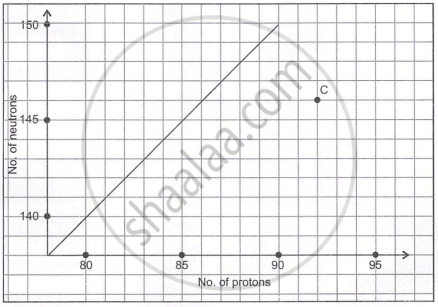
(a) Write the chemical symbol along with the mass number and atomic number for the element denoted as 'C'.
(b) Plot on the graph,
- The daughter element after the emission of beta radiation by the element 'C'.
- The daughter element, as indicated in the previous answer, if it undergoes alpha decay.
An element $$_{Z}P^{A}$$ emits one α-particle and then two β-particles consecutively to form an element Q.
- Show all the transformations by means of equations only.
- What are P and Q called?
Solutions for 11: Radioactivity
Goyal Brothers Prakashan solutions for अ न्यू अप्रोच टू आईसीएसई [इंग्रजी] इयत्ता १० chapter 11 - Radioactivity
Shaalaa.com has the CISCE Mathematics अ न्यू अप्रोच टू आईसीएसई [इंग्रजी] इयत्ता १० CISCE solutions in a manner that help students grasp basic concepts better and faster. The detailed, step-by-step solutions will help you understand the concepts better and clarify any confusion. Goyal Brothers Prakashan solutions for Mathematics अ न्यू अप्रोच टू आईसीएसई [इंग्रजी] इयत्ता १० CISCE 11 (Radioactivity) include all questions with answers and detailed explanations. This will clear students' doubts about questions and improve their application skills while preparing for board exams.
Further, we at Shaalaa.com provide such solutions so students can prepare for written exams. Goyal Brothers Prakashan textbook solutions can be a core help for self-study and provide excellent self-help guidance for students.
Concepts covered in अ न्यू अप्रोच टू आईसीएसई [इंग्रजी] इयत्ता १० chapter 11 Radioactivity are Isotopes, Structure of the Atom and Nucleus, Atomic Models, Radioactivity, Radioactivity as emission of Alpha, Beta, and Gamma Radiations, Properties of Alpha Particles, Properties of Beta Particles, Properties of Gamma Radiations, Changes Within the Nucleus in Alpha, Beta and Gamma Emission, Uses of Radioactive Isotopes, Sources of Harmful Radiations, Harmful Effects of Radiation, Safety Precautions While Using Nuclear Energy, Background Radiations, Nuclear Fission, Difference between Nuclear Fusion and Neclear Fission, Nuclear Fusion, Differences Between Radioactive Decay and Nuclear Fission, Distinction between the Properties of α, β, and γ Radiations, Forms of Energy > Nuclear Energy, Isobars, Isotones.
Using Goyal Brothers Prakashan अ न्यू अप्रोच टू आईसीएसई [इंग्रजी] इयत्ता १० solutions Radioactivity exercise by students is an easy way to prepare for the exams, as they involve solutions arranged chapter-wise and also page-wise. The questions involved in Goyal Brothers Prakashan Solutions are essential questions that can be asked in the final exam. Maximum CISCE अ न्यू अप्रोच टू आईसीएसई [इंग्रजी] इयत्ता १० students prefer Goyal Brothers Prakashan Textbook Solutions to score more in exams.
Get the free view of Chapter 11, Radioactivity अ न्यू अप्रोच टू आईसीएसई [इंग्रजी] इयत्ता १० additional questions for Mathematics अ न्यू अप्रोच टू आईसीएसई [इंग्रजी] इयत्ता १० CISCE, and you can use Shaalaa.com to keep it handy for your exam preparation.
