Advertisements
Chapters
1: Haunted Houses
2: The Glove and the Lions
3: When Great Trees fall
▶ 4: A Considerable Speck
5: The Power of Music
Section - 2 (Short Stories) Origin and Structure of the Short Story
1: With the Photographer
2: The Elevator
3: The Girl Who Can
4: The Pedestrian
5: The Last Lesson
Advertisements
Solutions for Chapter 4: A Considerable Speck
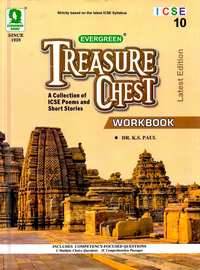
Below listed, you can find solutions for Chapter 4 of CISCE Evergreen Publication for इंग्लिश ट्रेजर चेस्ट वर्कबुक इयत्ता १० आयएससी.
Evergreen Publication solutions for इंग्लिश ट्रेजर चेस्ट वर्कबुक इयत्ता १० आयएससी 4 A Considerable Speck Competency - Focused Questions [Pages 63 - 74]
Multiple Choice Questions Read the following questions and select the correct option: Analysis, Application and Evaluation:
The poem expresses Frost’s ______.
love for the little organism
respect for intelligent life
indifference to the tiny creature
anger at the mite’s escape
Which of the following options contains the same literary device that appears in the following line:
“....On any but a paper sheet so white....”
Silver and blue as the mountain mist.
He names the sky his own.
The fir trees dark and high.
Song and mother-croon of bird.
Choose the option that lists the sequence of events in the correct order.
- He changes his mind when he notices something unusual about it.
- The poet realises that the speck is a living mite with preferences of its own.
- He intends to use the tip of his pen, dipped in ink, to erase the speck.
- The poet notices a speck on the white paper he is writing on.
(i), (ii), (iii), (iv)
(iv), (ii), (ii), (i)
(ii), (iii), (iv), (i)
(iv), (iii), (i), (ii)
Select the option that shows the correct relationship between statements I and II.
Statement I: The poet concludes that the mite proves to be an intelligent creature.
Statement II: The mite seems to dislike the ink as it quickly whirls around to fly away.
Statement II is the cause for Statement I.
Statement II is true, and Statement I is false.
Statement I and Statement II are independent of each other.
Statement I is true, and Statement II is false.
What is the central idea in Frost’s poem A Considerable Speck?
The poet critiques society's disregard for smaller aspects of life.
The idea is that every living being, no matter how small, has its own perspective and intelligence.
The struggle between man-made creations and the natural world.
The insignificance of individual thoughts in the grand scheme of the universe.
Select the correct option.
Assertion: The mite was not cowardly.
Reason: It did try to escape to safety.
1 is true but 2 is false.
1 is false but 2 is true.
Both 1 & 2 are true.
Both 1 & 2 are false.
Which of these statements is NOT true?
The poet spares the mite as he feels it has a mind of its own.
The poet spares the mite out of pity.
The poet once thinks of killing the mite.
The poet has no indiscriminate love for all living beings.
Which of the following lines contains the literary device used in the title of the poem itself - “A Considerable Speck”.
Parting is such sweet sorrow
Her mouth was a fountain of delight.
O, my love’s like a red, red rose
The fair breeze blow, the white foam flew.
What is the tone of the poet while observing the mite?
ironic
fearful
amusing
disgusting
In the poem, the poet invents the anecdote about the mite to ______.
narrate an amusing incident
express his disgust for useless insects
suggest the importance of individual mind
amuse the readers
Recall and Understanding:
What do you imply by ‘collectivistic regimenting love’?
love for the whole society or group
forced love
one-sided love
indiscriminate love for all, irrespective of one’s mental calibre.
The title ‘A Considerable Speck’ is quite ______.
amusing
ironical
surprising
foolish
What is this poem about?
a mite on a white sheet of paper
about the mind, its creativity and imagination
collectivist ideology
individuality
When did the poet notice something running across his paper?
when he sneezed
when he was writing
when he was about to put a full stop to his writing finally
when he left writing
What did the poet like in the mite?
its colour
its being intelligent
its being fearful
its running in terror
How did the mite taste or smell the ink?
with loathing
with relish
hesitatingly
with a shudder
What did the poet imagine?
that the mite was a proud creature
that the mite did not want to die
that the mite feared nothing
that the mite was mischievous
Why did the mite falter and hesitate?
It was happy.
It was terrified.
It was cunning.
It did not know what to do.
What did the mite finally do?
It squatted.
It bent down and moved backwards in fear.
It sat still.
It ran away to the edge of the sheet of paper.
Why did the poet not kill the mite?
because it had a mind of its own.
because it was a lively creature.
because it had no evil intention.
because the poet took pity on it.
Comprehension Passages:
Read the extract given below and answer the questions that follow:
| A speck that would have been beneath my sight On any but a paper sheet so white Set off across what I had written there. And I had idly poised my pen in air To stop it with a period of ink |
- What is a speck? What does the expression ‘beneath my sight’ signify in the context? (Analysis)
- What had the poet been doing? What does the last line here tell you in this context? (Understanding and Analysis)
- What do you mean by ‘idly poised my pen’? (Analysis)
- What did the poet observe about the mite later in the context? (Understanding)
- Why did the poet spare the mite? (Analysis)
Read the extract given below and answer the questions that follow:
| When something strange about it made me think, This was no dust speck by my breathing blown, But unmistakably a living mite With inclinations it could call its own. |
- What was strange about the speck that attracted the speaker’s attention? What was it in reality? Describe the speaker’s attitude towards the speck. (Recall and Understanding)
- What made the speaker realise that the mite had a mind of its own as well as intelligence? Give three reasons to justify your answer. (Recall and Understanding)
- Analyse the speaker’s decision to let the mite live. What does this reveal about his character? (Analysis)
- How would you evaluate the significance of the poem's ending? Why is the discovery of a ‘display of mind’ so important to the speaker? (Evaluate)
- What is the central theme of the poem? How does the speaker's action illustrate the theme of the poem? If you have to give the poem a different title, what will it be? Give a reason for your answer. (Evaluate and Create)
Read the extract given below and answer the questions that follow:
| It paused as with suspicion of my pen, And then came racing wildly on again To where my manuscript was not yet dry; Then paused again and either drank or smelt with loathing, for again it turned to fly. |
- How does the poet describe the movements of the speck? (Analysis)
- What is the significance of the word ‘suspicion’ in Line 1 here? (Analysis)
- How did the mite seem to drink or smell the ink? (Understanding)
- What is a manuscript? How would it be dry? (Understanding)
- What did the mite do in terror? (Understanding and Analysis)
Read the extract given below and answer the questions that follow:
| Plainly with an intelligence I dealt. It seemed too tiny to have room for feet, You must have had a set of them complete To express how much it didn’t want to die. It ran with terror and with cunning crept. It faltered: I could see it hesitate. |
- What do you mean by ‘an intelligence’ in Line 1? Why does the poet assert this? (Analysis)
- What was it that refuted the poet’s thinking that the mite had ‘no room for feet’? (Analysis)
- ‘It ran with terror and with cunning crept’. Explain. (Analysis)
- What is it that the poet satirizes later in the context? Why? (Understanding and Analysis)
- What does the poet appreciate in others? (Understanding)
Read the extract given below and answer the questions that follow:
| Then in the middle of the open sheet Cower down in desperation to accept Whatever I accorded it offate. I have none of the tenderer-than-thou Collectivistic regimenting love With which the modern world is being swept. But this poor microscopic item now! Since it was nothing I knew evil of I let it lie there till I hope it slept. |
- What position did the mite take eventually? In what state was it? (Understanding)
- Explain ‘Collectivistic regimenting love’? (Analysis)
- Which ideology is implicitly criticised here and why? (Analysis)
- What made the poet let the mite ‘lie there till ... it slept’? (Understanding and Analysis)
- Why does the poet choose a ‘considerable speck’ to express his appreciation of the mind, its imagination and creativity? (Analysis and Evaluation)
Read the extract given below and answer the questions that follow:
| I have a mind myself and recognize Mind when I meet with it in any guise No one can know how glad I am to find On any sheet the least display of mind. |
- In which mood is the poet here? (Analysis)
- What quality in a writing appeals to the poet? (Understanding and Analysis)
- Do you think the idea contained in this last stanza has relevance in the context? What is it? (Analysis and Evaluation)
- In what way did the poet identify himself with the mite? (Analysis)
- What does the poet mean by “display of mind”? (Analysis)
Read the following extract from Robert Frost’s poem, ‘A Considerable Speck’ and answer the questions that follow:
| This was no dust speck by my breathing blown, But unmistakably a living mite With inclinations it could call its own. |
- What did the narrator first imagine the ‘speck’ to be?
What does his use of the words ‘speck’ and ‘mite’ tell us about it? [3] - What was the narrator doing when he spotted the speck?
Which two words from the poem helped you come to this conclusion? [3] - What made him realise that he was dealing with ‘an intelligence’? [3]
- Why did the narrator conclude that the mite had feet? [3]
- Describe the narrator’s initial response to the speck.
What did he eventually decide to do about it?
Why does he make this decision?
What does this decision reveal of his character? [4]
Project Assignments:
‘I have none of the tenderer - than - thou
Collectivistic regimenting love’
Bring out the significance of the above lines of the poem in the context.
What does the poet observe? What surprises him? How does he react?
Comment on the central idea of the poem.
Is the title of the poem appropriate? Discuss.
Solutions for 4: A Considerable Speck
Evergreen Publication solutions for इंग्लिश ट्रेजर चेस्ट वर्कबुक इयत्ता १० आयएससी chapter 4 - A Considerable Speck
Shaalaa.com has the CISCE Mathematics इंग्लिश ट्रेजर चेस्ट वर्कबुक इयत्ता १० आयएससी CISCE solutions in a manner that help students grasp basic concepts better and faster. The detailed, step-by-step solutions will help you understand the concepts better and clarify any confusion. Evergreen Publication solutions for Mathematics इंग्लिश ट्रेजर चेस्ट वर्कबुक इयत्ता १० आयएससी CISCE 4 (A Considerable Speck) include all questions with answers and detailed explanations. This will clear students' doubts about questions and improve their application skills while preparing for board exams.
Further, we at Shaalaa.com provide such solutions so students can prepare for written exams. Evergreen Publication textbook solutions can be a core help for self-study and provide excellent self-help guidance for students.
Concepts covered in इंग्लिश ट्रेजर चेस्ट वर्कबुक इयत्ता १० आयएससी chapter 4 A Considerable Speck are .
Using Evergreen Publication इंग्लिश ट्रेजर चेस्ट वर्कबुक इयत्ता १० आयएससी solutions A Considerable Speck exercise by students is an easy way to prepare for the exams, as they involve solutions arranged chapter-wise and also page-wise. The questions involved in Evergreen Publication Solutions are essential questions that can be asked in the final exam. Maximum CISCE इंग्लिश ट्रेजर चेस्ट वर्कबुक इयत्ता १० आयएससी students prefer Evergreen Publication Textbook Solutions to score more in exams.
Get the free view of Chapter 4, A Considerable Speck इंग्लिश ट्रेजर चेस्ट वर्कबुक इयत्ता १० आयएससी additional questions for Mathematics इंग्लिश ट्रेजर चेस्ट वर्कबुक इयत्ता १० आयएससी CISCE, and you can use Shaalaa.com to keep it handy for your exam preparation.
