मराठी

SSC (English Medium) इयत्ता १० वी - Maharashtra State Board Question Bank Solutions

Advertisements
[object Object]
[object Object]
विषय
मुख्य विषय
अध्याय

Please select a subject first

Advertisements
Advertisements
< prev  381 to 400 of 10287  next > 

I think I could turn and live with animals, they are
              so placid and self-contain’d
I stand and look at them long and long.
They do not sweat and whine about their condition,
They do not lie awake in the dark and weep for their sins,
They do not make me sick discussing their duty to God,
Not one is dissatisfied, not one is demented with
                  the mania of owning things.
Not one kneels to another, nor to his kind that
                  lived thousands of years ago,
Not one is respectable or unhappy over the whole earth.
So they show their relations to me and I accept them,
They bring me tokens of myself, they evince
                   them plainly in their possession
I wonder where they get those tokens,
Did I pass that way huge times ago and negligently drop them?

(A1) Complete the following sentences with the help of the poem.
(a) The poet wishes he could.............................
(b) Animals do not complain about............................
(c) Animals do not merely discuss.............................
(d) Animals are not crazy about .............................

(A2) The qualities of animals that highlighted by the poet in the poem are

.............................................................................................................

............................................................................................................

..........................................................................................................

(A3) Name and explain the figures of speech.
“I stand and look at them long and long.’’

[2.1] Animals
Chapter: [2.1] Animals
Concept: undefined >> undefined

Read the following poem and write an appreciation of it with the help of the given points in paragraph format.

A Thing of Beauty is a Joy For Ever
A thing of beauty is a joy for ever:
Its loveliness increases; it will never
Pass into nothingness; but still will keep
A bower quiet for us, and a sleep
Full of sweet dreams, and health and quiet breathing.
Therefore, on every morrow, are we wreathing
A flowery band to bind us to the earth,
Spite of despondence, of the inhuman dearth
Of noble natures, of the gloomy days,
Of all the unhealthy and o’er-darkened ways
Made for our searching: yes, in spite of all,
Some shape of beauty moves a way the pall
From our dark spirits. Such the sun, the moon,
Trees old, and young, sprouting a shady boon
For simple sheep; and such are daffodils
With the green world they live in; and clear rills
That for themselves a cooling covert make
‘Gainst the hot season; the mid forest brake,
Rich with a sprinkling of fair musk-rose blooms:
And such too is the grandeur of the dooms
We have imagined for the mighty dead;
All lovely tales that we have heard or read:
An endless fountain of immortal drink
Pouring unto us from the heaven’s brink.
Nor do we merely feel these essences
For one short hour; no, even as the trees
That whisper round a temple become soon
Dear as the temple’s self, so does the moon,
The passion poesy, glories infinite,
Haunt us till they become a cheering light
Unto our souls, and bound to us so fast,
That, whether there be shine, or gloom o’ercast
They always must be with us, or we die.
- John Keats

You can use the following points while appreciating the given poem.

  • Title
  • Poet
  • Theme/Central Idea (At least 2 to 3 lines)
  • Rhyme Scheme
  • Figures of speech
  • Special Features
    (Type of the poem, imagery, implied meaning if any etc.)
    (At least 3 to 4 lines)
  • Favourite line/lines
  • Why I like/don’t like the poem
[4.1] A Thing of Beauty is a Joy for Ever
Chapter: [4.1] A Thing of Beauty is a Joy for Ever
Concept: undefined >> undefined

Advertisements

Drafting a Speech :
  You are going to speak in your school assembly convincing junior students that the secret of true happiness lies in Giving and Sharing more than in Receiving and Taking.

  You can use the following points - a hearty satisfaction, pleasure of sharing, peace of mind, etc. You can add your own points.

[6] Writing Skill
Chapter: [6] Writing Skill
Concept: undefined >> undefined

Find out 2 hidden words of minimum 4 letters from –
‘triumphant’

[5] Grammar
Chapter: [5] Grammar
Concept: undefined >> undefined

Arrange the following words in alphabetical order.
groan, glimpse, guilt, gorgeous,

[5] Grammar
Chapter: [5] Grammar
Concept: undefined >> undefined

Read the following passage and do the activities.
Social/Historical Context: Hemingway’s novel is based on real events and it also draws heavily on his own life. He had experience of fishing in the Cuban waters and like the old man he was also a fan of baseball. He worked for the Red Cross during the First World War and was injured by shrapnel when he was in Italy. Hemingway always talks about the need to struggle against defeat or death and how determination and endurance can help one to win in
this struggle. The old man is at the end of the novel very near death, but we know that the story of his suffering and loss will live on in the memories of the people of his village. Ultimately his story becomes one of triumph because the tales of his life will live on even after his death. The novel was published in 1952, when people were trying to recover from the mass destruction wrought by the two world wars, and this tale of endurance and ultimate triumph immediately struck a chord with the readers.
       Writing Style: Hemingway’s language is simple and pithy. He mostly writes in short and straight-forward sentences and practises an extreme economy in his
use of words. This simplicity is deceptive and a reader can read his work again and again and find new layers of meaning every time.

(A1) Complete the following sentences.
(a) Hemingway had experience of ……………..
(b) He worked for …………………… during the First World War.
(c) ‘The Old Man And The Sea’ was published in ………………….
(d) After reading his work reader can find ……………………..

(A2) Complete the following web.


(A3) Find the synonyms for the following from the passage.
(i) The ability to do something difficult for a long time.
(ii) Formed or worked
(iii) Brief
(iv) Likely to make someone believe something that is not true.
(A4)
(1) The old man is at the end of the novel very near death, but we know that the story of his suffering and loss will live on in the memories of the people of his village. (Rewrite the sentence using ‘Though’.)
(2) During the First World War Hemingway was injured by shrapnel. (Begin the sentence with ‘Shrapnel ………….)
(A5) Write four to five sentences about your favourite writer.

[4.5] The Old Man and the Sea : Book Review
Chapter: [4.5] The Old Man and the Sea : Book Review
Concept: undefined >> undefined

Read the following passage and do the activities.

He decided, instead to go to a hermit who was widely renowned for his wisdom. The hermit lived in a small hut in a forest which he never left. He spoke only to common folk. So the king put on simple clothes and approaching the hermit’s cell, dismounted his horse and left his bodyguard behind.
When the king arrived, the hermit was digging the ground in front of his hut. He greeted the king but went on digging. The hermit was frail and weak, and each time he struck the ground with the spade and turned over a little earth, he breathed heavily. The king went up to him and said, “I have come to you, wise hermit, to ask you to answer three questions-How can I learn to do the right thing at the right time? Who are the people I most need, and to whom should I, therefore, pay most attention ? And what affairs are the most important and need my first attention?”
The hermit listened to the king but said nothing. He just spat on his hand and resumed digging. The king watched in silence for a while. Then, feeling sorry for the hermit, he said, “You are tired, let me take the spade and work a while for you.” The hermit silently handed over the spade and sat down on the ground. When he had dug two beds, the king stopped and repeated his questions. The hermit again gave no answer, but rose, stretched out his hand for the spade, and said, “Now rest a while and let me work a bit”. But the king did not give him the spade and continued to dig.
One hour passed and another. The sun began to sink behind the trees and the king at last stuck the spade into the ground and said, “I came to you, wise one, for an answer to my questions. If you can give me none, please say so, and I will go home.’’ “Here comes someone running,’’ said the hermit, “let us see who it is.

(B1) State whether the following statements are True or False.
(a) The hermit answered all the questions.
(b) The hermit was strong and firm.
(c) The king had come to hermit to ask him answers of seven questions.
(d) The king felt sorry for the hermit after watching him tired.

(B2) Why did the king come to the hermit? How did the hermit respond to the king’s questions?

(B3) Find out two present participles and two past participles.

(B4)
(1) You are very tired.
(The correct exclamatory form of the sentence is …………..)
(i) How are you tired !
(ii) How tired you are !
iii) How you are tired !
(2) The hermit gave no answer. (Make it affirmative.)

(B5) Whom will you consult if you have any doubt or question in your mind? Why?

[2.2] Three Questions
Chapter: [2.2] Three Questions
Concept: undefined >> undefined

Read the following extract and do the activities.
I remember the night my mother
was stung by a scorpion. Ten hours
of steady rain had driven him
to crawl beneath a sack of rice.
Patting with his poison – flash
Of diabolic tail in the dark room -
he risked the rain again.
The peasants came like swarms of flies
And buzzed the name of God a hundred times
to paralyse the Evil One.
With candles and with lanterns
throwing giant scorpion shadows
on the mud-baked walls
they searched for him: he was not found.
They clicked their tongues.
With every movement that the scorpion made his poison
moved in Mother’s blood, they said.

(A1) Choose the correct option for the following.
(1) The incident in the poem took place in
(i) the morning (ii) the night
(iii) the afternoon (iv) the evening

(2) ‘The Evil’ mentioned in the poem was
(i) the peasant (ii) the God
(iii) the scorpion (iv) the mother

(3) The scorpion crawled beneath a sack of
(i) sugar (ii) a wheat
(iii) corns (iv) rice

(4) The peasants are compared with
(i) flock of sheep (ii) group of monkeys
(iii) swarms of flies (iv) herds of cattle

(A2) Write the reactions of the people when they knew that the mother was stung by a scorpion.
(i)..................................................................
(ii)................................................................
(iii)...............................................................
(iv)...............................................................

(A3) Write down the rhyming words from the stanzas for the following.
(i) fight - (ii) clash -

[3.1] Night of the Scorpion
Chapter: [3.1] Night of the Scorpion
Concept: undefined >> undefined

Drafting a Speech :
You are going to speak in a national level elocution competition on “How to live before you die.”. Draft a speech to deliver it in a competition with the help of the following points.
You can use the following points – Be happy, Help others, Burning desire to do something, Fulfil your hobbies and dreams, Explore the world, No worries, Be creative, Be friendly with others, Be social, Live tension free life, etc.

[6] Writing Skill
Chapter: [6] Writing Skill
Concept: undefined >> undefined

Find out 2 hidden words of minimum 4 letters from –
‘Introduction’

[5] Grammar
Chapter: [5] Grammar
Concept: undefined >> undefined

Read the following passage and do the activities.

Smita bit her lip in self-reproach. She had been so excited at seeing the announcement, that she had not remembered that her brother was very ill. She had seen how the doctors had shaken their heads gravely and spoken words that neither she nor even her parents could understand. But somewhere deep inside Smita had known the frightening truth – that Anant was going to die. The word cancer had hung in the air – her brother was dying of cancer even though she pretended that all would be well and they would return together, a small family of four, to their home in Gaganpur. And he was only fifteen and the best table-tennis player in the school and the fastest runner. He was learning to play the sitar; they were both taking sitar lessons, but Anant was better than her as in many other things. He was already able to compose his own tunes to the astonishment of their guru. Then cancer had struck and they had come to Bombay so that he could be treated at the cancer hospital in the city.
Whenever they came to Bombay they stayed with Aunt Sushila. Her apartment was not big but there was always room for them. They had come with high hopes in the miracles of modern science. They told themselves that Anant would be cured at the hospital and he would again walk and run and even take part in the forthcoming table-tennis tournament. And, he would play the sitar-perhaps be a great sitarist one day. But his condition grew worse with each-passing day and the doctors at the cancer hospital said, ‘Take him home. Give him the thing he likes, indulge him,’ and they knew then that the boy had not many days to live. But they did not voice their fears. They laughed and smiled and talked and surrounded Anant with whatever made him happy. They fulfilled his every need and gave him whatever he asked for. And now he was asking to go to the concert. ‘The chance of a lifetime,’ he was saying. ‘When you are better,’ his mother said. ‘This is not the last time they are going to play.’ Smita stood at the window looking at the traffic, her eyes wet with tears. Her mother whispered, ‘But you Smita, you must go. Your father will take you.’ When she was alone with Aunt Sushila, Smita cried out in a choked voice, ‘No, how can I? We’ve always done things together, Anant and I.’ ‘A walk in the park might make you feel better,’ said Aunt Sushila and Smita was grateful for her suggestion.

(B1) Who said to whom. 02
(1) This is not the last time they are going to play.
(2) We have done things together.

(B2) Describe the condition of Smita and her reaction to Anant when she came to know about the concert. 02

(B3) Write the root forms of the given words from the passage. 02
1. Indulgence 2. Surroundings 3. Fulfilment 4. Happiness

(B4) Choose the appropriate adverb or adjective to fill in the gaps. 02
1. He was able to compose his own tunes. (use ‘could’ and rewrite the sentence.)
2. Smita cried out in a choked voice. (Identify the tense.)

(B5) The two contradictory pictures are depicted in the story. Describe them in your own word. 02

[3.6] The Concert
Chapter: [3.6] The Concert
Concept: undefined >> undefined

Read the following extract and do the activities.

When God at first made Man,
Having a glass of blessings standing by;
Let us (said He) “pour on him all we can:”
Let the worlds riches, which dispersed lie,
Contract into a span.
So strength first made a way;
Then beauty flow’d, then wisdom, honour, pleasure:
When almost all was out, God made a stay,
Perceiving that alone of all His treasures
Rest in the bottom lay.

For if I should (said He)
Bestow this jewel also on my creature,
He would adore my gifts instead of me,
And rest in Nature, not the God of Nature.
So both should losers be.
Yet let him keep the rest,
But keep them with repining restlessness:
Let him be rich and weary, that at last,
If goodness lead him not, yet weariness
May toss him to my breast.

(A1) Choose the correct alternative from the following. 02
(1) The first gift that God gave man is _________
a. Wisdom b. Strength c. Beauty d. Rest
(2) The poem displays ___________ as the main theme.
a. Origin of human species
b. Origin of universe and galaxy
c. Origin of spirituality
d. Origin of earth and space

(A2) Explain the reason why rest is withheld from man by God. 02

(A3) Write the rhyme scheme of the first stanza. 01

[2.4] The Pulley
Chapter: [2.4] The Pulley
Concept: undefined >> undefined

Drafting a Speech :
Regular practice of Yoga can help in maintaining good health and even in the prevention of so many ailments. Write a speech to be delivered in the morning assembly on the usefulness of Yoga.

[6] Writing Skill
Chapter: [6] Writing Skill
Concept: undefined >> undefined

Find out two hidden words of minimum four letters from:

‘endurance’

[5] Grammar
Chapter: [5] Grammar
Concept: undefined >> undefined

Read the following passage and do the given activities :

B1. Answer in one word : (2)

  1. At what age was Stephen diagnosed with amyotrophic lateral sclerosis?
  2. Over the years. how many books has Stephen written or co-written?
  3. When did Stephen catapult to international prominence?
  4. In which year was his life story depicted?

Stephen Hawking (born January 8, 1942) is a British scientist, professor and author who has done groundbreaking work in physics and cosmology, and whose books have helped to make science accessible everyone. At the age of 21, while studying cosmology at the University of Cambridge, he was diagnosed with amyotrophic lateral sclerosis (ALS). Part of his life story was depicted in the 2014 film The Theory of
Everything.

Over the years, Stephen Hawking has written or co-written a total of 15 books. A few of the most noteworthy include :

In 1988 Hawking catapulted to international prominence with the publication of A Brief History of Time. The short, informative book became an account of cosmology for the masses and offered an overview of space and time, the existence of God and the future. The work was an instant success, spending more than four years atop the ‘London Sunday Times’ best-seller list. Since its publication, it has sold millions of copies worldwide and been translated into more than 40 languages.

A Brief History of Time also wasn’t as easy to understand as some had hoped. So in 2001, Hawking followed up his book with The Universe in a Nutshell, which offered a more illustrated guide to cosmology's big theories.

In 2005, Hawking authored the even more accessible A Briefer History of Time, which further simplified the original work’s core concepts and touched upon the newest developments in the field like String theory.

B2. Complete the following table with relevant information about Stephen Hawking: (2)

Books Film
(i)________________
(ii)__________________
(iii)_________________
(i)__________________

B3. Find out the 'Antonyms' from the passage for the following : (2)

  1. worst × ______
  2. exclude × ______
  3. duplicate × ______
  4. oldest × ______

B4.

  1. It has sold millions of copies world wide and been translated into more than 40 languages.  (1)
    (Change it into simple sentence) 
  2. The short informative book became an account of cosmology.  (1)
    (Add a Question Tag)

B5. ‘Stephen Hawking was a versatile personality’ Justify. (2)

[3.3] Stephen Hawking
Chapter: [3.3] Stephen Hawking
Concept: undefined >> undefined

Read the following extract and do the given activities :
A1. Fill in the web with what passion poesy can do to you: (2)

…...................and clear rills
That for themselves a cooling covert make
‘Gainst the hot season; the mid forest brake,
Rich with a sprinkling of fair musk-rose blooms :
And such too is the grandeur of the dooms
We have imagined for the mighty deed;
All lovely tales that we have heard or read
An endless fountain of immortal drink
Pouring unto us from the heaven’s brink.
Nor do we merely feel these essences
For one short hour; no, even as the trees
That whisper round a temple become soon
Dear as the temple’s self, so does the moon,
The passion poesy, glories infinite,
Haunt us till they become a cheering light
Unto our souls, and bound to us so fast,
That, whether there be shine, or gloom o’ercast
They always must be with us, or we die.

A2. List the things which express sorrow from the extract. (2)
A3. Write down the rhyme scheme of the last five lines. (1)

[4.1] A Thing of Beauty is a Joy for Ever
Chapter: [4.1] A Thing of Beauty is a Joy for Ever
Concept: undefined >> undefined

Prepare a speech to be delivered for District level Elocution Competition.
The subject given to you is How to live a happy and joyful. Use the following points:
• Live in a stress free atmosphere.
• Daily meditation and exercise.
• Be in a company of cheerful people.
• Take inspiration from great people.

[6] Writing Skill
Chapter: [6] Writing Skill
Concept: undefined >> undefined

Rearrange the letters to make a meaningful word:
yonnaed 

[5] Grammar
Chapter: [5] Grammar
Concept: undefined >> undefined

Read the following passage and do the given activities.
A1. Choose the correct alternatives to the given statement: 
 i. Dr. Kalam was invited to _______
 a. Swamiji’s programme
 b. attend 102nd birthday celebration
 c. meet Swamiji 
ii. Swamiji looked as steady and alert as any other _______ present there.
 a. Elder
 b. Person
 c. Youngster

iii. In Swamiji’s Ashram more than _______ children are taking education.
 a. Nine thousand
 b. Nineteen thousand
 c. Seven thousand
 iv. Dr. Kalam was deeply touched by _______
 a. Birthday celebration
 b. Swamiji’s inner strength
 c. Swamiji’s Ashram
 In April 2009, Dr. Kalam was invited to attend the 102nd birthday celebrations of His Holiness Dr. Sri Sri Shivakumara Mahaswamiji in the Tumkur district of Karnataka. Mahaswamiji is a remarkable person, who has dedicated his life to the service of humanity. His greatest contribution is the establishment of a free residential education system for more than nine thousand children in the ashram. The most astonishing aspect of the entire event of his birthday was that the 102 year old Swamiji stood on his feet without any support! He looked as steady and alert as any other youngster present there. This display of inner strength touched Dr. Kalam deeply.
 A couple of days later, we were discussing this unusual birthday party. I said to him, ‘Sir, do you know, only four out of 1 lakh people cross the age of 100?’ I had googled the subject beforehand. He replied, ‘But how many of these four would be able to stand tall for half an hour, give a wise discourse, and then go on to feed thousands of children?’ Of course, nobody could know the exact answer to his question but the question itself led to many other relevant queries. ‘I wonder what powers Mahaswamiji possesses that keeps him so strong at such an advanced age? Maybe it’s a balanced diet and a healthy lifestyle, or perhaps it’s genetics?’ I asked. 

A2. Find evidences from the passage that indicates that Swamiji: 
 i. was dedicated
 ii. had inner strength
 iii. contributed to the good of the society
 iv. was younger than the young generation. 
A3. Find out the noun forms of the following from the passage: 
 i. celebrate _______
 ii. contribute _______
 iii. educate _______
 iv. strong _______
 A4. Do as directed: 
 i. I had googled the subject beforehand.
 (Identify the tense of the sentence)
 ii. We were discussing this unusual birthday party.
 (Add a question tag)
 A5. Personal Response: 
 What measures will you take to keep yourself physically and mentally fit? 

[2.6] Science and Spirituality
Chapter: [2.6] Science and Spirituality
Concept: undefined >> undefined

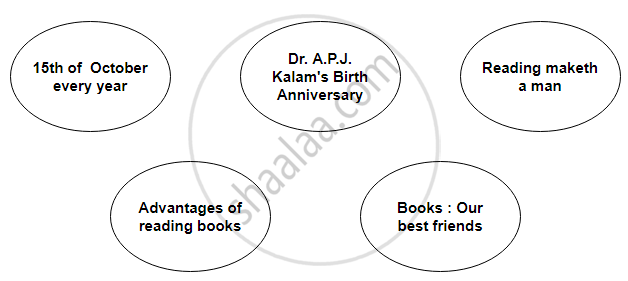
Prepare a speech to be delivered by you at children’s day celebration, laying stress on “Today’s Children - Future of India”.

Care of children's education Health care Inspiring them the national value Motivate them to become a good citizen
[6] Writing Skill
Chapter: [6] Writing Skill
Concept: undefined >> undefined
< prev  381 to 400 of 10287  next > 
Advertisements
Advertisements
Maharashtra State Board SSC (English Medium) इयत्ता १० वी Question Bank Solutions
Question Bank Solutions for Maharashtra State Board SSC (English Medium) इयत्ता १० वी Algebra
Question Bank Solutions for Maharashtra State Board SSC (English Medium) इयत्ता १० वी English
Question Bank Solutions for Maharashtra State Board SSC (English Medium) इयत्ता १० वी English (Second/Third Language)
Question Bank Solutions for Maharashtra State Board SSC (English Medium) इयत्ता १० वी Geography
Question Bank Solutions for Maharashtra State Board SSC (English Medium) इयत्ता १० वी Geometry Mathematics 2
Question Bank Solutions for Maharashtra State Board SSC (English Medium) इयत्ता १० वी Hindi
Question Bank Solutions for Maharashtra State Board SSC (English Medium) इयत्ता १० वी Hindi (Second/Third Language) [हिंदी (दूसरी/तीसरी भाषा)]
Question Bank Solutions for Maharashtra State Board SSC (English Medium) इयत्ता १० वी Hindi - Composite [हिंदी - संयुक्त]
Question Bank Solutions for Maharashtra State Board SSC (English Medium) इयत्ता १० वी History and Political Science
Question Bank Solutions for Maharashtra State Board SSC (English Medium) इयत्ता १० वी Marathi (Second Language) [मराठी (द्वितीय भाषा)]
Question Bank Solutions for Maharashtra State Board SSC (English Medium) इयत्ता १० वी Marathi - Composite [[मराठी - संयुक्त (द्वितीय भाषा)]
Question Bank Solutions for Maharashtra State Board SSC (English Medium) इयत्ता १० वी Sanskrit (Second Language) [संस्कृत (द्वितीय भाषा)]
Question Bank Solutions for Maharashtra State Board SSC (English Medium) इयत्ता १० वी Sanskrit - Composite [संस्कृत - संयुक्त (द्वितीय भाषा)]
Question Bank Solutions for Maharashtra State Board SSC (English Medium) इयत्ता १० वी Science and Technology 1
Question Bank Solutions for Maharashtra State Board SSC (English Medium) इयत्ता १० वी Science and Technology 2
Share
Notifications

Englishहिंदीमराठी


      Forgot password?
Use app×