Please select a subject first
Advertisements
Advertisements
The force of viscosity is
Concept: undefined >> undefined
The viscous force acting between two layers of a liquid is given by \[\frac{F}{A} = - \eta\frac{dv}{dz}\]. This F/A may be called
Concept: undefined >> undefined
Advertisements
A raindrop falls near the surface of the earth with almost uniform velocity because
Concept: undefined >> undefined
A spherical ball is dropped in a long column of a viscous liquid. The speed of the ball as a function of time may be best represented by the graph
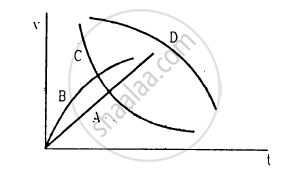
Concept: undefined >> undefined
In discussing Doppler effect, we use the word "apparent frequency". Does it mean that the frequency of the sound is still that of the source and it is some physiological phenomenon in the listener's ear that gives rise to Doppler effect? Think for the observer approaching the source and for the source approaching the observer.
Concept: undefined >> undefined
The engine of a train sounds a whistle at frequency v. The frequency heard by a passenger is
Concept: undefined >> undefined
The change in frequency due to Doppler effect does not depend on
Concept: undefined >> undefined
Find the increase in pressure required to decrease the volume of a water sample by 0.01%. Bulk modulus of water = 2.1 × 10⁹ N m−2.
Concept: undefined >> undefined
Estimate the change in the density of water in ocean at a depth of 400 m below the surface. The density of water at the surface = 1030 kg m−3 and the bulk modulus of water = 2 × 10⁹ N m−2.
Concept: undefined >> undefined
A metal sphere of radius 1 mm and mass 50 mg falls vertically in glycerine. Find (a) the viscous force exerted by the glycerine on the sphere when the speed of the sphere is 1 cm s−1, (b) the hydrostatic force exerted by the glycerine on the sphere and (c) the terminal velocity with which the sphere will move down without acceleration. Density of glycerine = 1260 kg m−3 and its coefficient of viscosity at room temperature = 8.0 poise.
Concept: undefined >> undefined
Estimate the speed of vertically falling raindrops from the following data. Radius of the drops = 0.02 cm, viscosity of air = 1.8 × 10⁻⁴ poise, g= 9.9 × 10 ms−2 and density of water = 1000 kg m−3.
Concept: undefined >> undefined
Water flows at a speed of 6 cm s−1 through a tube of radius 1 cm. Coefficient of viscosity of water at room temperature is 0.01 poise. Calculate the Reynolds number. Is it a steady flow?
Concept: undefined >> undefined
A tightly closed metal lid of a glass bottle can be opened more easily if it is put in hot water for some time. Explain.
Concept: undefined >> undefined
A metal sheet with a circular hole is heated. The hole
Concept: undefined >> undefined
Two identical rectangular strips, one of copper and the other of steel, are riveted together to form a bimetallic strip (acopper> asteel). On heating, this strip will
Concept: undefined >> undefined
Find the ratio of the lengths of an iron rod and an aluminium rod for which the difference in the lengths is independent of temperature. Coefficients of linear expansion of iron and aluminium are 12 × 10–6 °C–1 and 23 × 10–6 °C–1 respectively.
Concept: undefined >> undefined
An aluminium plate fixed in a horizontal position has a hole of diameter 2.000 cm. A steel sphere of diameter 2.005 cm rests on this hole. All the lengths refer to a temperature of 10 °C. The temperature of the entire system is slowly increased. At what temperature will the ball fall down? Coefficient of linear expansion of aluminium is 23 × 10–6 °C–1 and that of steel is 11 × 10–6 °C–1.
Concept: undefined >> undefined
A glass window is to be fit in an aluminium frame. The temperature on the working day is 40°C and the glass window measures exactly 20 cm × 30 cm. What should be the size of the aluminium frame so that there is no stress on the glass in winter even if the temperature drops to 0°C? Coefficients of linear expansion for glass and aluminium are 9.0 × 10⁻⁶ °C–1 and 24 ×100–6°C–1 , respectively.
Concept: undefined >> undefined
Does a gas have just two specific heat capacities or more than two? Is the number of specific heat capacities of a gas countable?
Concept: undefined >> undefined
Can we define specific heat capacity at constant temperature?
Concept: undefined >> undefined
