Advertisements
Advertisements
A tightly-wound, long solenoid has n turns per unit length, a radius r and carries a current i. A particle having charge q and mass m is projected from a point on the axis in a direction perpendicular to the axis. What can be the maximum speed for which the particle does not strike the solenoid?
Concept: undefined >> undefined
An AND gate can be prepared by repetitive use of
(a) NOT gate
(b) OR gate
(c) NAND gate
(d) NOR gate.
Concept: undefined >> undefined
Advertisements
Let \[X = A \overline{ BC} + B\overline{ CA} + C\overline{AB } .\] Evaluate X for A = 1, B = 0, C = 1.
Concept: undefined >> undefined
Let \[X = A \overline{ BC} + B\overline{ CA} + C\overline{AB } .\] Evaluate X for A = B = C = 1.
Concept: undefined >> undefined
Let \[X = A \overline{ BC} + B\overline{ CA} + C\overline{AB } .\] Evaluate X for A = B = C = 0.
Concept: undefined >> undefined
Design a logical circuit using AND, OR and NOT gates to evaluate \[A \overline { BC } + B \overline{ CA }\] .
Concept: undefined >> undefined
Show that \[AB + \overline {AB }\] is always 1.
Concept: undefined >> undefined
Why is the linear portion of the triode characteristic chosen to operate the triode as an amplifier?
Concept: undefined >> undefined
The amplification factor of a triode operating in the linear region depends strongly on ____________ .
Concept: undefined >> undefined
Derive an expression for voltage gain of the amplifier and hence show that the output voltage is in opposite phase with the input voltage.
Concept: undefined >> undefined
How is linearly polarised light obtained by the process of scattering of light. Find the Brewster angle for air – glass interface, when the refractive index of glass = 1.5.
Concept: undefined >> undefined
Find the ratio of the potential differences that must be applied across the parallel and series combination of two capacitors C1 and C2 with their capacitances in the ratio 1 : 2 so that the energy stored in the two cases becomes the same.
Concept: undefined >> undefined
An infinitely large thin plane sheet has a uniform surface charge density +σ. Obtain the expression for the amount of work done in bringing a point charge q from infinity to a point, distant r, in front of the charged plane sheet.
Concept: undefined >> undefined
Distinguish between unpolarized light and linearly polarized light
Concept: undefined >> undefined
What is an unpolarized light? Explain with the help of suitable ray diagram how an unpolarized light can be polarized by reflection from a transparent medium. Write the expression for Brewster angle in terms of the refractive index of denser medium.
Concept: undefined >> undefined
If the angle between the pass axis of polarizer and the analyser is 45º, write the ratio of the intensities of original light and the transmitted light after passing through the analyser.
Concept: undefined >> undefined
A charge Q is uniformly distributed on a spherical shell. What is the field at the centre of the shell? If a point charge is brought close to the shell, will the field at the centre change? Does your answer depend on whether the shell is conducting or non-conducting?
Concept: undefined >> undefined
A spherical shell made of plastic, contains a charge Q distributed uniformly over its surface. What is the electric field inside the shell? If the shell is hammered to deshape it, without altering the charge, will the field inside be changed? What happens if the shell is made of a metal?
Concept: undefined >> undefined
A rubber balloon is given a charge Q distributed uniformly over its surface. Is the field inside the balloon zero everywhere if the balloon does not have a spherical surface?
Concept: undefined >> undefined
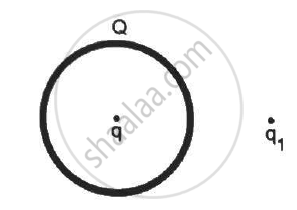
A thin, metallic spherical shell contains a charge Q on it. A point charge q is placed at the centre of the shell and another charge q1 is placed outside it as shown in the following figure . All the three charges are positive. The force on the charge at the centre is ____________.
Concept: undefined >> undefined
