Please select a subject first
Advertisements
Advertisements
When the frequency of the AC source in an LCR circuit equals the resonant frequency, the reactance of the circuit is zero. Does it mean that there is no current through the inductor or the capacitor?
Concept: undefined >> undefined
Which of the following plots may represent the reactance of a series LC combination?
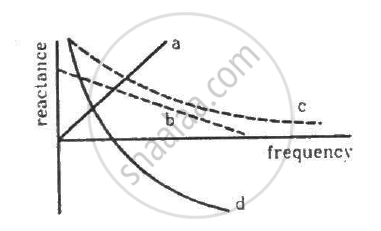
Concept: undefined >> undefined
Advertisements
The reactance of a circuit is zero. It is possible that the circuit contains
(a) an inductor and a capacitor
(b) an inductor but no capacitor
(c) a capacitor but no inductor
(d) neither an inductor nor a capacitor
Concept: undefined >> undefined
Figure shows a metallic wire of resistance 0.20 Ω sliding on a horizontal, U-shaped metallic rail. The separation between the parallel arms is 20 cm. An electric current of 2.0 µA passes through the wire when it is slid at a rate of 20 cm s−1. If the horizontal component of the earth's magnetic field is 3.0 × 10⁻⁵ T, calculate the dip at the place.
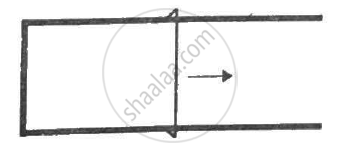
Concept: undefined >> undefined
Figure shows two parallel wires separated by a distance of 4.0 cm and carrying equal currents of 10 A along opposite directions. Find the magnitude of the magnetic field B at the points A1, A2, A3.
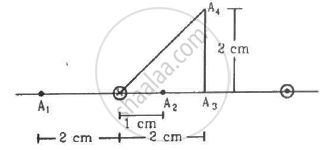
Concept: undefined >> undefined
Two parallel wires carry equal currents of 10 A along the same direction and are separated by a distance of 2.0 cm. Find the magnetic field at a point which is 2.0 cm away from each of these wires.
Concept: undefined >> undefined
Two long, straight wires, each carrying a current of 5 A, are placed along the x- and y-axis respectively. The currents point along the positive directions of the axes. Find the magnetic fields at the points (a) (1 m, 1 m), (b) (−1 m, 1 m), (c) (−1 m, −1 m) and (d) (1 m, −1 m).
Concept: undefined >> undefined
Four long, straight wires, each carrying a current of 5.0 A, are placed in a plane as shown in figure. The points of intersection form a square of side 5.0 cm.
(a) Find the magnetic field at the centre P of the square.
(b) Q1, Q2, Q3, and Q4, are points situated on the diagonals of the square and at a distance from P that is equal to the diagonal of the square. Find the magnetic fields at these points.
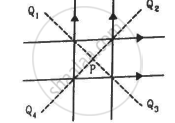
Concept: undefined >> undefined
Consider a 10-cm long piece of a wire which carries a current of 10 A. Find the magnitude of the magnetic field due to the piece at a point which makes an equilateral triangle with the ends of the piece.
Concept: undefined >> undefined
A long, straight wire carries a current i. Let B1 be the magnetic field at a point P at a distance d from the wire. Consider a section of length l of this wire such that the point P lies on a perpendicular bisector of the section B2 be the magnetic field at this point due to this second only. Find the value of d/l so that B2 differs from B1 by 1%.
Concept: undefined >> undefined
A straight, how wire carries a current of 20 A. Another wire carrying equal current is placed parallel to it. If the force acting on a length of 10 cm of the second wire is 2.0 × 10⁻⁵ N, what is the separation between them?
Concept: undefined >> undefined
Three coplanar parallel wires, each carrying a current of 10 A along the same direction, are placed with a separation 5.0 cm between the consecutive ones. Find the magnitude of the magnetic force per unit length acting on the wires.
Concept: undefined >> undefined
Two parallel wires separated by a distance of 10 cm carry currents of 10 A and 40 A along the same direction. Where should a third current by placed so that it experiences no magnetic force?
Concept: undefined >> undefined
A conducting circular loop of radius a is connected to two long, straight wires. The straight wires carry a current i as shown in figure. Find the magnetic field B at the centre of the loop.
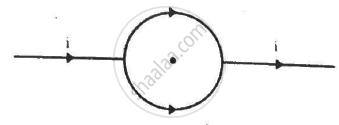
Concept: undefined >> undefined
Calculate n(T)/n(1000 K) for tungsten emitter at T = 300 K, 2000 K and 3000 K, where n(T) represents the number of thermions emitted per second by the surface at temperature T. Work function of tungsten is 4.52 eV.
Concept: undefined >> undefined
A tungsten cathode and a thoriated-tungsten cathode have the same geometric dimensions and are operated at the same temperature. The thoriated-tungsten cathode gives 5000 times more current than the other cathode. The constant A in the Richardson−Dushman equation is 60 × 104 Am −2 K−2 for pure tungsten and 3.0 × 10⁴ Am −2 k−2 for thoriated tungsten. The work function of pure tungsten is 4.5 eV and that of thoriated tungsten is 2.6 eV. Find the operating temperature.
Concept: undefined >> undefined
If the temperature of a tungsten filament is raised from 2000 K to 2010 K, by what factor does the emission current change? Work function of tungsten is 4.5 eV.
Concept: undefined >> undefined
If Coulomb’s law involved 1/r3 dependence (instead of 1/r2), would Gauss’s law be still true?
Concept: undefined >> undefined
The ground state energy of hydrogen atom is – 13∙6 eV. If an electron makes a transition from an energy level – 1∙51 eV to – 3∙4 eV, calculate the wavelength of the spectral line emitted and name the series of hydrogen spectrum to which it belongs.
Concept: undefined >> undefined
Find out the wavelength of the electron orbiting in the ground state of hydrogen atom.
Concept: undefined >> undefined
