Please select a subject first
Advertisements
Advertisements
Show that the following figure has two lines of symmetry and a rotational.

Concept: undefined >> undefined
Name a figure that has a line of symmetry but does not have any rotational symmetry.
Concept: undefined >> undefined
Advertisements
In the following figure, draw all possible lines of symmetry and also write the order of rotational symmetry:
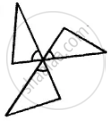
Concept: undefined >> undefined
In the following figure, draw all possible lines of symmetry and also write the order of rotational symmetry:
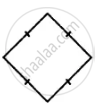
Concept: undefined >> undefined
In the following figure, draw all possible lines of symmetry and also write the order of rotational symmetry:
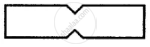
Concept: undefined >> undefined
In the following figure, draw all possible lines of symmetry and also write the order of rotational symmetry:
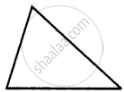
Concept: undefined >> undefined
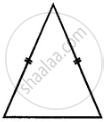
In the following figure, draw all possible lines of symmetry and also write the order of rotational symmetry:
Concept: undefined >> undefined
Draw a map of your classroom using proper scale and symbols for different objects.
Concept: undefined >> undefined
Draw a map of your school compound using proper scale and symbols for various features like a playground, main building, garden, etc.
Concept: undefined >> undefined
In the map of India, the distance between the two cities is 13.8 cm.
Taking scale: 1 cm = 12 km, find the actual distance between these two cities.
Concept: undefined >> undefined
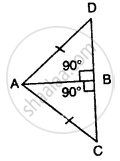
In the given figure, prove that: BD = BC.
Concept: undefined >> undefined
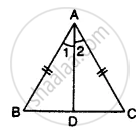
In the given figure ;
∠1 = ∠2 and AB = AC.
Prove that:
(i) ∠B = ∠C
(ii) BD = DC
(iii) AD is perpendicular to BC.
Concept: undefined >> undefined
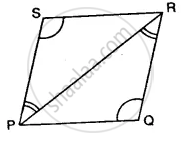
In the given figure prove that:
(i) PQ = RS
(ii) PS = QR
Concept: undefined >> undefined
(i) ∆ XYZ ≅ ∆ XPZ
(ii) YZ = PZ
(iii) ∠YXZ = ∠PXZ
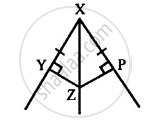
Concept: undefined >> undefined
In the given figure, prove that:
(i) ∆ ABC ≅ ∆ DCB
(ii) AC = DB
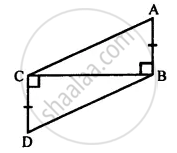
Concept: undefined >> undefined
In the given figure, prove that:
- ∆AOD ≅ ∆ BOC
- AD = BC
- ∠ADB = ∠ACB
- ∆ADB ≅ ∆ BCA
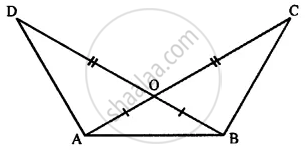
Concept: undefined >> undefined
ABC is an equilateral triangle, AD and BE are perpendiculars to BC and AC respectively. Prove that:
(i) AD = BE
(ii) BD = CE
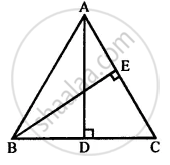
Concept: undefined >> undefined
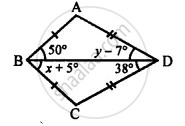
Use the information given in the following figure to prove triangles ABD and CBD are congruent. Also, find the values of x and y.
Concept: undefined >> undefined
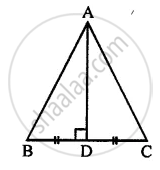
The given figure shows a triangle ABC in which AD is perpendicular to side BC and BD = CD. Prove that:
(i) ∆ ABD ≅ ∆ ACD
(ii) AB = AC
(iii) ∠B = ∠C
Concept: undefined >> undefined
The radius of a circle is 21 cm. Find the circumference (Take π = `3 1/7`).
Concept: undefined >> undefined
