Please select a subject first
Advertisements
Advertisements
A current of 0.2 A flows through a wire whose ends are at a potential difference of 15 V.
calculate:
(i) the resistance of the wire and
(ii) the heat energy produced in 1 minute.
Concept: undefined >> undefined
What is the resistance, under normal working conditions of a 240 V electric lamp rated at 60 W? If two such lamps are connected in series across a 240 V mains supply, explain why each one appears less bright.
Concept: undefined >> undefined
Advertisements
State one difference between a musical note and a noise.
Concept: undefined >> undefined
Two bulbs are rated 60 W, 220 V and 60 W, 110 V respectively. Calculate the ratio of their
resistances
Concept: undefined >> undefined
An electric bulb is rated 250 W, 230 V. Calculate:
- the energy consumed in one hour
- the time in which the bulb will consume 1.0 kWh energy when connected to 230 V mains.
Concept: undefined >> undefined
Two resistors A and B of resistance 4 Ω and 6 Ω respectively are connected in parallel. The combination is connected across a 6 volt battery of negligible resistance. Calculate: (i) the power supplied by the battery, (ii) the power dissipated in each resistor.
Concept: undefined >> undefined
A battery of e.m.f 15 V and internal resistance 2 Ω is connected to two resistors of resistance 4 ohm and 6 ohm joined in series. Find the electrical energy spent per minute in 6 ohm resistor.
Concept: undefined >> undefined
Water in an electric kettle connected to a 220 V supply took 5 minutes to reach its boiling point. How long would it have taken if the supply voltage had fallen to 200 V?
Concept: undefined >> undefined
An electric toaster draws 8 A current in a 220 V circuit. It is used for 2 h. Find the cost of
operating the toaster if the cost of electrical energy is Rs. 4.50 per kWh.
Concept: undefined >> undefined
An electric kettle is rated 2.5 kW, 250 V. Find the cost of running the kettle for two hours at Rs. 5.40 per unit.
Concept: undefined >> undefined
A geyser is rated 1500 W, 250 V. This geyer is connected to 250 V mains. Calculate:
(i) the current drawn
(ii) the energy consumed in 50 hours, and
(iii) the cost of energy consumed at Rs. 4.20 per kWh
Concept: undefined >> undefined
You are required to make an electromagnet from a soft iron bar by using a cell, an insulated coil of copper wire and a switch. (a) Draw a circuit diagram to represent the process. (b) label the poles of the electromagnet.
Concept: undefined >> undefined
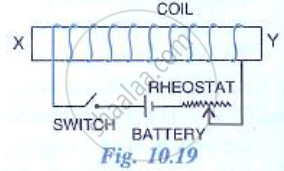
The adjacent diagram shows a coil would around a soft iron bar XY. (a) State the polarity at the end X and Y as the switch is pressed. (b) Suggest one way increasing the strength of electromagnet so formed.
Concept: undefined >> undefined
State two ways through which the strength of an electromagnet can be increased.
Concept: undefined >> undefined
Complete the following sentence :
……… energy is converted into …………energy by an electric motor.
Concept: undefined >> undefined
State two factors on which the magnitude of induced e.m.f. depend.
Concept: undefined >> undefined
Explain why an induced current must flow in such a direction so as to oppose the change producing it.
Concept: undefined >> undefined
Explain the significance of Lenz’s law to show the conservation of energy in electromagnetic induction.
Concept: undefined >> undefined
The following diagram in Fig.10.42 shows a coil of several turns of copper wire connected to a sensitive centre zero galvanometer G near a magnet NS. The coil is free to move in the direction shown in the diagram.
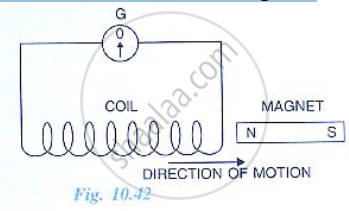
(i) Describe the observation if the coil is rapidly moved.
(ii) How would the observation be altered if (a) the coil has twice as many turns (b the coil was made to move three times as fast?
Concept: undefined >> undefined
