Advertisements
Advertisements
State two advantages of using a right-angle prism as a reflector, rather than a plane mirror.
Concept: undefined >> undefined
State the S.I. unit of electrical resistance and define it.
Concept: undefined >> undefined
Advertisements
Images formed by totally reflecting prisms are brighter than the image formed by ordinary reflected light, why?
Concept: undefined >> undefined
How does the resistance of a metallic wire depend on the length of wire?
Concept: undefined >> undefined
How does the resistance of a metallic wire depend on the thickness of wire?
Concept: undefined >> undefined
A ray of light incident at an angle of incidence ‘i’ passes through an equilateral glass prism such that the refracted ray inside the prism is parallel to its base and emerges from the prism at an angle of emergence ‘e’.
How is the angle of emergence ‘e’ related to the angle of incidence ‘i’?
Concept: undefined >> undefined
A ray of light incident at an angle of incidence ‘i’ passes through an equilateral glass prism such that the refracted ray inside the prism is parallel to its base and emerges from the prism at an angle of emergence ‘e’.
What can you say about the value of the angle of deviation in such a situation?
Concept: undefined >> undefined
A given wire is stretched to double its length. How will its resistance change?
Concept: undefined >> undefined
State one factor on which a critical angle for a given pair of media depends. The critical angle for the glass-air interface is 45° for the yellow light. Will it be equal to, less than or greater than 45° for (i) red light, (ii) blue light?
Concept: undefined >> undefined
Name the factors affecting the critical angle for the pair of media.
Concept: undefined >> undefined
What is meant by the statement, ‘the critical angle for diamond is 24°’?
Concept: undefined >> undefined
How is the critical angle of a material related to its refractive index?
Concept: undefined >> undefined
What is meant by the term ‘critical angle’?
Concept: undefined >> undefined
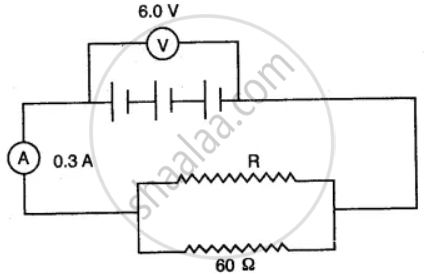
In the figure below, the ammeter A reads 0.3 A. Calculate:
(i) the total resistance of the circuit
(ii) the value of R
(iii) the current flowing through R.
Concept: undefined >> undefined
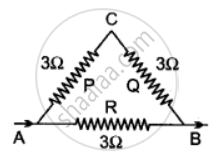
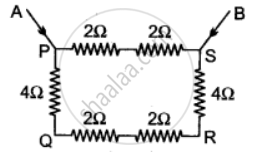
Calculate equivalent resistance in the following cases:
Concept: undefined >> undefined
Draw a diagram, properly labelled, to illustrate the use of a total reflecting prism (a right-angled isosceles prism) to turn a ray of light through 180°. Name an instrument in which this device is used.
Concept: undefined >> undefined
The diagram shows a point source P inside a water container. Three rays A, B, and C starting from P are shown up to the water surface. Show in the diagram the path of these rays after striking the water surface. The critical angle for the water-air pair is 48°.

Concept: undefined >> undefined
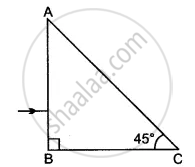
A ray of light passes through a right-angled prism as shown in the figure. State the angles of incidence at the faces AC and BC.
Concept: undefined >> undefined
The adjacent diagram shows two right-angled isosceles prisms A and B. Complete the diagram to show the path of rays P and Q emerging out of the prism B. What principles have you used to complete the diagram?

Concept: undefined >> undefined
Complete the following diagram to show the path of the ray of a single colour in the diagram as if enters in and emerges out of the prism. Mark the angles wherever necessary. (Critical angle for glass = 42°).

Concept: undefined >> undefined
