Advertisements
Advertisements
Name the energy changes for the following
human body
Concept: undefined >> undefined
Name the energy changes for each of the following cases:
dynamo
Concept: undefined >> undefined
Advertisements
Concept: undefined >> undefined
Concept: undefined >> undefined
Concept: undefined >> undefined
The following are some of the energy transformations.
A. Electrical to light
B. Work to heat
C. Chemical to light
D. Electrical to sound
E. Mechanical to electrical
Identify the energy transformation that takes place in the following by inserting the corresponding letter in the shape provided.
(i) A candle flame
(ii) A torch is lighted
(iii) A microphone is used in a meeting
(iv) A cycle dynamo
(v) A piece of metal is being filed
Concept: undefined >> undefined
Identify the type of energy possessed by the body in each of the following:
(a) A coiled spring of the toy car
(b) A hammer which is raised
(c) A stone shot from a catapult
(d) Water stored in the overhead tank
(e) A tadpole moving in water.
Concept: undefined >> undefined
Concept: undefined >> undefined
Can a transformer work when it is connected to a D.C. source? Give a reason.
Concept: undefined >> undefined
Draw a simple labeled diagram of a step-down transformer.
Concept: undefined >> undefined
Draw a simple labeled diagram of a step-up transformer.
Concept: undefined >> undefined
The diagram 10 shows two coils X and Y. The coil X is connected to a battery S and a key K. The coil Y is connected to a galvanometer G.
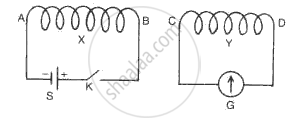
When the key K is closed. State the polarity
(i)At the end of the coil X,
(ii)At the end C of the coil Y,
(iii)At the end C of the coil Y if the coil Y is (a) Moved towards the coil X, (b) Moved away from the coil X.
Concept: undefined >> undefined
The following diagram shows a fixed coil of several turns connected to a center zero galvanometer G and a magnet NS which can move in the direction shown in the diagram.
- Describe the observation in the galvanometer if
- The magnet is moved rapidly,
- The magnet is kept still after it has moved into the coil
- The magnet is then rapidly pulled out the coil.
- How would the observation in (i) of part (a) change if a more powerful magnet is used?

Concept: undefined >> undefined
Draw and label the diagram of a simple D.C. motor.
(a) Explain the rotation of the coil, giving a reason for your answer.
(b) How can you reverse the direction of rotation of the armature?
(c) How can you increase the speed of rotation of the motor?
Concept: undefined >> undefined
Fig. shows a simple form of an A.C. generator.
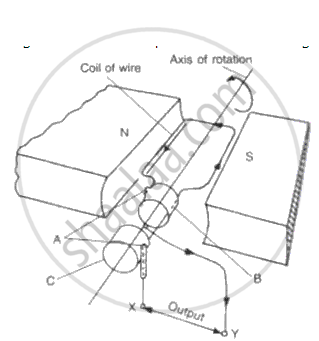
(a) Name the parts labeled A and B.
(b) What would be the effect of doubling the number of turns on the coil if the speed of rotation remains unchanged?
(c) Which of the output terminals is positive if the coil is rotating in the
direction shown in the diagram (anticlockwise)?
( d ) What is the position of the rotating coil when p.d. across its ends is zero? Explain why p.d. is zero when the coil is at this position .
(e) Sketch a graph showing how the p.d. across the ends of the rotating coil varies with time for an A.C. dynamo.
( f) On th e same sheet of paper and vertically below the first graph using the same time scale, sketch graphs to show the effect of
(i) Doubling the speed of rotation and at the same time keeping
the field and the number of turns constant,
(ii ) Doubling the number of turns on the coil and at the same time
doubling the speed of rotation of the coil, keeping th e speed
constant.
Concept: undefined >> undefined
Fill in the blanks by writing (i) Only soft iron, (ii) Only steel, (iii) Both soft-iron and steel for the material of core and/or magnet.
D.C. motor ______.
Concept: undefined >> undefined
Fill in the blanks by writing (i) Only soft iron, (ii) Only steel, (iii) Both soft-iron and steel for the material of core and/or magnet.
A. C. generator______.
Concept: undefined >> undefined
Fill in the blanks by writing (i) Only soft iron, (ii) Only steel, (iii) Both soft-iron and steel for the material of core and/or magnet.
Transformer______.
Concept: undefined >> undefined
A transformer has 400 turns in the primary winding and 10 turns in the secondary winding. The primary e.m.f. is 250 V and the primary current is 2.0 A. calculate:
(a) The secondary voltage,
(b) The secondary current, assuming 100% efficiency.
Concept: undefined >> undefined
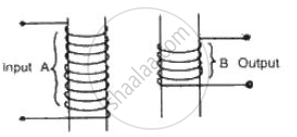
Complete the following diagram of a transformer and name the parts labeled A and B. Name the part you have drawn to complete the diagram . What is the material of this part? In this transformer a step-up or step-down? Why?
Concept: undefined >> undefined
