Advertisements
Advertisements
Read the source given below and answer the questions that follow:
|
Darbar-i Akbari Abu'l Fazl gives a vivid account of Akbar's darbar: Whenever His Majesty (Akbar) holds court (darbar) a large drum is beaten, the sounds of which are accompanied by Divine praise. In this manner, people of all classes receive notice. His Majesty's sons and grandchildren, the grandees of the Court, and all other men who have admittance,' attend to make the kornish, and remain standing in their proper places. Learned men of renown and skillful mechanics pay their respects; and the officers of justice present their reports. His Majesty, with his usual insights, gives orders, and settles everything in a satisfactory manner. During the whole time, skillful gladiators and wrestlers from all countries hold themselves in readiness, and singers, male and female, are in waiting. Clever jugglers and funny tumblers also are anxious to exhibit their dexterity and agility. |
- How were the people informed about the conduct of the court?
- How was the social control exercised in the court?
- How did Akbar dispose of the appeals or cases in the court?
Concept: undefined >> undefined
Which of the following informations are correct about Ain-i-Akbari?
- Written by Abdul Razi in Arabic language.
- Manzil-abadi, concerns the imperial household.
- Sipah-abadi, covers the military and civil administrations.
- Mulk-abadi, deals with the fiscal side of the empire.
Concept: undefined >> undefined
Advertisements
'Kabir is known as one of the saints whose philosophy has greatly influenced the Bhakti Movement.' Justify the statement with suitable points.
Concept: undefined >> undefined
Explain the limitations of epigraphy.
Concept: undefined >> undefined
"Meera Bai was perhaps one of the best known woman poet within the Bhakti Tradition." Substantiate the statement.
Concept: undefined >> undefined
Assertion (A): The book 'Sipah Abadi' was the important book on the military arid civil administration of the Mughals.
Reason (R): Book includes short biographical sketches of imperial officials like Mansabdars, Poets etc.
Concept: undefined >> undefined
'Kabir Das is one of the most outstanding examples of a Poet-saint who has given extensive views on social situation, institution and on ultimate reality.' Explain the statement.
Concept: undefined >> undefined
"Baba Nanak's vision of the sacred word was all inclusive." Explain the statement.
Concept: undefined >> undefined
'Meerabai was a well known poet of North Indian Hindu Tradition.' Explain her philosophy and belief system.
Concept: undefined >> undefined
Read the source given below and answer the questions that follow:
|
Abu'l Fazl gives a vivid account of Akbar's darbar: Whenever His Majesty (Akbar) holds court (darbar) a large drum is beaten, the sounds of which are accompanied by Divine praise. In this manner, people of all classes receive notice. His Majesty's sons and grandchildren, the grandees of the Court, and all other men who have admittance,' attend to make the kornish, and remain standing in their proper places. Learned men of renown and skillful mechanics pay their respects; and the officers of justice present their reports. His Majesty, with his usual insights, gives orders, and settles everything in a satisfactory manner. During the whole time, skillful gladiators and wrestlers from all countries hold themselves in readiness, and singers, male and female, are in waiting. Clever jugglers and funny tumblers also are anxious to exhibit their dexterity and agility. |
- How were the people informed about the conduct of the court?
- How was the social control exercised in the court?
- How did Akbar dispose of the appeals or cases in the court?
Concept: undefined >> undefined
Write a short essay (about 250-300 words) on the following:
Read any five of the sources included in this chapter and discuss the social and religious ideas that are expressed in them.
Concept: undefined >> undefined
What does the symbol of ‘empty seat’ symbolise?
Concept: undefined >> undefined
Which of these was the cause of decline of Harappan civilisation?
Concept: undefined >> undefined
Which of these was not worshipped by the Harappan?
Concept: undefined >> undefined
Which of the following pairs associated with Buddha’s symbolic representation is incorrect?
Concept: undefined >> undefined
Which of the following options is the most probable explanation for the incorporation of the ’Shailabhanjika’ Motif in the Sanchi Stupa?
Concept: undefined >> undefined
Assertion (A): Akbar was interested to spread Christianity in India and invite Jesuit Priests for the same.
Reason (R): The first Jesuit mission reached the Mughal court at Fatehpur Sikri in 1580 and stayed for about two years.
Concept: undefined >> undefined
Consider the following statements regarding the classification of lands under Akbar:
- In sulh-i kul some religions and schools of thought had freedom of expression.
- The ideal of sulh-I Kul was implemented through state policies.
- Shahjahan abolished the tax on pilgrimage in 1563 and jizya in 1564 as the two were based on religious discrimination.
Which of the following statement (s) is/are correct?
Concept: undefined >> undefined
Answer in 100-150 words
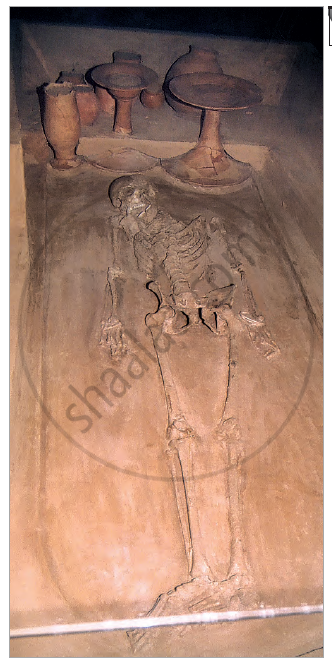
Look at following figure and describe what you see. How is the body placed? What are the objects placed near it? Are there any artefacts on the body? Do these indicate the sex of the skeleton?
Concept: undefined >> undefined
Write a short essay (about 500 words) on the following:
Discuss the development in sculpture and architecture associated with the rise of Vaishnavism and Shaivism.
Concept: undefined >> undefined
