Advertisements
Advertisements
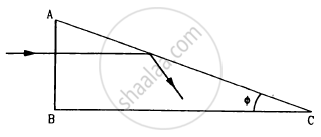
A light ray is incident normally on the face AB of a right-angled prism ABC (μ = 1.50) as shown in figure. What is the largest angle ϕ for which the light ray is totally reflected at the surface AC?
Concept: undefined >> undefined
Find the maximum angle of refraction when a light ray is refracted from glass (μ = 1.50) to air.
Concept: undefined >> undefined
Advertisements
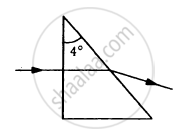
Find the angle of deviation suffered by the light ray shown in figure. The refractive index μ = 1.5 for the prism material.
Concept: undefined >> undefined
A light ray, going through a prism with the angle of prism 60°, is found to deviate by 30°. What limit on the refractive index can be put from these data?
Concept: undefined >> undefined
For paraxial rays, show that the focal length of a spherical mirror is one-half of its radius of curvature.
Concept: undefined >> undefined
Consider the diffraction pattern for a small pinhole. As the size of the hole is increased ______.
- the size decreases.
- the intensity increases.
- the size increases.
- the intensity decreases.
Concept: undefined >> undefined
A polariod (I) is placed in front of a monochromatic source. Another polatiod (II) is placed in front of this polaroid (I) and rotated till no light passes. A third polaroid (III) is now placed in between (I) and (II). In this case, will light emerge from (II). Explain.
Concept: undefined >> undefined

AC = CO = D, S1C = S2C = d << D
A small transparent slab containing material of µ = 1.5 is placed along AS2 (Figure). What will be the distance from O of the principal maxima and of the first minima on either side of the principal maxima obtained in the absence of the glass slab?
Concept: undefined >> undefined
Four identical monochromatic sources A, B, C, D as shown in the (Figure) produce waves of the same wavelength λ and are coherent. Two receiver R1 and R2 are at great but equal distances from B.
- Which of the two receivers picks up the larger signal?
- Which of the two receivers picks up the larger signal when B is turned off?
- Which of the two receivers picks up the larger signal when D is turned off?
- Which of the two receivers can distinguish which of the sources B or D has been turned off?

Concept: undefined >> undefined
Draw the graph showing intensity distribution of fringes with phase angle due to diffraction through a single slit. What is the width of the central maximum in comparison to that of a secondary maximum?
Concept: undefined >> undefined
Write two points of difference between an interference pattern and a diffraction pattern.
Concept: undefined >> undefined
How can you differentiate whether a pattern is produced by a single slit or double slit?
Concept: undefined >> undefined
Derive the expression for the angular position of (i) bright and (ii) dark fringes produced in a single slit diffraction.
Concept: undefined >> undefined
In a diffraction pattern due to a single slit, how will the angular width of the central maximum change, if orange light is used in place of green light?
Justify your answer.
Concept: undefined >> undefined
In a diffraction pattern due to a single slit, how will the angular width of the central maximum change, if the screen is moved closer to the slit?
Justify your answer.
Concept: undefined >> undefined
In a diffraction pattern due to a single slit, how will the angular width of the central maximum change, if the slit width is decreased?
Justify your answer.
Concept: undefined >> undefined
Draw the intensity distribution for the fringes produced in interference ?
Concept: undefined >> undefined
Why are coherent sources necessary to produce a sustained interference pattern?
Concept: undefined >> undefined
State the importance of coherent sources in the phenomenon of interference.
Concept: undefined >> undefined
Can we conclude from the interference phenomenon whether light is a transverse wave or a longitudinal wave?
Concept: undefined >> undefined
