Advertisements
Advertisements
When the width of the slit is made double the original width, how would this affect the size and intensity of the central diffraction band?
Concept: undefined >> undefined
In a Geiger-Marsden experiment, calculate the distance of closest approach to the nucleus of Z = 80, when a α-particle of 8Mev energy impinges on it before it comes momentarily to rest and reverses its direction.
How will the distance of closest approach be affected when the kinetic energy of the α-particle is doubles?
Concept: undefined >> undefined
Advertisements
In a Geiger-Marsden experiment, calculate the distance of closest approach to the nucleus of Z = 75, when a α-particle of 5 MeV energy impinges on it before it comes momentarily to rest and reverses its direction.
How will the distance of closest approach be affected when the kinetic energy of the α-particle is doubles?
Concept: undefined >> undefined
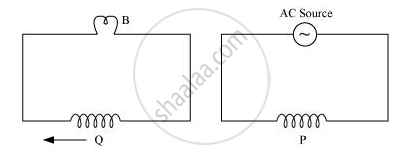
A coil Q is connected to low voltage bulb B and placed near another coil P as shown in the figure. Give reasons to explain the following observations:
(a) The bulb ‘B’ lights
(b) Bulb gets dimmer if the coil Q is moved towards left.
Concept: undefined >> undefined
State Huygens’s principle. Show, with the help of a suitable diagram, how this principle is used to obtain the diffraction pattern by a single slit.
Draw a plot of intensity distribution and explain clearly why the secondary maxima becomes weaker with increasing order (n) of the secondary maxima.
Concept: undefined >> undefined
Huygens' principle of secondary wavelets may be used to
(a) find the velocity of light in vacuum
(b) explain the particle behaviour of light
(c) find the new position of a wavefront
(d) explain Snell's Law
Concept: undefined >> undefined
Light waves travel in vacuum along the X-axis. Which of the following may represent the wave fronts?
Concept: undefined >> undefined
In motor vehicles, a convex mirror is attached near the driver's seat to give him the view of the traffic behind. What is the special function of this convex mirror which a plane mirror can not do?
Concept: undefined >> undefined
If an object far away from a convex mirror moves towards the mirror, the image also moves. Does it move faster, slower or at the same speed as compared to the object?
Concept: undefined >> undefined
Can mirrors give rise to chromatic aberration?
Concept: undefined >> undefined
In image formation from spherical mirrors, only paraxial rays are considered because they
Concept: undefined >> undefined
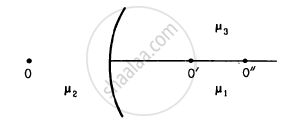
Following figure shows three transparent media of refractive indices \[\mu_1 , \mu_2 \text{ and } \mu_3\]. A point object O is placed in the medium \[\mu_2\]. If the entire medium on the right of the spherical surface has refractive index \[\mu_3\], the image forms at O". In the situation shown,
Concept: undefined >> undefined
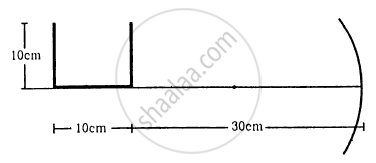
A U-shaped wire is placed before a concave mirror having radius of curvature 20 cm as shown in figure. Find the total length of the image.
Concept: undefined >> undefined
A man uses a concave mirror for shaving. He keeps his face at a distance of 25 cm from the mirror and gets an image which is 1.4 times enlarged. Find the focal length of the mirror.
Concept: undefined >> undefined
The image of an extended object, placed perpendicular to the principal axis of a mirror, will be erect if
(a) the object and the image are both real
(b) the object and the image are both virtual
(c) the object is real but the image is virtual
(d) the object is virtual but the image is real.
Concept: undefined >> undefined
Light is incident from glass (μ = 1.5) to air. Sketch the variation of the angle of deviation δ with the angle of incident i for 0 < i < 90°.
Concept: undefined >> undefined
A spherical surface of radius 30 cm separates two transparent media A and B with refractive indices 1.33 and 1.48 respectively. The medium A is on the convex side of the surface. Where should a point object be placed in medium A so that the paraxial rays become parallel after refraction at the surface?
Concept: undefined >> undefined
A narrow pencil of parallel light is incident normally on a solid transparent sphere of radius r. What should be the refractive index is the pencil is to be focussed (a) at the surface of the sphere, (b) at the centre of the sphere.
Concept: undefined >> undefined
A diverging lens of focal length 20 cm and a converging mirror of focal length 10 cm are placed coaxially at a separation of 5 cm. Where should an object be placed so that a real image is formed at the object itself?
Concept: undefined >> undefined
A converging lens of focal length 12 cm and a diverging mirror of focal length 7.5 cm are placed 5.0 cm apart with their principal axes coinciding. Where should an object be placed so that its image falls on itself?
Concept: undefined >> undefined
