Please select a subject first
Advertisements
Advertisements
Match the following:
| Column-I (Leaders) |
Column-II - (Role in the Constituent Assembly) |
||
| A. | Jawaharlal Nehru | i. | President of the Constituent Assembly |
| B. | B.R. Ambedkar | ii. | Constitutional Advisor |
| C. | Rajendra Prasad | iii. | Chairman of the Drafting Committee |
| D. | B.N. Rau | iv. | Worked on the 'Objective Resolution' |
Concept: undefined >> undefined
Who among the following rulers worked on the preservation of Sanchi Stupa?
Concept: undefined >> undefined
Advertisements
Consider the given statements regarding Constituent Assembly and select the correct from the following options:
- Motilal Nehru moved resolution of National flag in the Constituent Assembly.
- G.B. Pant was the Legal Advisor.
- Sardar Patel was the Constitutional Advisor.
- K.M. Munshi was called as Frontier Gandhi.
Concept: undefined >> undefined
Analyse the role of Indian Sanskritist V.S. Suthankar and his team in the preparation of critical edition of Mahabharata.
Concept: undefined >> undefined
Examine the sources to know about Mughal rural society.
Concept: undefined >> undefined
Which of the following issues did not contribute to the spread of the Revolt of 1857?
Concept: undefined >> undefined
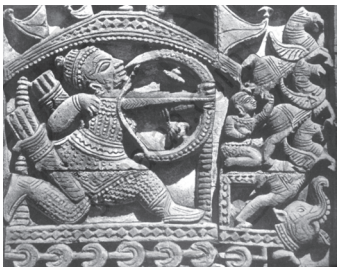
Identify the picture from the given options.
Concept: undefined >> undefined
With reference to the role of the British officers in India, match Column-B with column-A, by using the codes given below.
| Column-A | Column-B |
| A. Lord Cornwallis | 1. Observer |
| B. Augustus Cleveland | 2. Economist |
| C. Francis Buchanan | 3. Governor General of Benga |
| D. David Ricardo | 4. Policy of Pacification |
Concept: undefined >> undefined
Who among the following led the Flag of the Revolt 1857 against the British in Bihar?
Concept: undefined >> undefined
“The Burdwan auction had a strange twist and was considered as a big public event in 1797”, explain the statement.
Concept: undefined >> undefined
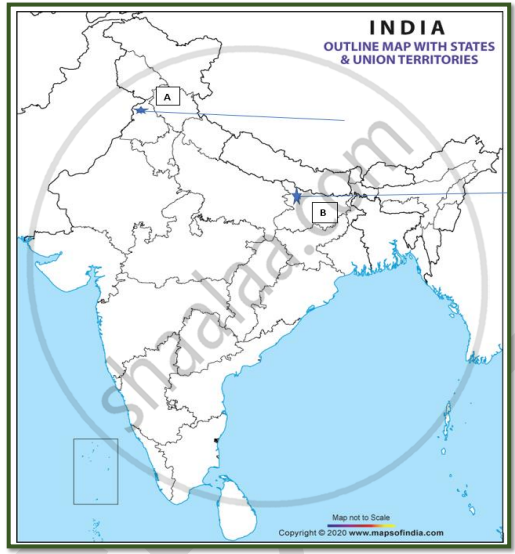
- On the given political map of India, locate and label the following with appropriate symbols:
- Kalibangan, a Harappan site
- Agra, a territory under Babur, Akbar, and Aurangzeb
- Sanchi, a Buddhist site
OR - Ajanta, a Buddhist site
- On the same outline map, two places have been marked as A and B, which are centres of the National movement. Identify them and write their correct names on the lines drawn near them.
Concept: undefined >> undefined
Read the source given below and answer the questions that follow:
|
Darbar-i Akbari Abu'l Fazl gives a vivid account of Akbar's darbar: Whenever His Majesty (Akbar) holds court (darbar) a large drum is beaten, the sounds of which are accompanied by Divine praise. In this manner, people of all classes receive notice. His Majesty's sons and grandchildren, the grandees of the Court, and all other men who have admittance,' attend to make the kornish, and remain standing in their proper places. Learned men of renown and skillful mechanics pay their respects, and the officers of justice present their reports. His Majesty, with his usual insights, gives orders, and settles everything in a satisfactory manner. During the whole time, skillful gladiators and wrestlers from all countries hold themselves in readiness, and singers, male and female, are in waiting. Clever jugglers and funny tumblers also are anxious to exhibit their dexterity and agility. |
- How were the people informed about the conduct of the court?
- How was the social control exercised in the court?
- How did Akbar dispose of the appeals or cases in the court?
Concept: undefined >> undefined
Read the source given below and answer the questions that follow:
|
Darbar-i Akbari Abu'l Fazl gives a vivid account of Akbar's darbar: Whenever His Majesty (Akbar) holds court (darbar) a large drum is beaten, the sounds of which are accompanied by Divine praise. In this manner, people of all classes receive notice. His Majesty's sons and grandchildren, the grandees of the Court, and all other men who have admittance,' attend to make the kornish, and remain standing in their proper places. Learned men of renown and skillful mechanics pay their respects; and the officers of justice present their reports. His Majesty, with his usual insights, gives orders, and settles everything in a satisfactory manner. During the whole time, skillful gladiators and wrestlers from all countries hold themselves in readiness, and singers, male and female, are in waiting. Clever jugglers and funny tumblers also are anxious to exhibit their dexterity and agility. |
- How were the people informed about the conduct of the court?
- How was the social control exercised in the court?
- How did Akbar dispose of the appeals or cases in the court?
Concept: undefined >> undefined
Read the source given below and answer the questions that follow.
|
“There cannot be any divided loyalty” Govind Ballabh Pant argued that in order to become loyal citizens people had to stop focusing only on the community and the self: For the success of democracy one must train himself in the art of self-discipline. In democracies, one should care less for himself and more for others. There cannot be any divided loyalty. All loyalties must exclusively be centered around the State. If in a democracy, you create rival loyalties, or you create a system in which any individual or group, instead of suppressing his extravagance, cares naught for larger or other interests, then democracy is doomed. |
- How did G.B. Pant encourage citizens to make a unified nation?
- Why did he urge citizens for loyal towards nation?
- How was loyalty considered the base of the social pyramid?
Concept: undefined >> undefined
Read the source given below and answer the questions that follow:
|
Darbar-i Akbari Abu'l Fazl gives a vivid account of Akbar's darbar: Whenever His Majesty (Akbar) holds court (darbar) a large drum is beaten, the sounds of which are accompanied by Divine praise. In this manner, people of all classes receive notice. His Majesty's sons and grandchildren, the grandees of the Court, and all other men who have admittance,' attend to make the kornish, and remain standing in their proper places. Learned men of renown and skillful mechanics pay their respects, and the officers of justice present their reports. His Majesty, with his usual insights, gives orders and settles everything in a satisfactory manner. During the whole time, skillful gladiators and wrestlers from all countries hold themselves in readiness, and singers, male and female, are in waiting. Clever jugglers and funny tumblers also are anxious to exhibit their dexterity and agility. |
- How were the people informed about the conduct of the court?
- How was the social control exercised in the court?
- How did Akbar dispose of the appeals or cases in the court?
Concept: undefined >> undefined
Read the source given below and answer the questions that follow.
|
“There cannot be any divided loyalty” Govind Ballabh Pant argued that in order to become loyal citizens people had to stop focusing only on the community and the self: For the success of democracy, one must train himself in the art of self-discipline. In democracies, one should care less for himself and more for others. There cannot be any divided loyalty. All loyalties must exclusively be centred around the State. If in a democracy, you create rival loyalties, or you create a system in which any individual or group, instead of suppressing his extravagance, cares nought for larger or other interests, then democracy is doomed. |
- How did G.B. Pant encourage citizens to make a unified nation?
- Why did he urge citizens for loyal towards the nation?
- How was loyalty considered the base of the social pyramid?
Concept: undefined >> undefined
Read the source given below and answer the questions that follow:
|
Darbar-i Akbari Abu'l Fazl gives a vivid account of Akbar's darbar: Whenever His Majesty (Akbar) holds court (darbar) a large drum is beaten, the sounds of which are accompanied by Divine praise. In this manner, people of all classes receive notice. His Majesty's sons and grandchildren, the grandees of the Court, and all other men who have admittance,' attend to make the kornish, and remain standing in their proper places. Learned men of renown and skillful mechanics pay their respects, and the officers of justice present their reports. His Majesty, with his usual insights, gives orders and settles everything in a satisfactory manner. During the whole time, skillful gladiators and wrestlers from all countries hold themselves in readiness, and singers, male and female, are in waiting. Clever jugglers and funny tumblers also are anxious to exhibit their dexterity and agility. |
- How were the people informed about the conduct of the court?
- How was the social control exercised in the court?
- How did Akbar dispose of the appeals or cases in the court?
Concept: undefined >> undefined
Read the source given below and answer the questions that follow.
|
“There cannot be any divided loyalty” Govind Ballabh Pant argued that in order to become loyal citizens people had to stop focusing only on the community and the self: For the success of democracy one must train himself in the art of self-discipline. In democracies, one should care less for himself and more for others. There cannot be any divided loyalty. All loyalties must exclusively be centred around the State. If in a democracy, you create rival loyalties, or you create a system in which any individual or group, instead of suppressing his extravagance, cares nought for larger or other interests, then democracy is doomed. |
- How did G.B Pant encourage citizens to make a unified nation?
- Why did he urge citizens for loyal towards nation?
- How was loyalty considered the base of the social pyramid?
Concept: undefined >> undefined
Read the following source carefully and answer the questions that follow.
|
The world beyond the palace Just as the Buddha’s teachings were compiled by his followers, the teachings of Mahavira were also recorded by his disciples. These were often in the form of stories, which could appeal to ordinary people. Here is one example, from a Prakrit text known as the Uttaradhyayana Sutta, describing how a queen named Kamalavati tried to persuade her husband to renounce the world: If the whole world and all its treasures were yours, you would not be satisfied, nor would all this be able to save you. When you die, O king and leave all things behind, dhamma alone, and nothing else, will save you. As a bird dislikes the cage, so do I dislike (the world). I shall live as a nun without offspring, without desire, without the love of gain, and without hatred …Those who have enjoyed pleasures and renounced them, move about like the wind, and go wherever they please, unchecked like birds in their flight … Leave your large kingdom … abandon what pleases the senses, be without attachment and property, then practise severe penance, being firm of energy…. |
- Identify the person who persuaded the king to renounce the world.
- “Oh king, dhamma alone and nothing else will save you”-. What does the word “dhamma” signifies and whose teachings was followed by the disciple.
- Under which context the following statement “unchecked like birds in their flight…….” was told by the disciple of Mahavira?
Concept: undefined >> undefined
Read the source given below and answer the · questions that follow:
|
Darbar-i Akbari Abul Fazl gives a vivid account of Akbar's darbar: Whenever His Majesty (Akbar) holds Court (darbar), a large drum is beaten, the sounds of which are accompanied by Divine praise. In this manner, people of all classes receive notice. His. Majesty's sons and grandchildren, the grandees of the Court, and all other men who have admittance,' attend to make the garnish and remain standing in their proper places. Learned men of renown and skilful mechanics pay their respects, and the officers of justice present their reports. His Majesty, with his usual insights, gives orders and settles everything in a satisfactory manner. During the whole time, skilful gladiators and wrestlers from all countries · hold themselves in readiness, and male and female singers are in waiting. Clever jugglers and funny tumblers are also anxious. To exhibit their skill and agility. |
- How were the people informed about the conduct of the Court?
- How was the social control exercised in the Court?
- How did Akbat dispose of the appeals or cases in the Court?
Concept: undefined >> undefined
