Please select a subject first
Advertisements
Advertisements
A block at rest explodes into three equal parts. Two parts start moving along X and Y axes respectively with equal speeds of 10 m/s. Find the initial velocity of the third part.
Concept: undefined >> undefined
When tall building are constructed on earth, the duration of day-night slightly increases. Is it true?
Concept: undefined >> undefined
Advertisements
Is Archimedes' principle valid in an elevator accelerating up ? In a car accelerating on a level road?
Concept: undefined >> undefined
Why is it easier to swim in sea water than in fresh water?
Concept: undefined >> undefined
A ferry boat loaded with rocks has to pass under a bridge. The maximum height of the rocks is slightly more than the height of the bridge so that the boat just fails to pass under the bridge. Should some of the rocks be removed or some more rocks be added?
Concept: undefined >> undefined
A 20 N metal block is suspended by a spring balance. A beaker containing some water is placed on a weighing machine which reads 40 N. The spring balance is now lowered so that the block gets immersed in the water. The spring balance now reads 16 N. The reading of the weighing machine will be
Concept: undefined >> undefined
A body of mass m makes an elastic collision with another identical body at rest. Show that if the collision is not head-on the bodies go at right angle to each other after the collision.
Concept: undefined >> undefined
A small particle travelling with a velocity v collides elastically with a spherical body of equal mass and of radius r initially kept at rest. The centre of this spherical body is located a distance ρ(< r) away from the direction of motion of the particle (see figure below). Find the final velocities of the two particles.
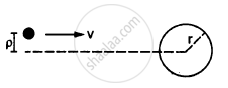
[Hint : The force acts along the normal to the sphere
through the contact. Treat the collision as onedimensional
for this direction. In the tangential direction no force acts and the velocities do not change].
Concept: undefined >> undefined
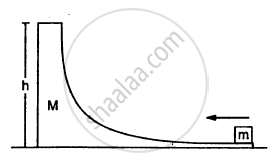
Figure shows a small body of mass m placed over a larger mass M whose surface is horizontal near the smaller mass and gradually curves to become vertical. The smaller mass is pushed on the longer one at a speed v and the system is left to itself. Assume that all the surface are frictionless. (a) Find the speed of the larger block when the smaller block is sliding on the vertical part. (b) Find the speed of the smaller mass when it breaks off the larger mass at height h. (c) Find the maximum height (from the ground) that the smaller mass ascends. (d) Show that the smaller mass will again land on the bigger one. Find the distance traversed by the bigger block during the time when the smaller block was in its flight under gravity.
Concept: undefined >> undefined
A metal cube is placed in an empty vessel. When water is filled in the vessel so that the cube is completely immersed in the water, the force on the bottom of the vessel in contact with the cube
Concept: undefined >> undefined
A solid floats in a liquid in a partially dipped position.
(a) The solid exerts a force equal to its weight on the liquid.
(b) The liquid exerts a force of buoyancy on the solid which is equal to the weight of the solid.
(c) The weight of the displaced liquid equals the weight of the solid.
(d) The weight of the dipped part of the solid is equal to the weight of the displaced liquid.
Concept: undefined >> undefined
A solid is completely immersed in a liquid. The force exerted by the liquid on the solid will
(a) increase if it is pushed deeper inside the liquid
(b) change if its orientation is changed
(c) decrease if it is taken partially out of the liquid
(d) be in the vertically upward direction.
Concept: undefined >> undefined
An ornament weighing 36 g in air, weighs only 34 g in water. Assuming that some copper is mixed with gold to prepare the ornament, find the amount of copper in it. Specific gravity of gold is 19.3 and that of copper is 8.9.
Concept: undefined >> undefined
Refer to the previous problem. Suppose, the goldsmith argues that he has not mixed copper or any other material with gold, rather some cavities might have been left inside the ornament. Calculate the volume of the cavities left that will allow the weights given in that problem.
Concept: undefined >> undefined
A cylindrical object of outer diameter 20 cm and mass 2 kg floats in water with its axis vertical. If it is slightly depressed and then released, find the time period of the resulting simple harmonic motion of the object.
Concept: undefined >> undefined
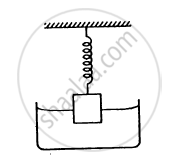
A cylindrical object of outer diameter 10 cm, height 20 cm and density 8000 kg/m3 is supported by a vertical spring and is half dipped in water as shown in figure. (a) Find the elongation of the spring in equilibrium condition. (b) If the object is slightly depressed and released, find the time period of resulting oscillations of the object. The spring constant = 500 N/m.
Concept: undefined >> undefined
A cube of ice of edge 4 cm is placed in an empty cylindrical glass of inner diameter 6 cm. Assume that the ice melts uniformly from each side so that it always retains its cubical shape. Remembering that ice is lighter than water, find the length of the edge of the ice cube at the instant it just leaves contact with the bottom of the glass.
Concept: undefined >> undefined
A wooden block with a coin placed on its top, floats in water as shown in figure. The distance l and h are shown in the figure. After some time the coin falls into the water. Then ______.
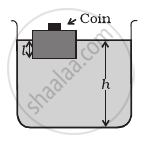
- l decreases.
- h decreases.
- l increases.
- h increase.
Concept: undefined >> undefined
Read the statement below carefully and state, with reason and example, if it is true or false:
A particle in one-dimensional motion with constant speed must have zero acceleration.
Concept: undefined >> undefined
Read the statement below carefully and state, with reason and example, if it is true or false:
A particle in one-dimensional motion with positive value of acceleration must be speeding up.
Concept: undefined >> undefined
