Advertisements
Advertisements
Match the ions given in Column I with their nature given in Column II.
| Column I | Column II |
| (i) \[\ce{CH3 - \overset{\bullet\bullet}{\underset{\bullet\bullet}{O}} - \overset{⊕}{C}H - CH3}\] | (a) Stable due to resonance |
| (ii) \[\ce{F3 - \overset{⊕}{C}}\] | (b) Destabilised due to inductive effect |
|
(iii) \[\begin{array}{cc} |
(c) Stabilised by hyperconjugation |
| (iv) \[\ce{CH3 - \overset{⊕}{C}H - CH3}\] | (d) A secondary carbocation |
Concept: undefined >> undefined
Arrange the halogens F2, Cl2, Br2, I2, in order of their increasing reactivity with alkanes.
Concept: undefined >> undefined
Advertisements
The addition of HBr to 1-butene gives a mixture of products A, B and C
| (A) | 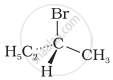 |
| (B) |  |
| (C) | CH3 – CH2 – CH2 – CH2 – Br |
The mixture consists of:
Concept: undefined >> undefined
Arrange the following hydrogen halides in order of their decreasing reactivity with propene.
Concept: undefined >> undefined
Which of the following alkenes on ozonolysis give a mixture of ketones only?
| (i) | CH3 – CH = CH – CH3 |
| (ii) | \[\begin{array}{cc} \ce{CH3 - C - CH = CH2}\\ |\phantom{.......}\\ \ce{CH3}\phantom{....} \end{array}\] |
| (iii) | 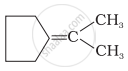 |
| (iv) | \[\begin{array}{cc} \phantom{...................}\ce{CH3}\\ \phantom{..............}/\\ \ce{(CH3)2 C = C}\\ \phantom{..............}\backslash\\ \phantom{...................}\ce{CH3} \end{array}\] |
Concept: undefined >> undefined
In the presence of peroxide addition of HBr to propene takes place according to anti Markovnikov’s rule but peroxide effect is not seen in the case of HCl and HI. Explain.
Concept: undefined >> undefined
An alkene ‘A’ contains three C – C, eight C – H σ bonds and one C – C π bond. ‘A’ on ozonolysis gives two moles of an aldehyde of molar mass 44 u. Write the IUPAC name of ‘A’.
Concept: undefined >> undefined
An alkene ‘A’ contains three C-C, eight C-H σ bonds and one C-C π bond. ‘A’ on ozonolysis gives two moles of an aldehyde of molar mass 44 u. Write the IUPAC name of ‘A’.
Concept: undefined >> undefined
What is the basic difference between the terms electron gain enthalpy and electronegativity?
Concept: undefined >> undefined
How would you react to the statement that the electronegativity of N on Pauling scale is 3.0 in all the nitrogen compounds?
Concept: undefined >> undefined
Yellow light emitted from a sodium lamp has a wavelength (λ) of 580 nm. Calculate the frequency (ν) and wave number (`bar v`) of the yellow light.
Concept: undefined >> undefined
Find energy of each of the photons which correspond to light of frequency 3 × 10¹⁵ Hz.
Concept: undefined >> undefined
Find energy of each of the photons which have the wavelength of 0.50 Å.
Concept: undefined >> undefined
What is the number of photons of light with a wavelength of 4000 pm that provide 1 J of energy?
Concept: undefined >> undefined
A photon of wavelength 4 × 10⁻⁷ m strikes on the metal surface, the work function of the metal being 2.13 eV. Calculate
- the energy of the photon (eV),
- the kinetic energy of the emission, and
- the velocity of the photoelectron (1 eV = 1.6020 × 10⁻¹⁹ J).
Concept: undefined >> undefined
A 25-watt bulb emits monochromatic yellow light of the wavelength of 0.57μm. Calculate the rate of emission of quanta per second.
Concept: undefined >> undefined
Electrons are emitted with zero velocity from a metal surface when it is exposed to radiation of wavelength 6800 Å. Calculate threshold frequency (v0) and work function (W0) of the metal.
Concept: undefined >> undefined
Following results are observed when sodium metal is irradiated with different wavelengths. Calculate (a) threshold wavelength and, (b) Planck’s constant.
| λ (nm) | 500 | 450 | 400 |
| v × 10-5 (cm s-1) | 2.55 | 4.35 | 5.35 |
Concept: undefined >> undefined
The electron energy in the hydrogen atom is given by En = (–2.18 × 10⁻¹⁸)/n2 J. Calculate the energy required to remove an electron completely from the n = 2 orbit. What is the longest wavelength of light in cm that can be used to cause this transition?
Concept: undefined >> undefined
In astronomical observations, signals observed from the distant stars are generally weak. If the photon detector receives a total of 3.15 × 10⁻¹⁸ J from the radiations of 600 nm, calculate the number of photons received by the detector.
Concept: undefined >> undefined
