Advertisements
Advertisements
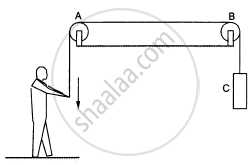
List all the forces acting on (a) the pulley A, (b) the boy and (c) the block C in figure.
Concept: undefined >> undefined
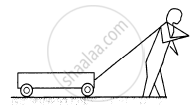
Figure shows a boy pulling a wagon on a road. List as many forces as you can which are relevant with this figure. Find the pairs of forces connected by Newton's third law of motion.
Concept: undefined >> undefined
Advertisements
Figure shows a cart. Complete the table shown below.
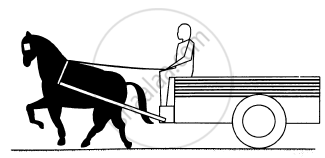
| Force on | Force by | Nature of the Force | Direction |
| Cart |
1 |
||
| Horse |
1 |
||
| Driver |
1 |
Concept: undefined >> undefined
When Neils Bohr shook hand with Werner Heisenberg, what kind of force they exerted ?
Concept: undefined >> undefined
Let E, G and N represent the magnitudes of electromagnetic gravitational and nuclear forces between two electrons at a given separation. Then
Concept: undefined >> undefined
The sum of all electromagnetic forces between different particles of a system of charged particles is zero
Concept: undefined >> undefined
A 60 kg man pushes a 40 kg man by a force of 60 N. The 40 kg man has pushed the other man with a force of
Concept: undefined >> undefined
A neutron exerts a force on a proton which is
(a) gravitational
(b) electromagnetic
(c) nuclear
(d) weak
Concept: undefined >> undefined
A proton exerts a force on a proton which is
(a) gravitational
(b) electromagnetic
(c) nuclear
(d) weak
Concept: undefined >> undefined
Mark the correct statements :
(a) The nuclear force between two protons is always greater than the electromagnetic force between them.
(b) The electromagnetic force between two protons is always greater than the gravitational force between them.
(c) The gravitational force between two protons may be greater than the nuclear force between them.
(d) Electromagnetic force between two protons may be greater than the nuclear force acting between them.
Concept: undefined >> undefined
If all matters were made of electrically neutral particles such as neutrons,
(a) there would be no force of friction
(b) there would be no tension in the string
(c) it would not be possible to sit on a chair
(d) the earth could not move around the sun.
Concept: undefined >> undefined
Which of the following systems may be adequately described by classical physics ?
(a) motion of a cricket ball
(b) motion of a dust particle
(c) a hydrogen atom
(d) a neutron changing to a proton.
Concept: undefined >> undefined
The gravitational force acting on a particle of 1 g due to a similar particle is equal to 6.67 × 10⁻¹⁷ N. Calculate the separation between the particles.
Concept: undefined >> undefined
Calculate the force with which you attract the earth.
Concept: undefined >> undefined
At what distance should two charges, each equal to 1 C, be placed so that the force between them equals your weight ?
Concept: undefined >> undefined
Two spherical bodies, each of mass 50 kg, are placed at a separation of 20 cm. Equal charges are placed on the bodies and it is found that the force of Coulomb repulsion equals the gravitational attraction in magnitude. Find the magnitude of the charge placed on either body.
Concept: undefined >> undefined
A monkey is sitting on a tree limb. The limb exerts a normal force of 48 N and a frictional force of 20 N. Find the magnitude of the total force exerted by the limb on the monkey.
Concept: undefined >> undefined
A body builder exerts a force of 150 N against a bullworker and compresses it by 20 cm. Calculate the spring constant of the spring in the bullworker.
Concept: undefined >> undefined
A satellite is projected vertically upwards from an earth station. At what height above the earth's surface will the force on the satellite due to the earth be reduced to half its value at the earth station? (Radius of the earth is 6400 km.)
Concept: undefined >> undefined
The momentum p of a particle changes with time t according to the relation
\[\frac{dp}{dt} = \left( 10 N \right) + \left( 2 N/s \right)t\] If the momentum is zero at t = 0, what will the momentum be at t = 10 s?
Concept: undefined >> undefined
