Advertisements
Advertisements
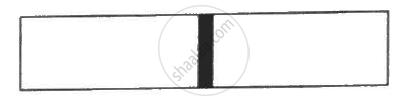
Figure shows a cylindrical tube with adiabatic walls and fitted with a diathermic separator. The separator can be slid in the tube by an external mechanism. An ideal gas is injected into the two sides at equal pressures and equal temperatures. The separator remains in equilibrium at the middle. It is now slid to a position where it divides the tube in the ratio of 1:3. Find the ratio of the pressures in the two parts of the vessel.
Use R=8.314J K-1 mol-1
Concept: undefined >> undefined
Air is pumped into an automobile tyre's tube up to a pressure of 200 kPa in the morning when the air temperature is 20°C. During the day the temperature rises to 40°C and the tube expands by 2%. Calculate the pressure of the air in the tube at this temperature.
Concept: undefined >> undefined
Advertisements
An air bubble of radius 2.0 mm is formed at the bottom of a 3.3 m deep river. Calculate the radius of the bubble as it comes to the surface. Atmospheric pressure = 1.0 × 10⁵ Pa and density of water = 1000 kg m−3.
Concept: undefined >> undefined
A vessel contains 1.60 g of oxygen and 2.80 g of nitrogen. The temperature is maintained at 300 K and the volume of the vessel is 0.166 m3. Find the pressure of the mixture.
Use R = 8.3 J K-1 mol-1
Concept: undefined >> undefined
A container of volume 50 cc contains air (mean molecular weight = 28.8 g) and is open to atmosphere where the pressure is 100 kPa. The container is kept in a bath containing melting ice (0°C). (a) Find the mass of the air in the container when thermal equilibrium is reached. (b) The container is now placed in another bath containing boiling water (100°C). Find the mass of air in the container. (c) The container is now closed and placed in the melting-ice bath. Find the pressure of the air when thermal equilibrium is reached.
Use R = 8.3 J K-1 mol-1
Concept: undefined >> undefined
When an object cools down, heat is withdrawn from it. Does the entropy of the object decrease in this process? If yes, is it a violation of the second law of thermodynamics stated in terms of increase in entropy?
Concept: undefined >> undefined
Is a slow process always isothermal? Is a quick process always adiabatic?
Concept: undefined >> undefined
Why does blowing over a spoonful of hot tea cools it? Does evaporation play a role? Does radiation play a role?
Concept: undefined >> undefined
Two identical metal balls one at T1 = 300 K and the other at T2 = 600 K are kept at a distance of 1 m in a vacuum. Will the temperatures equalise by radiation? Will the rate of heat gained by the colder sphere be proportional to `t_2^4 - t_1^4` as may be expected from the Stefan's law?
Concept: undefined >> undefined
Standing in the sun is more pleasant on a cold winter day than standing in shade. Is the temperature of air in the sun considerably higher than that of the air in shade?
Concept: undefined >> undefined
Cloudy nights are warmer than the nights with clean sky. Explain
Concept: undefined >> undefined
Why is a white dress more comfortable than a dark dress in summer?
Concept: undefined >> undefined
In an adiabatic process on a gas with γ = 1.4, the pressure is increased by 0.5%. The volume decreases by about
Concept: undefined >> undefined
A solid at temperature T1 is kept in an evacuated chamber at temperature T2 > T1. The rate of increase of temperature of the body is proportional to
Concept: undefined >> undefined
Two bodies A and B having equal surface areas are maintained at temperature 10°C and 20°C. The thermal radiation emitted in a given time by A and B are in the ratio
Concept: undefined >> undefined
A vessel of volume V0 contains an ideal gas at pressure p0 and temperature T. Gas is continuously pumped out of this vessel at a constant volume-rate dV/dt = r keeping the temperature constant. The pressure of the gas being taken out equals the pressure inside the vessel. Find (a) the pressure of the gas as a function of time, (b) the time taken before half the original gas is pumped out.
Use R = 8.3 J K−1 mol−1
Concept: undefined >> undefined
A heated body emits radiation which has maximum intensity near the frequency v0. The emissivity of the material is 0.5. If the absolute temperature of the body is doubled.
(a) the maximum intensity of radiation will be near the frequency 2v0
(b) the maximum intensity of radiation will be near the frequency v0/2
(c) the total energy emitted will increase by a factor of 16
(d) the total energy emitted will increase by a factor of 8
Concept: undefined >> undefined
A solid sphere and a hollow sphere of the same material and of equal radii are heated to the same temperature.
(a) Both will emit equal amount of radiation per unit time in the biginning
(b) Both will absorb equal amount of radiation from the surrounding in the biginning.
(c) The initial rate of cooling (dT/dt) will be the same for the two spheres
(d) The two spheres will have equal temperature at any instant
Concept: undefined >> undefined
An ideal gas is kept in a long cylindrical vessel fitted with a frictionless piston of cross-sectional area 10 cm2 and weight 1 kg. The length of the gas column in the vessel is 20 cm. The atmospheric pressure is 100 kPa. The vessel is now taken into a spaceship revolving round the earth as a satellite. The air pressure in the spaceship is maintained at 100 kPa. Find the length of the gas column in the cylinder.
Use R = 8.3 J K-1 mol-1
Concept: undefined >> undefined
A gas is enclosed in a cylindrical can fitted with a piston. The walls of the can and the piston are adiabatic. The initial pressure, volume and temperature of the gas are 100 kPa, 400 cm3 and 300 K, respectively. The ratio of the specific heat capacities of the gas, Cp / Cv = 1.5. Find the pressure and the temperature of the gas if it is (a) suddenly compressed (b) slowly compressed to 100 cm3.
Concept: undefined >> undefined
