Please select a subject first
Advertisements
Advertisements
The magnetic field lines in the middle of the current-carrying solenoid are?
(a) circles
(b) spirals
(c) parallel to the axis of the tube
(d) perpendicular to the axis of the tube
Concept: undefined >> undefined
The front face of a circular wire carrying current behaves like a north pole. The direction of current in this face of circular wire is:
(a) clockwise
(b) downwards
(c) anticlockwise
(d) upwards
Concept: undefined >> undefined
Advertisements
A current-carrying straight wire is held in exactly vertical position. If the current passes through this wire in the vertically upward direction, what is the direction of magnetic field produced by it? Name the rule used to find the direction of magnetic field.
Concept: undefined >> undefined
The magnetic field associated with a current-carrying straight conductor is in anticlockwise direction. If the conductor was held along the east-west direction, what will be the direction of current through it? Name and state the rule applied to determine the direction of current?
Concept: undefined >> undefined
A current-carrying conductor is held in exactly vertical direction. In order to produce a clockwise magnetic field around the conductor, the current should passed in the conductor:
(a) from top towards bottom
(b) from left towards right
(c) from bottom towards top
(d) from right towards left
Concept: undefined >> undefined
What happens when a current-carrying conductor is placed in a magnetic field?
Concept: undefined >> undefined
When is the force experienced by a current-carrying conductor placed in a magnetic field largest?
Concept: undefined >> undefined
In a statement of Fleming's left-hand rule, what do the following represent?
(a) direction of centre finger.
(b) direction of forefinger.
(c) direction of thumb.
Concept: undefined >> undefined
For Fleming's left-hand rule, write down the three things that are 90° to each other, and next to each one write down the finger or thumb that represents it.
Concept: undefined >> undefined
A current-carrying conductor is placed perpendicularly in a magnetic field. Name the rule which can be used to find the direction of force acting on the conductor.
Concept: undefined >> undefined
State two ways to increase the force on a current-carrying conductor in a magnetic field.
Concept: undefined >> undefined
Name one device whose working depends on the force exerted on a current-carrying coil placed in a magnetic field.
Concept: undefined >> undefined
State Fleming's left-hand rule. Explain it with the help of labelled diagrams.
Concept: undefined >> undefined
The force experienced by a current-carrying conductor placed in a magnetic field is the largest when the angle between the conductor and the magnetic field is:
45°
60°
90°
180°
Concept: undefined >> undefined
The force exerted on a current-carrying wire placed in a magnetic field is zero when the angle between the wire and the direction of magnetic field is:
45°
60°
90°
180°
Concept: undefined >> undefined
A current flows in a wire running between the S and N poles of a magnet lying horizontally as shown in Figure below:
The force on the wire due to the magnet is directed:
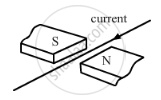
fron N to S
from S to N
vertically downwards
vertically upwards
Concept: undefined >> undefined
A horizontal wire carries a current as shown in Figure below between magnetic poles N and S:
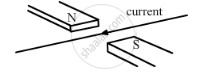
Is the direction of the force on the wire due to the magnet:
(a) in the direction the current
(b) vertically downwards
(c) opposite to the current direction
(d) vertically upwards
Concept: undefined >> undefined
In the simple electric motor of figure given below, the coil rotates anticlockwise as seen by the eye from the position X when current flows in the coil
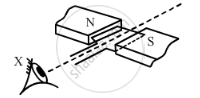
Is the current flowing clockwise or anticlockwise around the coil when viewed from above?
Concept: undefined >> undefined
If the current in a wire is flowing in the vertically downward direction and a magnetic field is applied from west to east, what is the direction of force in the wire?
Concept: undefined >> undefined
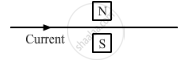
Which way does the wire in the diagram below tend to move?
Concept: undefined >> undefined
