मराठी

SSC (Marathi Semi-English) इयत्ता १० वी - Maharashtra State Board Important Questions for Science and Technology 2

Advertisements
[object Object]
[object Object]
विषय
मुख्य विषय
अध्याय
Advertisements
Advertisements
Science and Technology 2
< prev  81 to 100 of 411  next > 

Observe the picture and answer the following questions.
A) Which evidence of evolution is shown in the picture?
B) What can be proven with this proof?
C) Give one more example of evidence of evolution

Appears in 1 question paper
Chapter: [1] Heredity and Evolution
Concept: Evidence of Evolution > Morphological Evidences

Answer the following question.
Wisdom teeth : Vestigial organs :: Lungfish : ....................

Appears in 1 question paper
Chapter: [1] Heredity and Evolution
Concept: Evidence of Evolution > Morphological Evidences

a) Explain in brief - Lamarck’s principle of ‘use or disuse of organs’.
b) Give two examples.
c) What are ‘acquired characters’?

Appears in 1 question paper
Chapter: [1] Heredity and Evolution
Concept: Lamarck’s Theory of Evolution (Lamarckism)

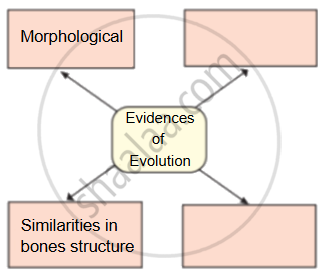
Complete the following chart:
Appears in 1 question paper
Chapter: [1] Heredity and Evolution
Concept: Evidence of Evolution > Morphological Evidences

What do you mean by vestigial structures? Name four vestigial organs found in man.

Appears in 1 question paper
Chapter: [1] Heredity and Evolution
Concept: Evidence of Evolution > Morphological Evidences

State Darwin’s theory of evolution.

Appears in 1 question paper
Chapter: [1] Heredity and Evolution
Concept: Darwin’s Theory of Natural Selection (Darwinism)

Explain the importance of Anatomical evidences with examples.

Appears in 1 question paper
Chapter: [1] Heredity and Evolution
Concept: Evidence of Evolution > Morphological Evidences

Which process is shown in the diagram given below?

Appears in 1 question paper
Chapter: [1] Heredity and Evolution
Concept: Protein Synthesis

Name the parts shown in the diagram.
Human jaw

Appears in 1 question paper
Chapter: [1] Heredity and Evolution
Concept: Evidence of Evolution > Morphological Evidences

Match the following.

Column A Column B
1) Morphological evidences a) Tail-bone or wisdom teeth
2) Paleontological evidences b) Leaf venation
  c) Fossils
Appears in 1 question paper
Chapter: [1] Heredity and Evolution
Concept: Evidence of Evolution > Morphological Evidences

Define.

Translation

Appears in 1 question paper
Chapter: [1] Heredity and Evolution
Concept: Protein Synthesis

Define Translocation.

Appears in 1 question paper
Chapter: [1] Heredity and Evolution
Concept: Protein Synthesis

Define mutation.

Appears in 1 question paper
Chapter: [1] Heredity and Evolution
Concept: Protein Synthesis

Give scientific reason.

Duck-billed platypus shows relationship with mammals.

Appears in 1 question paper
Chapter: [1] Heredity and Evolution
Concept: Evidence of Evolution > Morphological Evidences

Complete the flowchart.

Appears in 1 question paper
Chapter: [1] Heredity and Evolution
Concept: Evidence of Evolution > Morphological Evidences

Distinguish between the following.

Transcription and Translation

Appears in 1 question paper
Chapter: [1] Heredity and Evolution
Concept: Protein Synthesis

Write the answers to the questions by observing the figure below.

(a) (b) (c)
  1. Write the name of the animal ‘(a)’ in the figure.
  2. Write the name of the animal ‘(b)’ in the figure.
  3. Write the name of the animal ‘(c)’ in the figure.
  4. Which evolutionary evidence is illustrated by this figure?
  5. Write the definition of that evidence for evolution.
Appears in 1 question paper
Chapter: [1] Heredity and Evolution
Concept: Evidence of Evolution > Morphological Evidences

Complete the following diagram:

Appears in 1 question paper
Chapter: [1] Heredity and Evolution
Concept: Evidence of Evolution > Morphological Evidences

Complete the following chart:

Appears in 1 question paper
Chapter: [1] Heredity and Evolution
Concept: Evidence of Evolution > Morphological Evidences

Give a scientific reason.

Morphological evidences suggest that dog, sheep and wolf have a common origin.

Appears in 1 question paper
Chapter: [1] Heredity and Evolution
Concept: Evidence of Evolution > Morphological Evidences
< prev  81 to 100 of 411  next > 
Advertisements
Advertisements
Maharashtra State Board SSC (Marathi Semi-English) इयत्ता १० वी Important Questions
Important Questions for Maharashtra State Board SSC (Marathi Semi-English) इयत्ता १० वी Algebra
Important Questions for Maharashtra State Board SSC (Marathi Semi-English) इयत्ता १० वी English (Second/Third Language)
Important Questions for Maharashtra State Board SSC (Marathi Semi-English) इयत्ता १० वी Geography [भूगोल]
Important Questions for Maharashtra State Board SSC (Marathi Semi-English) इयत्ता १० वी Geometry Mathematics 2
Important Questions for Maharashtra State Board SSC (Marathi Semi-English) इयत्ता १० वी Hindi (Second/Third Language) [हिंदी (दूसरी/तीसरी भाषा)]
Important Questions for Maharashtra State Board SSC (Marathi Semi-English) इयत्ता १० वी Hindi - Composite [हिंदी - संयुक्त]
Important Questions for Maharashtra State Board SSC (Marathi Semi-English) इयत्ता १० वी History and Political Science [इतिहास व राज्यशास्त्र]
Important Questions for Maharashtra State Board SSC (Marathi Semi-English) इयत्ता १० वी Marathi [मराठी]
Important Questions for Maharashtra State Board SSC (Marathi Semi-English) इयत्ता १० वी Sanskrit (Second Language) [संस्कृत (द्वितीय भाषा)]
Important Questions for Maharashtra State Board SSC (Marathi Semi-English) इयत्ता १० वी Sanskrit - Composite [संस्कृत - संयुक्त (द्वितीय भाषा)]
Important Questions for Maharashtra State Board SSC (Marathi Semi-English) इयत्ता १० वी Science and Technology 1
Important Questions for Maharashtra State Board SSC (Marathi Semi-English) इयत्ता १० वी Science and Technology 2
Share
Notifications

Englishहिंदीमराठी


      Forgot password?
Use app×