Advertisements
Advertisements
A block and tackle system of pulleys has a velocity ratio of 4.
- Draw a labelled diagram of the system indicating clearly the points of application and directions of load and effort.
- What is the value of the mechanical advantage of the given pulley system if it is an ideal pulley system?
Concept: Pulley
Name a single pulley in which displacement of load and effort is not the same.
Concept: A Single Movable Pulley
A metre scale of weight 50 gf can be balanced at 40 cm mark without any weight suspended on it.
- If this ruler is cut at its centre then state which part [0 to 50 cm or 50 to 100 cm] of the ruler will weigh more than 25 gf.

- What minimum weight placed on this metre ruler can balance this ruler when it is pivoted at its centre?
Concept: Combination of Pulleys
Name the class of the lever shown in the picture below:
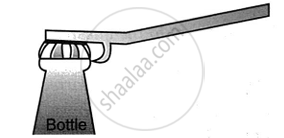
Concept: Levers >> Types of Levers
| Meera chose to use a block and tackle system of '9' pulleys instead of a single movable pulley to lift a heavy load. |
What is the advantage of using a block and tackle system over a single movable pulley?
Concept: A Single Movable Pulley
| Meera chose to use a block and tackle system of '9' pulleys instead of a single movable pulley to lift a heavy load. |
Why should she connect more number of pulleys in the upper fixed block?
Concept: Pulley

Two identical marbles A and B are rolled down along Path 1 and Path 2 respectively.
Path 1 is frictionless and Path 2 is rough.
- Which marble will surely reach the next peak?
- Along which path/s the mechanical energy will be conserved?
- Along which path/s is the law of conservation of energy obeyed?
Concept: Principle of a Machine
Copy and complete the labelled diagram connecting the two pulleys with a tackle to obtain Velocity Ratio= 2.

Concept: Combination of Pulleys
If Load = 48 kgf and efficiency is 80% then calculate:
- Mechanical Advantage.
- Effort needed to lift the load.

Concept: Combination of Pulleys
The adjacent diagram shows the movable block of a block and tackle system with effort in a convenient direction. From the diagram we can conclude that the number of pulleys used in the fixed block are ______.
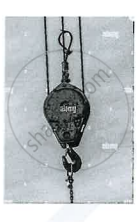
Concept: Combination of Pulleys
A ______ lever will always have M.A. > 1.
Concept: Levers >> Types of Levers
In a block and tackle system, increase in the weight of the movable block ______ the efficiency of the pulley system.
Concept: Combination of Pulleys
How is the refractive index of a material related to real and apparent depth?
Concept: Real and Apparent Depth
State the conditions required for total internal reflection of light to take place.
Concept: Total Internal Reflection
Draw a ray diagram to show the refraction of a monochromatic ray through a prism when it suffers minimum deviation.
Concept: Refraction of Light Through a Rectangular Glass Block
A ray of light travels from water to air as shown in the diagram given below :
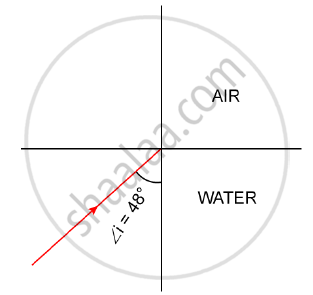
1) Copy the diagram and complete the path of the way. Given the critical angle for water is 48°.
2) State the condition so that internal reflection occurs in the above diagram.
Concept: Total Internal Reflection
The diagram below shows a point source P inside a water container. Four rays A, B, C, D starting from the source P, are shown up to the water surface.
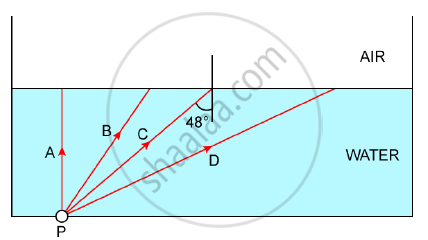
- Show in the diagram the path of these rays after striking the water surface. The Critical Angle for the water-air surface is 48°.
- Name the phenomenon which the rays B and D exhibit.
Concept: Total Internal Reflection
A boy uses the blue colour of light to find the refractive index of glass. He then repeats the experiment using the red colour of light. Will the refractive index be the same or different in the two cases? Give a reason to support your answer.
Concept: Refraction Laws & Glass Index
Copy the diagram given below and complete the path of the light ray till it emerges out of the prism. The critical angle of glass is 42°. In your diagram mark the angles wherever necessary.

Concept: Total Internal Reflection in a Prism
