Please select a subject first
Advertisements
Advertisements
What are tropic hormones?
Concept: Human Endocrine Glands and Harmones >> Pituitary Gland or Hypophysis Gland
Give one example of a Tropic hormone.
Concept: Human Endocrine Glands and Harmones >> Pituitary Gland or Hypophysis Gland
Expand the abbreviation ADH.
Concept: Human Endocrine Glands and Harmones >> Pituitary Gland or Hypophysis Gland
Write the exact location of the following gland:
Thyroid
Concept: Human Endocrine Glands and Harmones >> Thyroid Gland
Name the following:
The structure which connects the placenta and the foetus.
Concept: Placenta (Growth) in Human
The diagram given below represents a system in the human body. Study the diagram and answer the following questions:
- Identify the system.
- Label the parts marked 5 and 6.
- Name the two hormones secreted by 1.
- Mention the number and the name of the part involved in fertilization and implantation from the above diagram.
- Mention the surgical methods of contraception in:
- Human males.
- Human females.
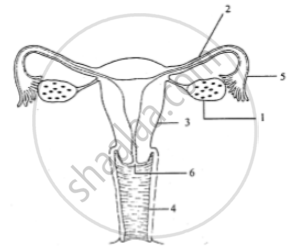
Concept: The Female Reproductive System
The onset of menstruation in a human female is called ______.
Concept: Menstrual Cycle (Ovarian Cycle)
Write any two objectives of Swachh Bharat Abhiyan.
Concept: Control of Pollution
Give one word or phrase for the following:
The amount of energy released when an atom in the gaseous state accepts an electron to form an anion.
Concept: Periodic Properties >> Electron Affinity
Identify the following:
The energy required to remove an electron from a neutral gaseous atom.
Concept: Periodic Properties >> Ionisation Potential (Ionisation Energy)
The electron affinity of an element X is greater than that of element Y.
- How is the oxidising power of X likely to compare with that of Y?
- How is the electronegativity of X likely to compare with that of Y?
- State whether X is likely to be placed to the left or to the right of Y in the periodic table?
Concept: Periodic Properties >> Electron Affinity
The electron affinity of an element X is greater than that of element Y.
How is the electronegativity of X likely to compare with that of Y?
Concept: Periodic Properties >> Electron Affinity
The electron affinity of an element X is greater than that of element Y.
State whether X is likely to be placed to the left or to the right of Y in the periodic table.
Concept: Periodic Properties >> Electron Affinity
Give a reason for Inert gases do not form ions.
Concept: Coordinate Bond
Give the appropriate term defined by the statement given below:
The covalent bond in which the electrons are shared equally between the combining atoms.
Concept: The Covalent Bond
Identify the following:
A bond formed between two atoms by sharing of a pair of electrons, with both electrons being provided by the same atom.
Concept: Coordinate Bond
The salt prepared by the method of direct combination is _______.
Concept: Salts
Identify the following:
A salt formed by the complete neutralization of an acid by a base.
Concept: Classification of Salts
You are provided with the list of chemicals mentioned below in the box:
| Sodium hydroxide solution, copper carbonate, zinc, hydrochloric acid, copper, dilute sulphuric acid, chlorine, iron |
Using suitable chemicals from the list given, write a balanced chemical equation for the preparation of the salt mentioned below:
Copper sulphate
Concept: Salts
You are provided with the list of chemicals mentioned below in the box:
| Sodium hydroxide solution, copper carbonate, zinc, hydrochloric acid, copper, dilute sulphuric acid, chlorine, iron |
Using suitable chemicals from the list given, write a balanced chemical equation for the preparation of the salt mentioned below:
Sodium zincate
Concept: Salts
