Advertisements
Advertisements
|
The diagram given below represents the location and structure of an endocrine gland. Study the same and answer the questions that follow:
|
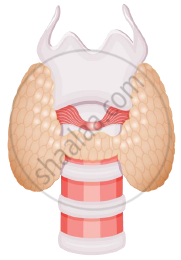
- Name the endocrine gland shown in the diagram.
- Name the secretion of the gland which regulates basal metabolism.
- Name the mineral element required for the synthesis of the above mentioned hormone.
- Name the disease caused due to undersecretion of the above mentioned hormone in children.
- Name the disease caused due to hypersecretion of the above mentioned hormone.
Concept: Human Endocrine Glands and Hormones >> Adrenal Gland (Suprarenal Gland)
Gigantism and Acromegaly are due to :
A. Hyposecretion of Thyroxine
B. Hyposecretion of Growth hormone
C. Hypersecretion of Thyroxine
D. Hypersecretion of Growth hormone
Concept: Human Endocrine Glands and Hormones >> Adrenal Gland (Suprarenal Gland)
Given below is the outline of the human body showing the important glands:

- Name the glands marked 1 to 4.
- Name the hormone secreted by part 2. Give one important function of this hormone.
- Name the endocrine part of the numbered 3.
- Why is the part labelled 1 called the master gland? Which part of the forebrain controls the gland labelled 1?
- Name the gland that secretes the ‘emergency hormone’.
Concept: Human Endocrine Glands and Hormones >> Adrenal Gland (Suprarenal Gland)
Briefly explain the following terms: Hormone
Concept: Human Endocrine Glands and Hormones >> Adrenal Gland (Suprarenal Gland)
Rewrite the correct form of the statement : Alpha cells of pancreas secrete Insulin.
Concept: Human Endocrine Glands and Hormones >> Adrenal Gland (Suprarenal Gland)
Rewrite the correct form of the statement: Cretinism is caused due to deficiency of Adrenaline.
Concept: Human Endocrine Glands and Hormones >> Adrenal Gland (Suprarenal Gland)
fill in the blanks with suitable functions: Thyroid gland and _________
Concept: Human Endocrine Glands and Hormones >> Adrenal Gland (Suprarenal Gland)
The hormone secreted by islets of langerhans.
Concept: Human Endocrine Glands and Hormones >> Adrenal Gland (Suprarenal Gland)
Identify the odd one in each set : Oxytocin, Insulin, Prolactin, Progesterone
Concept: Human Endocrine Glands and Hormones >> Adrenal Gland (Suprarenal Gland)
Cretinism and Myxoedema are due to
A. Hypersecretion of thyroxin
B. Hypersecretion of growth hormone
C. Hyposecretion of thyroxin
D. Hyposecretion of growth hormone
Concept: Human Endocrine Glands and Hormones >> Adrenal Gland (Suprarenal Gland)
Explain Hormones.
Concept: Human Endocrine Glands and Hormones >> Adrenal Gland (Suprarenal Gland)
Give technical terms for the A method of contraception in which the sperm duct is cut and ligated
Concept: Human Endocrine Glands and Hormones >> Adrenal Gland (Suprarenal Gland)
Give technical terms for Group of hormones which influence other endocrine glands to produce hormones
Concept: Human Endocrine Glands and Hormones >> Adrenal Gland (Suprarenal Gland)
Match the items given in Column A with the most appropriate ones in Column B and rewrite the correct matching pairs
| Column A | Column B | ||
| 1 | Cretinism | a | Hypersecretion of the adrenal cortex |
| 2 | Diabetes insipidus | b | Hyposecretion of Thyroxine |
| 3 | Exophthalmic Goitre | c | Hyposecretion of growth hormone |
| 4 | Adrenal virilism | d | Hyposecretion of Vasopressin |
| 5 | Dwarfism | e | Hyposecretion of the adrenal cortex |
| f | Hypersecretion of Growth hormone | ||
| g | Hypersecretion of thyroxine |
Concept: Human Endocrine Glands and Hormones >> Adrenal Gland (Suprarenal Gland)
Differentiate between the following pairs on the basis of what is indicated in the brackets.
Testosterone and Oestrogen (Organ which secretes)
Concept: Human Endocrine Glands and Hormones >> Adrenal Gland (Suprarenal Gland)
Identify the ODD term in each set and name the CATEGORY to which the remaining three belong :
Example : glucose, starch, cellulose, calcium
Odd term : calcium
Category : others are different types of carbohydrates
Addison’s disease, Cushing’s Syndrome, Acromegaly, Leukemia
Concept: Human Endocrine System
Identify the ODD term in each set and name the CATEGORY to which the remaining three belong :
Example : glucose, starch, cellulose, calcium
Odd term : calcium Category : others are different types of carbohydrates
Insulin, Adrenaline, Pepsin, Thyroxine
Concept: Human Endocrine System
The diagram given below represents an organ system in the human body. Study the same and answer the questions that follow :
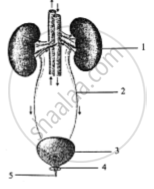
Draw a neat, labelled diagram showing the longitudinal section of part 1.
Concept: Human Endocrine Glands and Hormones >> Pituitary Gland or Hypophysis Gland
The diagram given below represents an endocrine gland in the human body. Study the diagram and answer the following questions:
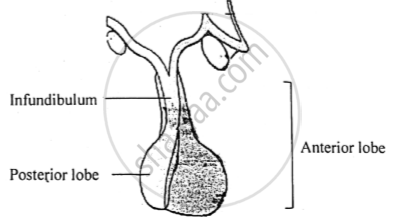
- Identify the endocrine gland. Where is it located?
- Why is the above gland referred to as the ‘Master gland’?
- Name the hormone which in deficiency causes Diabetes Insipidus. How does this disorder differ from Diabetes Mellitus?
- Explain the term ‘Hormone’. What is the role of Tropic hormones in the human body?
- Which lobe of the above gland secretes:
- Oxytocin
- ACTH
- Growth hormone
Concept: Human Endocrine Glands and Hormones >> Pituitary Gland or Hypophysis Gland
Concept: Human Endocrine Glands and Hormones >> Adrenal Gland (Suprarenal Gland)
