Advertisements
Advertisements
प्रश्न
The diagram given below represents an endocrine gland in the human body. Study the diagram and answer the following questions:
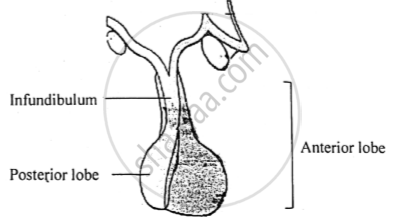
- Identify the endocrine gland. Where is it located?
- Why is the above gland referred to as the ‘Master gland’?
- Name the hormone which in deficiency causes Diabetes Insipidus. How does this disorder differ from Diabetes Mellitus?
- Explain the term ‘Hormone’. What is the role of Tropic hormones in the human body?
- Which lobe of the above gland secretes:
- Oxytocin
- ACTH
- Growth hormone
Advertisements
उत्तर
(i) The endocrine gland represented is the pituitary gland. It is located at the base of the brain, attached to the hypothalamus.
(ii) The pituitary gland is referred to as the ‘Master gland’ because it secretes hormones that regulate and control the activity of other endocrine glands in the body.
(iii) Diabetes Insipidus is caused by the deficiency (hyposecretion) of the Antidiuretic Hormone (ADH), also known as vasopressin. This is secreted by the posterior pituitary.
Diabetes Insipidus differs from Diabetes Mellitus because Diabetes Mellitus is caused by a deficiency of insulin produced by the pancreas, whereas Diabetes Insipidus results from the inability of the kidneys to retain water due to a lack of ADH.
(iv) A hormone is a chemical substance secreted by an endocrine gland directly into the bloodstream that acts as a chemical messenger to regulate various physiological and metabolic activities.
The role of tropic hormones is hormones secreted by the pituitary gland that specifically stimulate and control the activity of other endocrine glands.
(v)
- Oxytocin: Secreted by the posterior lobe of the pituitary gland.
- ACTH (Adrenocorticotropic hormone): Secreted by the anterior lobe of the pituitary gland.
- Growth hormone: Secreted by the anterior lobe of the pituitary gland.
APPEARS IN
संबंधित प्रश्न
Mention which of the statements are true (T) and which are false (F). Give reason in support of your answer.
Gigantism and dwarfirm in humans basically depend on the qualtity and quantity of the food eaten during early growing age.
Name the following:
Growth hormone.
Name the Following: The master gland of the body, because it controls the activity of other endocrine gland also.
Mention, if the following statement is True or False. If false rewrite the wrong statement in its correct form:
The alpha cells of the pancreas secrete insulin.
Describe any four hormones secreted by Adenohypophysis.
The pituitary gland is divided into four lobes.
Match the following.
| Column I | Column II | ||
| i. | Insulin | p. | Addison's disease |
| ii. | Thyroxine | q. | Diabetes mellitus |
| iii. | Mineralocorticoids and Glucocorticoids | r. | Acromegaly |
| iv. | Growth Hormone | s. | Goitre |
Which endocrine gland is also known as ‘master gland’?
Spermatogenesis is induced by ______.
Mention the name of disease based on the clue/symptom given below:
Excessive growth of bones in the face, hands and feet.
