CBSE Science (English Medium) इयत्ता १२ Important Questions for Physics - Atoms
Advertisements
Advertisements
Chapter wise important questions with answers and solutions for Physics in CBSE Science (English Medium) इयत्ता १२.
A hydrogen atom initially in the ground level absorbs a photon, which excites it to the n = 4 level. Determine the wavelength and frequency of the photon.
पाठ: [12] Atoms
State Bohr's postulate to define stable orbits in the hydrogen atom. How does de Broglie's hypothesis explain the stability of these orbits?
पाठ: [12] Atoms
Write two important limitations of Rutherford's nuclear model of the atom.
पाठ: [12] Atoms
How does one explain, using de Broglie hypothesis, Bohr's second postulate of quantization of orbital angular momentum?
पाठ: [12] Atoms
Show that the radius of the orbit in hydrogen atom varies as n2, where n is the principal quantum number of the atom.
पाठ: [12] Atoms
Using Rutherford's model of the atom, derive the expression for the total energy of the electron in hydrogen atom. What is the significance of total negative energy possessed by the electron?
पाठ: [12] Atoms
Using Bohr's postulates of the atomic model, derive the expression for radius of nth electron orbit. Hence obtain the expression for Bohr's radius.
पाठ: [12] Atoms
Suppose you are given a chance to repeat the alpha-particle scattering experiment using a thin sheet of solid hydrogen in place of the gold foil. (Hydrogen is a solid at temperatures below 14 K.) What results do you expect?
पाठ: [12] Atoms
Define the distance of closest approach. An α-particle of kinetic energy 'K' is bombarded on a thin gold foil. The distance of the closest approach is 'r'. What will be the distance of closest approach for an α-particle of double the kinetic energy?
पाठ: [12] Atoms
Using Bohr’s postulates, derive the expression for the frequency of radiation emitted when electron in hydrogen atom undergoes transition from higher energy state (quantum number ni) to the lower state, (nf).
When electron in hydrogen atom jumps from energy state ni = 4 to nf = 3, 2, 1, identify the spectral series to which the emission lines belong.
पाठ: [12] Atoms
Using Bohr’s second postulate of quantization of orbital angular momentum show that the circumference of the electron in the nth orbital state in hydrogen atom is n times the de Broglie wavelength associated with it.
पाठ: [12] Atoms
The electron in hydrogen atom is initially in the third excited state. What is the maximum number of spectral lines which can be emitted when it finally moves to the ground state?
पाठ: [12] Atoms
What is meant by ionisation energy?
पाठ: [12] Atoms
The diagram shows the four energy levels of an electron in the Bohr model of the hydrogen atom. Identify the transition in which the emitted photon will have the highest energy.

पाठ: [12] Atoms
The radius of the nth orbit in the Bohr model of hydrogen is proportional to ______.
पाठ: [12] Atoms
(i) State Bohr's quantization condition for defining stationary orbits. How does the de Broglie hypothesis explain the stationary orbits?
(ii) Find the relation between three wavelengths λ1, λ2 and λ3 from the energy-level diagram shown below.
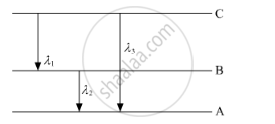
पाठ: [12] Atoms
In both β− and β+ decay processes, the mass number of a nucleus remains the same, whereas the atomic number Z increases by one in β− decay and decreases by one in β+ decay. Explain giving reason.
पाठ: [12] Atoms
Using Bohr's postulates, derive the expression for the total energy of the electron in the stationary states of the hydrogen atom ?
पाठ: [12] Atoms
Using Bohr’s postulates for hydrogen atom, show that the total energy (E) of the electron in the stationary states tan be expressed as the sum of kinetic energy (K) and potential energy (U), where K = −2U. Hence deduce the expression for the total energy in the nth energy level of hydrogen atom.
पाठ: [12] Atoms
Obtain Bohr’s quantisation condition for angular momentum of electron orbiting in nth orbit in hydrogen atom on the basis of the wave picture of an electron using de Broglie hypothesis.
