Please select a subject first
Advertisements
Advertisements
Assertion (A): The real challenge to Indira Gandhi came not from the opposition but from within her own party.
Reason (R): She had to deal with the ‘Syndicate’, a group of powerful and influential leaders from within Congress.
Concept: Split in the Congress
Arrange the following in chronological order -
- Second General Elections.
- V.V. Giri was elected as the President of India.
- Fourth General Elections.
- Congress(R)-CPI alliance won many seats in General Elections.
Concept: Fourth General Elections, 1967
Evaluate any three outcomes of the Lok Sabha elections of 1971.
Concept: The 1971 Election and Restoration of Congress
Why were the fifth General Elections held one year earlier in 1971 instead of 1972? Explain any two reasons.
Concept: The 1971 Election and Restoration of Congress
Name the political party which came to power at the Centre in 1977.
Concept: 1977 Elections and the Formation of Janata Party
Evaluate the consequences of declaration of emergency in 1975.
Concept: Emergency - Context, Constitutional and Extra-constitutional Dimensions, Resistance to Emergency
Examine any six reasons for the imposition of emergency in India in 1975.
Concept: Emergency - Context, Constitutional and Extra-constitutional Dimensions, Resistance to Emergency
Why is emergency considered to be one of the most controversial episodes in Indian politics? Analyse any three reasons.
Concept: Emergency - Context, Constitutional and Extra-constitutional Dimensions, Resistance to Emergency
Describe the story of Goa's liberation from the Portuguese to its becoming a state of the Indian Union.
Concept: Rise of Civil Liberties Organisations
How far do you agree that the proclamation of emergency weakened the federal distribution of power in India?
Concept: Emergency - Context, Constitutional and Extra-constitutional Dimensions, Resistance to Emergency
Explain the circumstances that led to the mid-term elections in 1980.
Concept: 1977 Elections and the Formation of Janata Party
What is meant by defection?
Concept: Emergency - Context, Constitutional and Extra-constitutional Dimensions, Resistance to Emergency
Name the original states from which the following states were carved out:-
i. Meghalaya
ii. Gujarat
Concept: Navnirman Movement in Gujarat and the Bihar Movement
Describe any three weaknesses and any three points of strength of India's democracy that came to light during the Emergency of 1975.
Concept: Emergency - Context, Constitutional and Extra-constitutional Dimensions, Resistance to Emergency
What were the major conflicts between the Parliament and the Judiciary during the leadership of Indira Gandhi?
Concept: Emergency - Context, Constitutional and Extra-constitutional Dimensions, Resistance to Emergency
Find the odd one out in the context of the proclamation of Emergency.
Concept: Background to Emergency
Name the judge of the Allahabad High Court who declared Mrs. Indira Gandhi’s election invalid ______
Concept: Declaration of Emergency
Analyze two reasons for the imposition of a national emergency in India on June 25, 1975.
Concept: Declaration of Emergency
State any two reasons for imposing an emergency by the Government in 1975.
Concept: Declaration of Emergency
Study the given cartoon and answer the questions that follow:
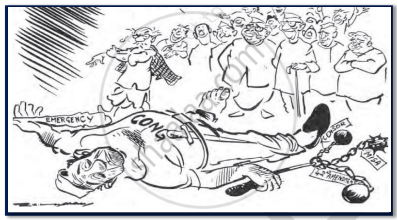
- Identify any two leaders shown in the cartoon who had won the 1977 elections.
- Explain the term MISA.
- Why was the Congress voted out of power?
Concept: Declaration of Emergency
