Advertisements
Advertisements
A line intersects the y-axis and x-axis at the points P and Q respectively. If (2, –5) is the mid-point of PQ, then find the coordinates of P and Q.
Concept: Co-ordinate Geometry
If the distances of P(x, y) from A(5, 1) and B(–1, 5) are equal, then prove that 3x = 2y
Concept: Distance Formula
If the points A(k + 1, 2k), B(3k, 2k + 3) and C(5k − 1, 5k) are collinear, then find the value of k
Concept: Co-ordinate Geometry
Find the distance of a point P(x, y) from the origin.
Concept: Distance Formula
If A(–2, 1), B(a, 0), C(4, b) and D(1, 2) are the vertices of a parallelogram ABCD, find the values of a and b. Hence find the lengths of its sides
Concept: Co-ordinate Geometry
The distance of the point (–1, 7) from x-axis is ______.
Concept: Co-ordinate Geometry
Read the following passage:
|
Use of mobile screen for long hours makes your eye sight weak and give you headaches. Children who are addicted to play "PUBG" can get easily stressed out. To raise social awareness about ill effects of playing PUBG, a school decided to start 'BAN PUBG' campaign, in which students are asked to prepare campaign board in the shape of a rectangle: One such campaign board made by class X student of the school is shown in the figure.
|
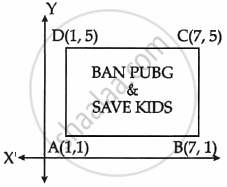
Based on the above information, answer the following questions:
- Find the coordinates of the point of intersection of diagonals AC and BD.
- Find the length of the diagonal AC.
-
- Find the area of the campaign Board ABCD.
OR - Find the ratio of the length of side AB to the length of the diagonal AC.
- Find the area of the campaign Board ABCD.
Concept: Distance Formula
If 4 tan θ = 3, evaluate `((4sin theta - cos theta + 1)/(4sin theta + cos theta - 1))`
Concept: Trigonometric Ratios
Prove the following trigonometric identities.
sec A (1 − sin A) (sec A + tan A) = 1
Concept: Trigonometric Identities (Square Relations)
If cos A = `4/5`, then the value of tan A is ______.
Concept: Trigonometric Ratios
Proved that `(1 + secA)/secA = (sin^2A)/(1 - cos A)`.
Concept: Trigonometric Identities (Square Relations)
sec θ when expressed in term of cot θ, is equal to ______.
Concept: Trigonometric Identities (Square Relations)
Prove that `(cot A - cos A)/(cot A + cos A) = (cos^2 A)/(1 + sin A)^2`
Concept: Trigonometric Identities (Square Relations)
Prove that (sec θ + tan θ) (1 – sin θ) = cos θ
Concept: Trigonometric Identities (Square Relations)
Due to sudden floods, some welfare associations jointly requested the government to get 100 tents fixed immediately and offered to contribute 50% of the cost. If the lower part of each tent is of the form of a cylinder of diameter 4.2 m and height 4 m with the conical upper part of same diameter but of height 2.8 m, and the canvas to be used costs Rs. 100 per sq. m, find the amount, the associations will have to pay. What values are shown by these associations? [Use π=22/7]
Concept: Surface Area of a Combination of Solids
A hemispherical bowl of internal diameter 36 cm contains liquid. This liquid is filled into 72 cylindrical bottles of diameter 6 cm. Find the height of each bottle, if 10% liquid is wasted in this transfer.
Concept: Surface Area of a Combination of Solids
A cubical block of side 10 cm is surmounted by a hemisphere. What is the largest diameter that the hemisphere can have? Find the cost of painting the total surface area of the solid so formed, at the rate of Rs. 5 per 100 sq. cm. [Use π = 3.14]
Concept: Surface Area of a Combination of Solids
504 cones, each of diameter 3.5 cm and height 3 cm, are melted and recast into a metallic sphere. Find the diameter of the sphere and hence find its surface area.
[Use π=22/7]
Concept: Surface Area of a Combination of Solids
In Fig. 5, is a decorative block, made up two solids – a cube and a hemisphere. The base of the block is a cube of side 6 cm and the hemisphere fixed on the top has diameter of 3.5 cm. Find the total surface area of the bock `(Use pi=22/7)`
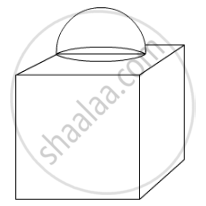
Concept: Surface Area of a Combination of Solids
The number of solid spheres, each of diameter 6 cm that can be made by melting a solid metal cylinder of height 45 cm and diameter 4 cm, is:
Concept: Surface Area of a Combination of Solids
