Wavefront is defined as the locus of all the points in space that reach a particular distance by a propagating wave at the same instant.
A wave front is defined as a surface of constant phase.
Definition: Wave Optics
The branch of optics that considers light as a wave which can bend around objects, diffract and interfere, etc. is called wave optics.
Definition: Electromagnetic Wave (Maxwell)
Coupled time-varying electric and magnetic fields that propagate in space are called electromagnetic waves.
Definition: Polarisation
The phenomenon that is based on the fact that light waves are transverse electromagnetic waves is called polarisation.
Definition: Ray Optics
The branch of optics that is based on rectilinear propagation of light and deals with mirrors, lenses, reflection, refraction, etc. is called ray optics.
Definition: Spherical Wave
If a point source emits waves uniformly in all directions, the locus of points which have the same amplitude and vibrate in the same phase is a sphere. This is known as a spherical wave.
Definition: Plane Wave
At a large distance from the source, a small portion of the spherical wave can be considered as a plane. This is known as a plane wave.
Definition: Wavefront
A wavefront is a surface of constant phase.
Definition: Plane of Vibration
The plane of vibration is the plane in which the electric field vector \[\vec{E}\] vibrates or oscillates.
Definition: Polaroid
A Polaroid is a thin film of ultramicroscopic crystals used to produce plane-polarised light.
Definition: Unpolarised Wave
An unpolarised wave is one in which the plane of vibration changes randomly in very short time intervals.
Definition: Plane of Polarisation
The plane of polarisation is the plane in which vibrations are present — it is perpendicular to the plane of vibration and contains the direction of propagation.
Definition: Polarisation of Light
Polarisation is the phenomenon of restricting the vibration of a light wave to a particular plane perpendicular to the direction of propagation of the wave, or confining the electric vector vibrations to one direction perpendicular to the direction of propagation.
Definition: Transverse Wave
A transverse wave is one in which the displacement of particles is perpendicular to the direction of propagation of the wave.
Definition: Linearly Polarised Wave (Plane Polarised Wave)
A wave in which the electric field vectors are confined in one plane and are parallel to a unique direction is called a linearly polarised wave or plane polarised wave.
Definition: Interference of Light
The phenomenon of redistribution of energy on account of superposition of light waves from two coherent sources is called interference of light.
Definition: Wave Interference
The phenomenon that occurs when two waves meet while travelling along the same medium is called wave interference.
Definition: Constructive Interference
The points of maximum intensity in the regions of superposition of waves are said to be in constructive interference.
Definition: Destructive Interference
The points of minimum intensity in the regions of superposition of waves are said to be in destructive interference.
Definition: Diffraction
Diffraction is the phenomenon of bending of light (or any wave) around the corners or edges of an obstacle or aperture, causing it to spread into the geometrical shadow region and produce alternate dark and bright regions.
Definition: Resolving Power of an Optical Instrument
The ability of an optical instrument to produce distinctly separate images of two objects very close to each other is called the resolving power of the instrument.
Definition: Limit of Resolution
The minimum distance of separation between two objects when they can be observed as separate by an optical instrument is called the limit of resolution of that instrument.
Definition: Resolving Power (Mathematical)
The reciprocal of the limit of resolution is called its resolving power.
Definition: Resolving Power of Telescope
The reciprocal of the least angular separation between the objects that are just resolved is called the resolving power of the telescope.
Definition: Numerical Aperture (N.A.)
The quantity μ sin θ, where μμ is the refractive index of the medium between the object and the objective, is called the numerical aperture (N.A.) of the objective of the microscope.
Definition: Polarizer
A material that allows only those light waves to pass whose electric field is along a particular direction (polarizing axis).
Defintiion: Diffraction of Light
Diffraction of light is the phenomenon in which light spreads into the geometrical shadow region when it passes around the edges of an obstacle or through a narrow aperture whose size is comparable to its wavelength.
Definition: Principle of Superposition
When two or more waves travel simultaneously in a medium, the resultant displacement at each point of the medium at any instant is equal to the vector sum of the displacements produced by the two waves separately. This principle is called 'principle of superposition'.
Definition: Zero-Order Fringe
“The central white fringe formed when the path difference is zero for all wavelengths is called the zero-order fringe.”
Definition: Plane of Polarisation
The plane containing the direction of propagation of light and perpendicular to the plane of vibration is called the ‘plane of polarisation’.
Definition: Transverse Wave
A wave in which the vibrations of the particles of the medium are perpendicular to the direction of propagation.
Definition: Longitudinal Wave
A wave in which the vibrations of the particles of the medium are parallel to the direction of propagation.
Definition: Polarisation of Light
The phenomenon in which the vibrations of the electric field vector of light are restricted to a single direction in a plane perpendicular to the direction of propagation.
Definition: Fraunhofer Diffraction
Diffraction observed when the source and screen are at large distances from the diffracting element, so that the incident wavefront is plane.
Definition: Ray of Light
- The path along which light travels is called a ray of light.
- A ray is defined as the path of energy propagation in the limit of wavelength tending to zero.
Definition: Ray Optics or Geometrical Optics
- The study of optical phenomena under the assumption that it travels in a straight line as a ray is called ray optics or geometrical optics, as geometry is used in this study.
- The branch of optics in which one completely neglects the finiteness of the wavelength is called geometrical optics.
Definition: Polariser
The first crystal which polarises the light wave is called ‘polariser'.
Definition: Analyser
The second crystal which examines the nature of the light emerging from the first crystal, whether it is polarised or not, is called the ‘analyser'.
Definition: Unpolarised Light
Unpolarised light is light in which the vibrations of the electric field vector occur in all possible directions in a plane perpendicular to the direction of propagation.
Definition: Plane Polarised Light
In plane polarised light, the vibrations of the electric vector E occur in a plane perpendicular to the direction of propagation of light, and are confined to a single direction in the plane (do not occur symmetrically in all possible directions).
Definition: Plane of Vibration
The plane containing the direction of vibration of the electric vector and the direction of propagation of light is called the 'plane of vibration'.
Definition: Wavefront
If we draw a surface in a medium such that all the medium particles lying in the surface are in the same phase of oscillation, then the surface is called a 'wavefront'.
Definition: Interference of Light
The redistribution of light intensity due to the superposition of two light waves is called 'interference of light'.
Definition: Incoherent Sources
“If the phase difference between two light waves arriving at a point varies with time in a random way, the wave-sources are said to be incoherent.”
Definition: Coherent Sources
“Two sources are said to be coherent, if they emit light waves having a sharply defined phase difference that remains constant with time.”
Definition: Optical Path
The optical path travelled by a light ray is the product of the refractive index of the medium and the actual distance travelled by light in that medium.
Definition: Diffraction of Light
The bending of light round the corners of the obstacles, or apertures, is called 'diffraction’.
Definition: Diffraction Pattern
“The intensity distribution upon the screen is called the ‘diffraction pattern’ of the aperture.”
Definition: Polaroid
Polaroid is a cheap commercial device for producing and detecting plane-polarised light.
Definition: Plane of Polarization
The plane perpendicular to the plane of the vibration and the electric field vector is called plane of polarization.
Definition: Plane of Vibration
The plane containing the electric field vectors of plane polarized light is called the plane of vibration.
Definition: Fresnel Diffraction
Diffraction observed when the source or screen (or both) are at finite distances from the obstacle, and the incident wavefront is spherical or cylindrical.
Definition: Interference
Interference is the phenomenon in which the intensity of light (or any wave) at a point becomes non-uniform due to the superposition of two or more coherent waves, resulting in regions of constructive and destructive interference.
Definition: Limit of Resolution
The minimum visual angle between two objects that can be just resolved by an instrument is called the limit of resolution.
Definition: Resolving Power of Telescope
The resolving power of a telescope is then defined as the reciprocal of the least angular separation between the objects that are just resolved.
Definition: Resolving Power
The ability of an optical instrument to distinguish two closely spaced objects as separate and distinct is called its resolving power.
Definition: Polarization by Scattering
Polarisation by scattering is the phenomenon in which unpolarized light becomes partially or completely plane polarised when it is scattered by small particles such as air molecules or dust particles.
Definition: Wave Optics
The branch of optics which uses the wave nature of light to explain the optical phenomena is called wave optics.
Definition: Unpolarized Light
Light in which the electric field vectors vibrate in all possible directions perpendicular to the direction of propagation.
Definition: Plane Polarized Light
Light in which the electric field vectors vibrate only in one particular direction perpendicular to the direction of propagation.
Formula: Resultant Amplitude
When two waves of amplitudes a1 and a2 interfere at a point where phase difference is ϕ, the resultant amplitude is:
\[A^2=a_1^2+a_2^2+2a_1a_2\cos\phi\]
Formula: Resultant Intensity
I = I1 + I2 + 2\[\sqrt {I_1I_2}\] ⋅ cos ϕ
When I1 = I2 = I0:
I = \[2I_0(1+\cos\phi)=4I_0\cos^2\left(\frac{\phi}{2}\right)\]
Formula: Ratio of Maximum to Minimum Intensity
\[\frac{I_{\max}}{I_{\min}}=\left(\frac{a_1+a_2}{a_1-a_2}\right)^2=\left(\frac{\sqrt{I_1}+\sqrt{I_2}}{\sqrt{I_1}-\sqrt{I_2}}\right)^2\]
Formula: Resolving Power
R.P. = \[\frac {1}{\text {Limit of resolution}}\]
Formula: Resolving Power of Microscope
R.P. = \[\frac {1}{d}\] = \[\frac{2\mu\sin\theta}{\lambda}\]
where μ sin θ is the Numerical Aperture (N.A.) of the objective.
Formula: Resolving Power of Telescope
R.P. = \[\frac{1}{d\theta}=\frac{D}{1.22\lambda}\]
Formula: Variation of Wavelength in Media
λw = \[\frac {λ}{n}\]
Formula: Optical Path
\[t=\frac{D}{v}=\frac{D}{c/n}=\frac{nD}{c}\]
OR
d = n D.
Formula: Subsidiary Maxima
e sin θ = \[\frac{(2m+1)\lambda}{2}\]
Formula: Fraunhofer Diffraction at a Single Slit
\[a\sin\theta=\pm\left(n+\frac{1}{2}\right)\lambda\]
Formula: Width of the Central Bright Fringe
\[W_{c}=2y_{1d}=2W=2\left(\frac{\lambda D}{a}\right)\]
Formula: Average Intensity of Interference Pattern
Iav = \[\frac{I_{\max}+I_{\min}}{2}\] = K(a12 + a22)
Formula: Single Slit Diffraction
e sin θ = ±mλ (m=1,2,3,…)
Law: Malus' Law
Statement
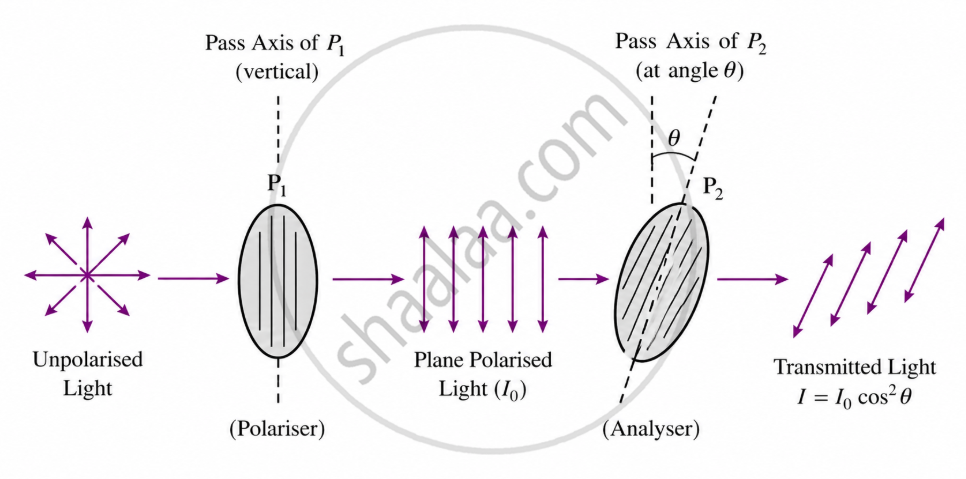
When a beam of plane polarised light is incident on an analyser, the intensity of the transmitted light is directly proportional to the square of the cosine of the angle θ between the pass-axis of the analyser and the plane of polarisation of the incident light.
I = I0 cos2θ
Where:
- I0 = intensity of plane-polarised light incident on the analyser
- I = intensity of the transmitted light
- θ = angle between the pass axes of the polariser and analyser
Derivation
Step 1: Set up
- Let plane-polarised light with amplitude a and intensity I0 be incident on analyser P2. The pass-axis of P2 makes an angle θ with the pass-axis of P1.
Step 2: Resolve the amplitude
The electric field amplitude aaa is resolved into two rectangular components relative to P2's pass-axis:
- Component parallel to P2's pass-axis: a cos θ → transmitted
- Component perpendicular to P2's pass-axis: a sin θ → absorbed/blocked
Step 3: Calculate transmitted intensity
Since only the parallel component passes through, and intensity ∝ (amplitude)2:
- I ∝ (a cos θ)2 = a2 cos2 θ
Step 4: Substitute I0
Since I0 ∝ a2 (the maximum intensity when θ = 0°):
Law: Young's Double Slit Experiment
Thomas Young first demonstrated the phenomenon of interference of light with the help of a slit, using a monochromatic source and two slits S1 and S2, producing alternating bright fringes (constructive interference) and dark fringes (destructive interference) on a screen.
Law: Brewster’s Law
Statement
When unpolarised light is incident on the surface of a transparent medium at a particular angle, the reflected light becomes completely plane-polarised.
This angle of incidence is called the polarising angle or Brewster’s angle (ip).
According to Brewster’s Law, the refractive index n of the medium is related to the polarising angle by:
n = tan ip
Explanation / Proof
Consider unpolarised light incident on the surface of a transparent medium (e.g., air–glass interface) at the polarising angle ip.
Let:
- ip = angle of incidence (polarising angle)
- r = angle of refraction
- n = refractive index of the second medium w.r.t. the first
From Snell’s law:
n = \[\frac {sin i_p}{sin r}\]
From Brewster’s law:
n = tan ip = \[\frac {sin i_p}{cos i_p}\]
Equating the two expressions for n:
\[\frac{\sin i_p}{\sin r}=\frac{\sin i_p}{\cos i_p}\]
⇒ sin r = cos ip
⇒ sin r = sin(90∘ − ip)
⇒ r = 90∘ − ip
Hence,
ip + r = 90∘
Therefore, the reflected ray and refracted ray are mutually perpendicular.
Conclusion
- Brewster’s law establishes a direct relation between refractive index and polarising angle:
n = tan ip
- At the polarising angle:
Reflected light is completely plane-polarised
Reflected and refracted rays are perpendicular to each other
- This law explains the polarisation of light by reflection and is a strong confirmation of the transverse nature of light waves
Law: Law of Malus
Statement
The intensity of plane-polarised light transmitted through an analyser is directly proportional to the square of the cosine of the angle between the transmission axes of the polariser and the analyser.
I = I0 cos2θ
Explanation / Proof
- Let a beam of completely plane-polarised light of amplitude aaa fall on an analyser.
- Let θ be the angle between the transmission axes of the polariser and analyser.
- The amplitude of light along the analyser’s axis is a cos θ.
- Since intensity ∝ (amplitude)2,
I = K(a cos θ)2 = K a2 cos2 θ
- If I0 = Ka2 is the incident intensity, then:
I = I0 cos2 θ
Conclusion
Thus, the transmitted intensity depends on the relative orientation of the polariser and analyser and follows the relation
I = I0 cos2 θ
This relation is known as the Law of Malus.
Law: Brewster’s Law
Statement
When unpolarized light is incident on a transparent surface at a particular angle (called Brewster’s angle), the reflected light is completely plane polarised.
At this angle, the reflected and refracted rays are perpendicular to each other.
tanθB = \[\frac {n_2}{n_1}\]
where
θB = Brewster’s angle
n1, n2 = refractive indices of the two media
Proof
At Brewster’s angle,
θB + r = 90∘
From Snell’s law:
n1 sin θB = n2 sin r
Since r = 90∘ − θB,
n1 sinθB = n2 cosθB
tan θB = \[\frac {n_2}{n_1}\]
Conclusion
At Brewster’s angle, the reflected light is completely plane polarized and the reflected and refracted rays are mutually perpendicular.
Law: Huygens' Principle
"Each point on a wavefront acts as a secondary source of light emitting secondary light waves called wavelets in all directions which travel with the speed of light in the medium. The new wavefront can be obtained by taking the envelope of these secondary wavelets travelling in the forward direction and is thus, the envelope of the secondary wavelets in forward direction. The wavelets travelling in the backward direction are in effective".
Law: Laws of Reflection
First Law of Reflection:
i = r
The angle of incidence is equal to the angle of reflection.
Second Law of Reflection:
The incident ray, reflected ray, and the normal at the point of incidence lie in the same plane.
Law: Malus’ Law
I2 = I1cos2θ
It gives the intensity of plane polarized light after passing through a second polarizer, where θ is the angle between the axes of the two polarizers.
Principle: Huygens' Wave Theory
Huygens proposed a geometrical construction to explain the propagation of a wavefront in the medium and determined the position of the wavefront after any interval of time. This is known as 'Huygens' principle' and may be stated as follows :
- Every particle of the medium situated on the wavefront acts as a new wave-source from which fresh waves originate. These waves are called ‘secondary wavelets'.
- The secondary wavelets travel in the medium in all directions with the speed of the original wave (light) in the medium.
- The envelope of the secondary wavelets in the forward
direction at any instant gives the new wavefront at that instant.
