Definitions [7]
Plane Curve: Any drawing (straight or non-straight) done without lifting the pencil may be called a curve.
Closed Curves: Figures in which initial and endpoints coincide with each other are called closed figures.
Region: The interior of a curve together with its boundary is called its region.
Open Curves: A curve has two endpoints, and when it does not enclose the area within itself it is known as an open curve.
Simple Curves: Simple curve are those curves which changes direction but does not cross itself while changing direction.
Non-simple curve: If a curve does cross itself, then it is called a Non-simple curve.
A polygon is any closed, flat shape that is formed by straight line segments (sides).
Example:


- Trapezium: A trapezium is a quadrilateral where only two sides are parallel to each other.
Kite: A kite is a quadrilateral whose four sides can be grouped into two pairs of equal-length sides that are adjacent to each other.
Parallelogram: A parallelogram is a quadrilateral whose opposite sides are parallel.
Rhombus: A rhombus is a quadrilateral with four equal-length sides and opposite sides parallel to each other.
Formulae [1]
Sum of interior angles of a polygon = (n – 2) × 180°
Explanation:
- A polygon with n sides can be divided into smaller triangles by drawing diagonals from one vertex.
- Each triangle has a total angle sum of 180°.
- Since the number of triangles formed inside the polygon is (n – 2).
- The total sum of all interior angles is therefore (n – 2) × 180°.
Theorems and Laws [6]
The opposite sides of a parallelogram are of equal length.
Given: ABCD is a parallelogram.
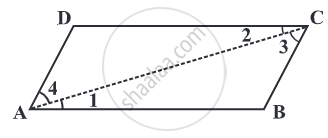
To Prove: AB = DC and BC = AD.
Construction: Draw any one diagonal, say `bar(AC)`.
Proof:
Consider a parallelogram ABCD,
In triangles ΔABC and ΔADC,
∠ 1 = ∠2, ∠ 3 = ∠ 4 .....(Pair of alternate angle)
and `bar(AC)` is common side.
Side AC = Side AC .....(common side)
∠ 1 ≅ ∠2 .....(Pair of alternate angle)
∠ 3 ≅ ∠ 4 .....(Pair of alternate angle)
by ASA congruency condition,
∆ ABC ≅ ∆ CDA
This gives AB = DC and BC = AD.
Hence Proved.
The diagonals of a rhombus are perpendicular bisectors of one another.
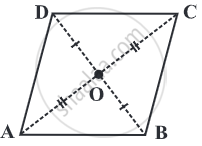
Given: ABCD is a rhombus.
To Prove: m∠ AOD = m∠ COD = 90°.
Proof:
ABCD is a rhombus. .........(Given)
Since the opposite sides of a rhombus have the same length, it is also a parallelogram. ........(Properties of a rhombus)
The diagonals of a rhombus bisect each other. ..........(Properties of a rhombus)
Thus,
OA = OC .....(DB ⟂ AC, Divides AO and OC into two equal parts)(1)
OB = OD ......(AC ⟂ DB, Divides DO and OB into two equal parts)(2)
OA = OC .....(From 1)
OB = OD ......(From 2)
AD = CD ......(All the sides of a rhombus are equal.)
by SSS congruency criterion,
∆ AOD ≅ ∆ COD
Therefore, m∠ AOD = m ∠ COD.......(C.A.C.T.)
Since, ∠AOD and ∠ COD are a linear pair.
m∠ AOD = m∠ COD = 90°.
Hence Proved.
Prove that the bisectors of interior angles of a parallelogram form a rectangle.
Given: A parallelogram ABCD. The bisectors of interior angles of || gm form a quadrilateral PQRS.
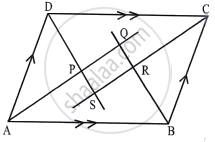
To Prove: PQRS is a rectangle.
Proof:
(1) In || gm ABCD, we have
∠A + ∠B = 180° ...[Sum of co-interior angles = 180°]
⇒ `1/2 (∠A + ∠B) = 1/2 xx 180^circ`
⇒ `1/2 ∠A + 1/2 ∠B = 90^circ`
∠QAB + ∠QBA = 90° ...`[{:(∵ (i) AQ "is bisector of" ∠A","),(∴ 1/2 ∠A = ∠QAB),((ii) BQ "is bisector of" ∠B","),(∴ 1/2 ∠B = ∠QBA):}]`
(2) In ΔAQB, we have
∠QAB + ∠QBA + ∠Q = 180° ...[Sum of angles of a triangle = 180°]
⇒ 90° + ∠Q = 180°
⇒ ∠Q = 180° – 90°
∠Q = 90°
(3) Similarly, from ΔBCR, we can prove that ∠R = 90°.
From ΔCDS, we can prove that ∠S = 90° and from ΔADP, we can prove that ∠P = 90°
(4) ∠P = ∠Q = ∠R = ∠S = 90° ...[Proved in (2) and (3)]
Also, ∠P = ∠R and ∠Q = ∠S
i.e. Both pairs of opposite angles are equal.
It is parallelogram with each angle = 90°.
Hence, it is a rectangle.
The diagonals of a rectangle are of equal length.
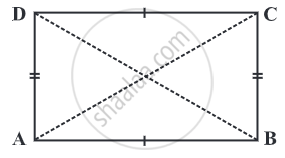
Given: ABCD is a rectangle. The diagonals are AC and BD bisect each other at a point O.
To prove: AC = BD
Proof:
ABCD is a rectangle.
BC = AD ...........(Opposite sides are equal and parallel)(1)
m∠A = m∠ B = 90°. ...........(Each of the angles is a right angle and opposite angles of a rectangle are equal.)(2)
Then looking at triangles ABC and ABD separately.
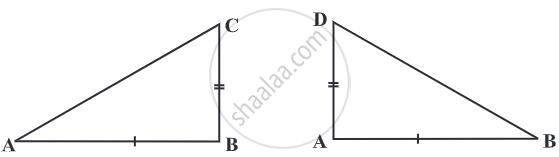
We have,
In ∆ ABC and ∆ABD,
AB = AB ......(Common side)
BC = AD ......(From 1)
m∠A = m∠ B = 90°. ......(From 2)
by SAS congruency criterion,
∆ ABC ≅ ∆ ABD .....(lies between two parallel lines)
Thus, AC = BD ......(C.S.C.T.)
Hence Proved.
Prove that the bisectors of the interior angles of a rectangle form a square.
Given: A rectangle ABCD in which AR, BR, CP, DP are the bisects of ∠A, ∠B, ∠C, ∠D, respectively forming quadrilaterals PQRS.
To prove: PQRS is a square.

Proof:
In Δ ARB,
∠RAB + ∠RBA + ∠ARB = 180°
45° + 45° + ∠ARB = 180°
90° + ∠ARB = 180°
∠ARB = 180° - 90°
∴ ∠ARB = 90°
Similarly, ∠SRQ = 90°
In Δ ARB,
AR = BR ...(i)
ΔASD ≅ Δ BQC ...[By ASA rule]
AS = BQ ...(ii) [by CPCTC]
(i) - (ii)
AR - AS = BR - BQ
SR = RQ ...(iii)
Also, SP = PQ ...(iv)
PQ = RS ...(v)
Hence, PQRS is a square.
The diagonals of a square are perpendicular bisectors of each other.

Given: ABCD is a square, where AC and BD is a diagonal bisect each other at a Point 'O'.
To Prove: ∠AOD = ∠COD = 90°.
Proof:
ABCD is a square whose diagonals meet at O. ......(Given)
OA = OC. ......(Since the square is a parallelogram)(1)
In ΔAOD and ∆COD,
OD = OD .........(Common side)
OA = OC .........(From 1)
AD = DC ..........(All the sides of square have equal length.)
By SSS congruency condition,
∆AOD ≅ ∆COD
Therefore, m∠ AOD = m∠ COD ......(C.A.C.T.)
Since, m∠ AOD and m∠ COD are a linear pair,
∠AOD = ∠COD = 90°.
Hence Proved.
Concepts [21]
- Concept of Curves
- Different Types of Curves - Closed Curve, Open Curve, Simple Curve.
- Basic Concept of Polygons
- Classification of Polygons
- Properties of Quadrilateral
- Sum of Interior Angles of a Polygon
- Sum of Exterior Angles of a Polygon
- Quadrilaterals
- Properties of Trapezium
- Properties of Kite
- Properties of a Parallelogram
- Properties of Rhombus
- Property: The Opposite Sides of a Parallelogram Are of Equal Length.
- Property: The Opposite Angles of a Parallelogram Are of Equal Measure.
- Property: The adjacent angles in a parallelogram are supplementary.
- Property: The diagonals of a parallelogram bisect each other. (at the point of their intersection)
- Property: The diagonals of a rhombus are perpendicular bisectors of one another.
- Property: The Diagonals of a Rectangle Are of Equal Length.
- Properties of Rectangle
- Properties of a Square
- Property: The diagonals of a square are perpendicular bisectors of each other.
