Formulae [2]
\[sineA=\frac{\text{Perpendicular}}{\text{Hypotenuse}}\]
\[cosineA=\frac{\mathrm{Base}}{\text{Hypotenuse}}\]
\[tangentA=\frac{\text{Perpendicular}}{\mathrm{Base}}\]
\[cotangent A = \frac{\text{Base}}{\text{Perpendicular}}\]
\[secantA=\frac{\text{Hypotenuse}}{\mathrm{Base}}\]
\[cosecantA=\frac{\text{Hypotenuse}}{\text{Perpendicular}}\]
For an acute angle A,
- sin (90° - A) = cos A
- cos (90° - A) = sin A
- tan (90° - A) = cot A
- cot (90° - A) = tan A
- sec (90° - A) = cosec A
- cosec (90° - A) = sec A
Theorems and Laws [8]
If `cot theta = 3/4`, prove that `sqrt((sec theta - cosec theta)/(sec theta + cosec theta)) = 1/sqrt7`
`cot theta = "𝑎𝑑𝑗𝑎𝑐𝑒𝑛𝑡 𝑠𝑖𝑑𝑒"/"𝑜𝑝𝑝𝑜𝑠𝑖𝑡𝑒 𝑠𝑖𝑑𝑒"`
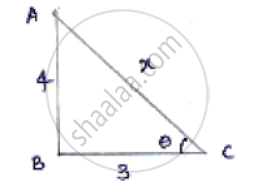
Let x be the hypotenuse by applying Pythagoras theorem.
𝐴𝐶2 = 𝐴𝐵2 + 𝐵𝐶2
𝑥2 = 16 + 9
`x^2 = 25 => x = 5`
`sec theta = (AC)/(BC) = 5/3`
`cosec theta = (AC)/(AB) = 5/4`
On substituting in equation we get
`sqrt((sec theta - cosec theta)/(sec theta + cosec theta)) = sqrt((5/3 - 5/4)/(5/3 + 5/4))`
`= sqrt(((20 - 15)/12)/((20 + 15)/12)) = sqrt(5/35) = 1/sqrt7`
If `sin θ = 3/4` prove that `sqrt(("cosec"^2θ - cot^2θ)/(sec^2θ - 1)) = sqrt(7)/3`.
We have `sin theta = 3/4`
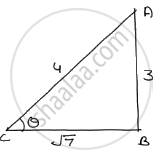
In ΔABC
`AC^2 = AB^2 + BC^2`
`=> (4)^2 = (3)^2 + BC^2`
`=> BC^2= 16 - 9`
`=> BC^2 = 7`
`=> BC = sqrt7`
`:. cosec theta = 4/3, sec theta = 4/sqrt7 and cot theta = sqrt7/3`
Now
L.H.S `sqrt((cosec^2 theta - cot^2 theta)/(sec^2 theta - 1))`
`= sqrt(((4/3)^2 - (sqrt7/3)^2)/((4/sqrt7)^2 - 1)`
`= sqrt((16/9 - 7/9)/(16/7 - 1)`
`=sqrt((9/9)/((16 - 7)/7 ))`
`= sqrt(7/9)`
`= sqrt7/3`
= R.H.S
If `tan θ = a/b` then prove that `((a sin theta - b cos theta)/(a sin theta + b cos theta)) = ((a^2 - b^2))/((a^2 + b^2))`.
Let `(a sin theta - b cos theta)/(a sin theta + b cos theta)`
Divide both Nr and Dr with cos θ of (a)
`((a sin theta - b cos theta)/cos theta)/((a sin theta + b cos theta)/cos theta)`
`= (tan theta - b)/(a tan theta + b)`
`=(a xx (a/b) - b)/(a xx (a/b) + b)`
`= (a^2 - b^2)/(a^2 + b^2)`
Without using trigonometric tables, prove that:
sec 70° sin 20° + cos 20° cosec 70° = 2
LHS = sec 70° sin 70° + cos 20° cosec 70°
= sec (90° - 20°) sin 20° + cos 20° cosec (90° - 20°)
`= "cosec" 20°. 1/("cosec" 20°)+ 1/(sec 20°) sec 20°`
= 1 + 1
= 2
= RHS
Prove the following trigonometric identities.
(secθ + cosθ) (secθ − cosθ) = tan2θ + sin2θ
We have to prove`(sec theta + cos theta)(sec theta - cos theta) = tan^2 theta + sin^2 theta`
We know that
`sin^2 theta + cos^2 theta = 1`
`sec^2 theta - tan^2 theta = 1`
`(sec theta + cos theta)(sec theta - cos theta) = sec^2 theta - cos^2 theta`
`= (1 + tan^2 theta) - (1 - sin^2 theta)`
`= 1 + tan^2 theta - 1 + sin^2 theta`
`= tan^2 theta + sin^2 theta`
Prove the following trigonometric identities:
`((1 + cot^2 theta) tan theta)/sec^2 theta = cot theta`
We have to prove `((1 + cot^2 theta) tan theta)/sec^2 theta = cot theta`
We know that, `sec^2 theta - tan^2 theta = 1`
So
`((1 + cot^2 theta)tan theta)/sec^2 theta = ((1 + cot^2 theta)tan theta)/(1 + tan^2 theta)`
` = ((1 + 1/tan^2 theta)tan theta)/(1 + tan^2 theta)`
`= (((tan^2 theta + 1)/(tan^2 theta)) tan theta)/(1 + tan^ 2 theta)`
`= ((1 + tan^2 theta)tan theta)/(tan^2 theta(1 + tan^2 theta))`
`= 1/tan theta`
`= cot theta`
If tan A = cot B, prove that A + B = 90°.
∵ tan A = cot B
tan A = tan (90° – B)
A = 90° – B
A + B = 90°. Proved
Prove that `(tan A)/(cot A) = (sec^2A)/("cosec"^2A)`.
R.H.S. = `(sec^2A)/("cosec"^2A)`
= `(1 + tan^2A)/(1 + cot^2A)` ...`[(∵ 1 + tan^2A = sec^2A),(1 + cot^2A = "cosec"^2A)]`
= `(1 + (sin^2A)/(cos^2A))/(1 + (cos^2A)/(sin^2A))`
= `((cos^2A + sin^2A)/(cos^2A))/((sin^2A + cos^2A)/(sin^2A))`
= `(1/(cos^2A))/(1/(sin^2A))` ...[∵ sin2A + cos2A = 1]
= `(sin^2A)/(cos^2A)`
= tan2A
= tan A . tan A
= `(tan A)/(cot A)`
= L.H.S.
∴ `(tan A)/(cot A) = (sec^2A)/("cosec"^2A)`
Key Points
For an acute angle A in a right-angled triangle:
-
Hypotenuse is the side opposite the right angle.
-
Perpendicular is the side opposite angle A.
-
Base is the side adjacent to angle A.
| Angle | 0° | 30° | 45° | 60° | 90° |
|---|---|---|---|---|---|
| sin | 0 | 1/2 | 1/√2 | √3/2 | 1 |
| cos | 1 | √3/2 | 1/√2 | 1/2 | 0 |
| tan | 0 | 1/√3 | 1 | √3 | Not defined |
| cosec | Not defined | 2 | √2 | 2/√3 | 1 |
| sec | 1 | 2/√3 | √2 | 2 | Not defined |
| cot | Not defined | √3 | 1 | 1/√3 | 0 |
