मराठी

Revision: Reproduction in Lower and Higher Plants Biology HSC Science (General) 12th Standard Board Exam Maharashtra State Board

Advertisements

Definitions [85]

Definition: Reproduction

Reproduction is the process of formation of new individuals by sexual or asexual means, which can repeat the process in their own turn.

or

Formation of new organism of same species by earlier existing organism is called as reproduction.

or

Reproduction is a biological process that results in the formation of new individuals of the same kind, though usually with slight genetic, structural and physiological variations.

Definition: Lifespan

Lifespan is the duration or period from birth to the natural death of an organism.

Definition: Asexual Reproduction

A mode of reproduction where a new organism is formed from a part of the parent body without involving gametes.

or

The process of forming a new organism from an organism of the same species without the involvement of gametes is called asexual reproduction.

or

When offspring is produced by a single parent by the formation of specialised asexual reproductive structures by the parent body, the reproduction is asexual.

Definition: Binary fission

Binary fission is an asexual reproduction process in single-celled organisms where a parent cell divides into two genetically identical daughter cells through coordinated nuclear and cytoplasmic division.

Definition: Simple binary fission

Simple binary fission is an asexual reproduction process in which a single Amoeba cell divides along a randomly oriented plane to form two genetically identical daughter cells.

or

When a unicellular organism divides into two identical daughter cells in any plane, due to lack of definite shape, it is called simple binary fission.

Example: Amoeba

Definition: Transverse Binary Fission

When a unicellular organism divides across the transverse (horizontal) axis, it is called transverse binary fission.

or

Transverse binary fission is an asexual reproduction process where the plane of division runs along the transverse (horizontal) axis of the individual, splitting it into two parts.

Example: Paramecium

Definition: Longitudinal Binary Fission

When a unicellular organism divides along the longitudinal (vertical) axis, it is called longitudinal binary fission.

or

Longitudinal binary fission is an asexual reproduction process where the plane of division passes along the longitudinal (vertical) axis of the animal, splitting it into two parts.

Example: Euglena

Definition: Amoebulae (Pseudopodiospores)

The small daughter cells formed when each daughter nucleus produced during multiple fission in Amoeba gets surrounded by a small amount of cytoplasm are called amoebulae or pseudopodiospores.

Definition: Multiple Fission

When a single organism divides into many daughter cells by forming multiple nuclei followed by cytoplasmic division, it is called multiple fission.

or

The mode of asexual reproduction in which a single parent organism divides to produce many daughter organisms at the same time is called multiple fission.

Definition: Encystation

The process by which Amoeba withdraws its pseudopodia and forms a hard, protective, three-layered cyst around its body during unfavourable conditions is called encystation.

Definition: Cyst

When an Amoeba forms a protective covering around itself during adverse conditions and stops movement, it is called a cyst.

Definition: Sporozoites

The daughter individuals formed as a result of sporogony in Plasmodium are called sporozoites.

Definition: Spores

The end products of multiple fission that are enclosed in a hard, resistant covering are called spores.

Definition: Sporogony

The process of multiple fission occurring in the oocyst of Plasmodium inside the mosquito is called sporogony.

Definition: Sporulation (in Amoeba)

The type of multiple fission in which the parent Amoeba forms a cyst and releases many daughter individuals on return of favourable conditions is called sporulation.

Definition: Budding in Unicellular Organisms

In unicellular organisms like yeast, when a small bud forms on the parent cell, gets a nucleus, grows, and separates to become a new cell, it is called budding.

Definition: Fragmentation

When the body of a multicellular organism breaks into two or more fragments, and each fragment grows into a new individual, it is called fragmentation.

or

The mode of asexual reproduction in which the body of an organism breaks into fragments, each capable of developing into a complete new organism, is called fragmentation.

Example: Ulothrix, Spirogyra, etc

Definition: Non-motile Spores

Spores that lack flagella and are incapable of movement are called non-motile spores.

Definition: Motile Spores (Zoospores)

Spores that possess flagella and are capable of movement in water are called motile spores or zoospores.

Definition: Spore

A special reproductive structure formed by simple plants and fungi that germinates directly to form a new individual is called a spore.

Definition: Sporangiospores

Asexual spores produced inside a sporangium are called sporangiospores.

Definition: Conidia (Conidiospores)

Non-motile asexual spores produced externally and not inside a sporangium in many fungi are called conidia or conidiospores.

Definition: Aplanospores

Non-motile spores with a typical cell wall and without flagella are called aplanospores.

Define vegetative propagation.

Reproduction in plants, in which a new plant can arise from a vegetative part such as a root, stem, or leaf without the help of any reproductive organ, is called vegetative propagation.

Definition: Vegetative Reproduction or Vegetative Propagation

When plants reproduce using vegetative parts like root, stem, leaf, or bud to form a new plant, it is called vegetative propagation.

or

Regeneration of new plants from a part of the vegetative organ is called vegetative reproduction or vegetative propagation.

Definition: Natural Vegetative Propagation

The process in which a new plant develops from a vegetative part (stem, root, or leaf) of the parent plant under suitable conditions is called natural vegetative propagation.

Definition: Artificial Vegetative Propagation

The process in which a part of a plant is detached from the mother plant by humans and grown independently into a new plant to quickly produce plants while retaining the mother plant's qualities is called artificial vegetative propagation. It is done by cuttings, layering, and grafting.

Definition: Sexual Reproduction

A mode of reproduction involving the fusion of male and female gametes (sperm and egg) to form a zygote that develops into a new organism.

Definition: Juvenile Phase (Vegetative Phase in plants)

The period of growth and development before an organism becomes sexually mature is called the juvenile phase.

Definition: Thalamus (Receptacle)

The swollen terminal part of the pedicel on which all floral whorls are arranged is called the thalamus or receptacle.

Definition: Perianth

When calyx and corolla are not differentiated, the floral envelope is called the perianth.

Definition: Tepals

Individual members of the perianth are called tepals.

Definition: Placentation

The pattern of ovule arrangement in the ovary is called placentation. 

Definition: Flower

A modified, compressed reproductive shoot of angiosperms bearing sepals, petals, stamens, and carpels, meant for sexual reproduction, is called a flower.

Definition: Whorl

A circular arrangement of floral organs at the same level on the thalamus is called a whorl.

Definition: Compound Pollen Grains

When microspores of a tetrad do not separate and remain attached together in groups, they are called compound pollen grains.

Definition: Microsporogenesis

The process of formation of microspores from the sporogenous tissue is said to be microsporogenesis.

Definition: Pollinium

A compact mass formed when all microspores within a pollen sac remain united as a single structure is called a pollinium.

Definition: Palynology

The study of external morphology of mature pollen grain is called palynology.

Definition: Sporoderm

The protective wall or covering of a pollen grain is called the sporoderm.

Definition: Germ Pore

The region where the exine is absent and through which the pollen tube emerges is called a germ pore.

Definition: Pollenkitt

A yellowish, sticky, oily substance covering the exine of insect-pollinated pollen grains is called pollenkitt.

Definition: Ovule (Megasporangium)

The structure in flowering plants that develops into a seed after fertilization is called the ovule.

Definition: Megasporogenesis

Development of the megaspore within the ovule (megasporangium) is known as megasporogenesis.

Definition: Female Gametophyte (Embryo Sac)

The female gametophyte of angiosperms is called the embryo sac. It is the haploid (n) structure inside the ovule that contains the egg cell and all supporting cells required for fertilisation and early seed development.

Definition: Pollination

Transfer of pollen grains from the anther to the stigma of a flower is called pollination.

or

Pollination is the transfer of pollen grains from the anther of a flower to the stigma of the same flower or of another flower of usually the same species.

Definition: Autogamy

When pollen grains from the anther are transferred to the stigma of the same flower, it is known as autogamy.

Definition: Cross-pollination

When pollination occurs between flowers on two different plants of the same species, it is called cross-pollination.

or

Transfer of pollen grains from the anther of a flower from one plant to the stigma of the flower on another plant is called cross-pollination

Definition: Geitonogamy

When pollens of a flower pollinate any other flower present on the same plant, it is said to be geitonogamy.

Definition: Biotic Agents

Biotic agents are living organisms, such as insects, birds, bats, and snails, that help transfer pollen grains from one flower to another, thereby assisting plant reproduction.

Definition: Abiotic Agents

Abiotic agents are the non-living external means, namely wind and water, that bring about the transfer of pollen grains from one flower to another.

Definition: Anemophily

Transfer of pollen grains from the anther to the stigma through wind is known as anemophily.

Definition: Hypo-hydrophily

When pollination of flowers occurs below water, it is said to be hypo-hydrophily.

Definition: Hydrophily

Transfer of pollen grains from the anther to the stigma through water is known as hydrophily.

Definition: Epi-hydrophily

When pollination of flowers occurs at the surface of water, it is called epi-hydrophily. 

Definition: Entomophily

Transfer of pollen grains through the agency of insects is known as entomophily.

Definition: Ornithophily

Transfer of pollen grains by birds is known as ornithophily.

Definition: Chiropterophily

Transfer of pollen grains by bats is known as chiropteriphily.

Definition: Malacophily

Transfer of pollen grains by snails and slugs is known as malacophily.

Definition: Fertilization

Union of a male gamete with the egg cell to form a zygote is called fertilization.

Definition: Pollen–pistil interaction

The recognition and acceptance or rejection of pollen by the pistil, from pollen deposition on the stigma to pollen tube entry into the ovule, is called pollen–pistil interaction.

Definition: Artificial Hybridization (Artificial Fertilization)

The controlled crossing of selected male and female parent plants to produce genetically superior offspring is called artificial hybridization.

Definition: Double Fertilization

Union of the second male gamete with two polar nuclei to form endosperm, along with fertilization, is called double fertilization.

Definition: Endosperm

Endosperm is a nutritive tissue formed after fertilisation in flowering plants. It is usually triploid and provides food to the developing embryo.

Definition: Embryo

The embryo is the young developing plant formed from the zygote after fertilisation. It develops at the micropylar end of the embryo sac.

Definition: Apomixis

Apomixis is the production of seeds without fertilisation and is a form of asexual reproduction that mimics sexual reproduction.

Definition: Parthenocarpy

The process of fruit formation without fertilisation is called parthenocarpy.

Define Parthenocarpy.

It is the condition in which fruit is developed without the process of fertilization. It occurs naturally in some varieties of Pineapple, Banana, Papaya, etc.

Define Apomixis.

Apomixis is a type of asexual reproduction that mimics sexual reproduction, i.e., the production of seeds without pollination and fertilization.

Definition: Polyembryony

Presence of more than one embryo within a single seed is called polyembryony.

Definition: Biotic Pollination

Pollination carried out with the help of living organisms is called as biotic pollination.

Definition: Epihydrophily

Pollination in which pollen grains float on the surface of water and reach the stigma is called as epihydrophily.

Definition: Hypohydrophily

Pollination that occurs below the surface of water where pollen grains sink and reach the stigma is called as hypohydrophily.

Definition: Hydrophily

The transfer of pollen grains through water as a medium for pollination is called as hydrophily.

Definition: Megasporogenesis

The process of formation of haploid megaspores from a diploid megaspore mother cell (MMC) in the nucellus of ovule is called as megasporogenesis.

Definition: Microsporogenesis

The process in which each microspore mother cell undergoes meiosis to form a tetrad of haploid microspores (pollen grains) is called as microsporogenesis.

Definition: Dormancy

A temporary state of metabolic arrest that enables organisms to survive adverse environmental conditions is called as dormancy.
Definition: Apogamy

The formation of an embryo-like structure directly from a gametophytic organ or cell without fertilisation is called as apogamy.

Definition: Embryogenesis

The process of development of zygote into an embryo is called embryogenesis.

Definition: Apospory

The development of a diploid gametophyte from a diploid sporophytic cell without undergoing meiosis is called as apospory (e.g., Orange, Mango).

Definition: Parthenocarpy

The development of fruit from the ovary without fertilisation, resulting in a seedless fruit, is called as parthenocarpy.

Definition: Pollenkit

The yellow, sticky substance present on pollen grains that helps in adhesion to insect body is called as pollenkit.

Definition: Chiropterophily

Pollination carried out with the help of bats is called as chiropterophily.

Definition: Ornithophily

Pollination carried out with the help of birds is called as ornithophily.

Definition: Entomophily

Pollination carried out with the help of insects is called as entomophily.

Key Points

Key Points: Reproduction
  • Meaning - Reproduction is the production of young ones similar to their parents. It is an essential biological process for the continuation of the species and continuity of life.
  • Lifespan = period from birth to natural death; ranges from 1 day (Mayfly) to 3,000–4,000 years (Sequoia).
  • Two Types - All methods of reproduction fall into two categories: Asexual Reproduction and Sexual Reproduction.
  • Single-celled organisms (Amoeba, Bacteria) do not undergo natural death — they divide by binary fission.
  • Four life stages: Juvenile → Reproductive → Senescent → Death.
  • In plants, the reproductive phase begins at flowering.
  • Monocarpic plants flower once; Polycarpic plants flower every season.
  • Asexual reproduction = one parent, clones produced, faster.
  • Sexual reproduction = two parents, gametes, zygote formed, genetic variation.
  • The three phases of sexual reproduction: Pre-fertilisation → Fertilisation → Post-fertilisation.
Key Points: Asexual Reproduction
  • Meaning: Asexual reproduction involves only one parent, produces no fusion of gametes, and results in offspring that are genetically identical to the parent, called clones.
  • Modes of Asexual Reproduction: Common methods include Binary Fission (Amoeba, Paramoecium), Fragmentation (Spirogyra), Budding (Yeast, Protosiphon), Spore Formation/Zoospores (Chlamydomonas), Conidia (Penicillium), and Gemmules (Marchantia).
  • In Plants: Asexual reproduction in plants is called Vegetative Propagation. It can be Natural or Artificial (e.g., cutting, grafting, tissue culture).
  • In Animals: Common in lower animals only. Does not involve meiosis or gamete formation. Lower animals reproduce asexually by budding and gemmule formation.
  • Key Feature: Since only one parent is involved and no fusion occurs, all offspring are morphologically and genetically identical (clones) to the parent.
Key Points: Simple binary fission
  • Simple binary fission is an asexual reproduction method in which a unicellular organism, such as an Amoeba, divides along a random plane to produce two genetically identical daughter cells.
  • The process begins with cell growth and DNA replication, ensuring that the parent cell synthesises the necessary proteins and creates an exact duplicate of its genetic material.
  • Following replication, the cell undergoes nuclear division (mitosis), during which the nuclear membrane dissolves and the duplicated chromosomes separate into two distinct daughter nuclei.
  • The final step is cytokinesis, wherein a cleavage furrow forms randomly, pinching the cell membrane inward to divide the cytoplasm and release two independent, fully functional daughter cells.
Key Points: Transverse Binary Fission
  • Transverse binary fission is an asexual reproduction process in which an organism divides horizontally along its transverse axis to produce two distinct individuals.
  • In Paramecium, the larger macronucleus divides amitotically while the smaller micronucleus divides mitotically, distributing one pair of each to the anterior and posterior ends of the cell.
  • Following nuclear division, a horizontal constriction forms in the middle of the Paramecium and deepens until the cell splits completely into two independent daughter paramecia.
  • Planaria (flatworms) also utilise this method by developing a constriction behind the pharynx and splitting in two, with each resulting half regenerating its missing segments to form a complete organism.
Key Points: Longitudinal Binary Fission
  • A unicellular organism divides along its longitudinal (vertical) axis, splitting into two daughter cells - an asexual reproduction process, as seen in Euglena.
  • The cell first suspends locomotion (flagellum sometimes withdrawn), then the blepharoplast splits, followed by eumitotic nuclear division where the nuclear membrane fully dissolves.
  • A longitudinal cleavage furrow begins at the reservoir on the anterior end and proceeds down the body, gradually dividing the cell into two.
  • The furrow deepens until two independent daughter euglenae are formed, with any lost parts regenerated immediately after division.
Key Points: Multiple Fission
  • In multiple fission, a single parent divides into many daughter cells at once by first forming multiple nuclei, followed by cytoplasmic division around each.
  • In Amoeba, under unfavourable conditions, it withdraws its pseudopodia and secretes a three-layered chitinous cyst around itself - a process called encystation.
  • Inside the cyst, the nucleus divides repeatedly into many daughter nuclei, each gathering a little cytoplasm to form tiny daughter cells called amoebulae (pseudopodiospores), which are released as adults when favourable conditions return.
  • In Plasmodium, schizogony occurs in the human liver and red blood cells, producing many merozoites by multiple fission.
  • In Plasmodium, sporogony occurs in the oocyst inside the female Anopheles mosquito, where multiple fission produces sporozoites.
Key Points: Budding in Unicellular Organisms
  • In unicellular organisms like yeast, a small bud forms on the parent cell, receives a nucleus, grows, and separates to become a new cell.
  • A small projection appears on the parent cell's surface and enlarges into a bud, while the nucleus divides and one nucleus moves into the bud.
  • The bud continues to grow while attached to the parent, then the mature bud separates to become an independent new yeast cell.
Key Points: Fragmentation
  • When the body of a multicellular organism breaks into two or more fragments, each fragment grows into a new individual - a common, efficient method of asexual reproduction.
  • In filamentous algae like Ulothrix and Spirogyra, the thallus breaks into small fragments, and each grows independently into a new thallus.
  • In fungi, a small fragment of the hypha detaches from the parent mycelium and develops into a new individual.
Key Points: Spore Formation
  • A spore is a reproductive structure in simple plants and fungi that germinates directly into a new individual; it may be motile (zoospores) or non-motile (aplanospores).
  • In algae like Chlamydomonas, the protoplast divides into 4–8 parts, each forming a zoospore that grows into a new individual.
  • Fungi reproduce asexually by two spore types - sporangiospores and conidia.
  • Sporangiospores form inside a sporangium: motile zoospores (e.g., Pythium) and non-motile aplanospores (e.g., Rhizopus).
  • Conidia are non-motile spores formed externally on conidiophores, as in Aspergillus and Penicillium.
Key Points: Vegetative Reproduction or Vegetative Propagation
  • Vegetative propagation is an asexual method where a new plant regenerates from root, stem, leaf, or bud, forming offspring genetically identical to the parent (a clone).
  • It is rapid, easy, and inexpensive, useful for plants with poor seed viability or that cannot form seeds, like banana, seedless grapes, and rose.
  • It preserves the parent's characters (mango, citrus, litchi) and aids grafting and disease-free micropropagation.
  • Drawbacks: propagules decay easily, are prone to disease, show no variation, and cause overcrowding due to poor dispersal.
Key Points: Natural Vegetative Propagation
Part Involved Structure Key Feature Example
Underground stem Rhizome / Tuber / Bulb / Corm Modified stem with buds Ginger, Potato, Onion, Colocasia
Sub-aerial stem Runner / Offset / Sucker / Stolon Creeping or branching stem Doob grass, Water hyacinth, Mint, Strawberry
Root Tuberous / Adventitious roots Roots bear buds Sweet potato, Dahlia
Leaf Foliar buds Buds on leaf margin or surface Bryophyllum, Begonia
Special structure Bulbil Modified bud or flower Agave, Dioscorea

Note: All such structures capable of forming new plants are called vegetative propagules.

Key Points: Artificial Vegetative Propagation
Method Basic idea Main advantage Common examples
Cutting A cut plant part develops into a new plant Simple and economical Rose, bougainvillaea, sugarcane 
Layering A branch forms roots while attached to parent plant Better survival during root formation Jasmine, grapevine, litchi 
Grafting Two plant parts are joined to grow as one Combines useful qualities of two plants Mango, apple, pear, rose 
Micropropagation Plant tissue is grown in sterile conditions Mass multiplication in short time Banana, orchids 
Key Points: Sexual Reproduction
  • Sexual reproduction involves the formation and fusion of male and female gametes (amphimixis) through meiotic division to create a diploid zygote.
  • Life cycles progress from an initial juvenile phase focused purely on vegetative growth and development to a mature reproductive phase in which sex organs become functional.
  • The reproductive process is strictly regulated by hormones and sequence-driven, consisting of three sequential stages: pre-fertilisation, fertilisation, and post-fertilisation.
  • Pre-fertilisation focuses on gamete production and transfer, while post-fertilisation events track zygote development and the formation of embryonic structures.
  • Meiotic cell division and cross-fertilisation blend parental genetic material, generating the vital variations needed to drive species adaptation and organic evolution.
Key Points: The Flower
  • Flower: A modified shoot and the reproductive unit of angiosperms.
  • Structure: Consists of four whorls—calyx, corolla (accessory), androecium, and gynoecium (reproductive).
  • Types by sex: Flowers may be unisexual (male/female) or bisexual (both present).
  • Symmetry: Actinomorphic (radial), zygomorphic (bilateral), or asymmetric.
  • Based on floral parts: Flowers can be trimerous, tetramerous, or pentamerous depending on the number of parts.
  • Position of ovary: Hypogynous (superior), perigynous (half inferior), epigynous (inferior).
Key Points: Structure and Development of Anther
  • A typical anther is dithecous and tetrasporangiate, having two lobes, each with two microsporangia (pollen sacs).
  • Microsporangia contain sporogenous tissue, which develops into microspore mother cells that form pollen grains.
  • The anther wall has four layers: epidermis, endothecium, middle layers, and tapetum.
  • The tapetum provides nutrition to developing pollen, and microspore mother cells undergo meiosis to form haploid microspores.
  • During anther dehiscence, the endothecium helps in rupture at the stomium, releasing pollen grains for pollination.
Key Points: Microsporogenesis
  • Microsporogenesis is the process in which pollen mother cells (PMC) undergo meiosis to form haploid microspores (pollen grains).
  • Each PMC divides meiotically to produce a tetrad of four haploid microspores.
  • Microspores separate at maturity and develop into pollen grains.
  • A pollen grain has a two-layered wall called sporoderm: outer exine and inner intine.
  • Exine is made of sporopollenin, a tough and resistant substance, and contains germ pores for pollen tube growth.
  • Intine is the inner layer made of cellulose and pectin.
  • Pollen viability (ability to germinate) depends on temperature and humidity; it is short (about 30 minutes) in crops like rice and wheat but can last for months in some plant families.
Key Points: Structure and Development of Male Gametophyte
  • Pollen grains act as male gametophytes and are usually spherical, measuring about 25–50 μm in diameter.
  • Each pollen grain has a two-layered wall (sporoderm) consisting of a thick outer exine and a thin inner intine.
  • The exine contains sporopollenin, which makes pollen grains highly resistant and helps in their fossil preservation.
  • Germ pores are present where the exine is absent; dicots usually have three pores, while monocots have one pore.
  • The intine protrudes through the germ pore during germination to form the pollen tube.
  • In insect-pollinated plants, pollen grains are coated with pollenkitt, which aids in insect attraction and pollination.
  • Pollen viability varies widely, lasting minutes in cereals and months in some dicots; pollen can be preserved at –196°C in pollen banks.
  • After release, the pollen grain divides into a vegetative cell and a generative cell, and the generative cell later forms two male gametes.
Key Points: Structure and Development of Ovule
  • The ovule is an integumented megasporangium present inside the ovary and is attached to the placenta by a stalk called the funicle.
  • The nucellus is the central part containing reserve food, surrounded by one or two integuments for protection.
  • The integuments leave a small opening called the micropyle at the apex, while the basal region is called the chalaza, and the attachment point is the hilum.
  • The ovule is commonly anatropous, and contains an embryo sac (female gametophyte) with structures like egg cell, synergids, and polar nuclei.
  • During development, the ovule arises from the placenta, and integuments grow around the nucellus to form a mature ovule.
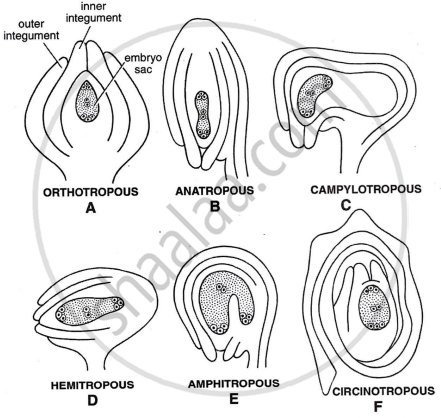
Key Points: Types of Ovules (Based on Orientation)
Type of Ovule Position / Curvature of Ovule Relation of Micropyle, Chalaza & Funicle Examples

Orthotropous (Atropous)


Ovule upright Micropyle, chalaza and funicle in one straight line Polygonum, Cycas
Anatropous Ovule inverted through 180° Micropyle near funicle; micropyle & chalaza in one line; funicle parallel Mustard (Brassica), Sunflower, Pea
Campylotropous Ovule slightly curved Micropyle and chalaza not in straight line; funicle at right angle to chalaza Chenopodium
Hemitropous Ovule turned through 90° (horizontal) Micropyle and chalaza in horizontal line; funicle at right angle Primula
Amphitropous Ovule strongly curved Embryo sac bent and horse-shoe shaped Alisma
Circinotropous Ovule bent through 360° Funicle coils completely around ovule Opuntia, Plumbago

Key Points: Types of Ovules (Based on Integuments)
Type of Ovule Number of Integuments Key Feature Proper Examples
Unitegmic One integument Single protective covering around ovule Cycas, Pinus (Gymnosperms)
Bitegmic Two integuments Typical condition of flowering plants Sunflower, Mustard, Pea
Ategmic No integuments Ovule without protective layers Loranthus, Olax, Santalum, Liriosma
Key Points: Megasporogenesis
  • Megasporogenesis is the process of formation of megaspores from a diploid megaspore mother cell (MMC) in the ovule.
  • It occurs inside the nucellus of the ovule, usually near the micropylar region.
  • The MMC undergoes meiosis to form four haploid megaspores arranged in a linear tetrad.
  • Out of the four megaspores, three degenerate, and only one functional megaspore remains.
  • The functional megaspore undergoes three mitotic divisions to form an 8-nucleate, 7-celled embryo sac (female gametophyte).
  • The embryo sac contains one egg cell, two synergids, three antipodal cells, and one central cell with two polar nuclei.
Key Points: Development of Female Gametophyte or Embryo Sac
  • The female gametophyte (embryo sac) develops from the functional megaspore through mitotic divisions.
  • The nucleus divides to form 8 nuclei, arranged with four at each pole, and one from each pole moves to the centre as polar nuclei.
  • At the micropylar end, three nuclei form the egg apparatus (one egg cell and two synergids), which help in guiding the pollen tube.
  • At the chalazal end, three nuclei form the antipodal cells, while the two polar nuclei fuse to form a diploid secondary nucleus.
  • The mature embryo sac is monosporic, 7-celled and 8-nucleated (Polygonum type), which is the most common in angiosperms.
Key Points: Pollination
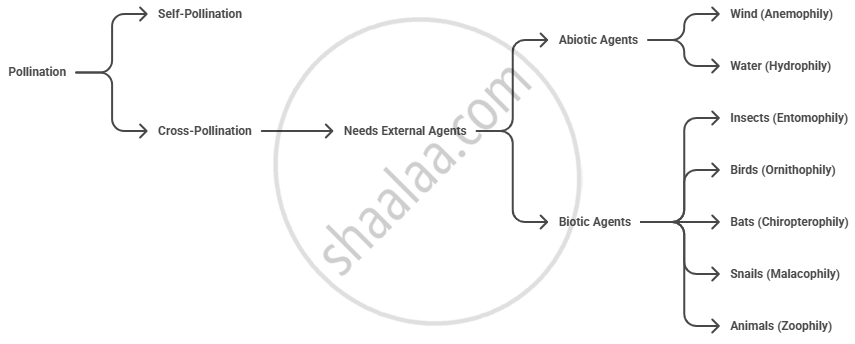
  • Pollination is the transfer of pollen grains from anther to stigma and is essential for fertilisation since gametes are non-motile.
  • Pollination occurs through external agents such as wind, water, and animals because pollen grains cannot move on their own.
  • There are three types of pollination: autogamy (same flower), geitonogamy (same plant), and xenogamy (different plants of the same species).
  • Self-pollination leads to inbreeding, while cross-pollination increases genetic variation.
  • Abiotic agents of pollination include wind (anemophily) and water (hydrophily).
  • Biotic agents include insects, birds, and bats, which help in effective pollen transfer between flowers.
Agencies of Pollination
Agency Agent Type Examples
Anemophily Wind Abiotic Wheat, rice, maize, grass
Hydrophily (Hypo) Water (submerged) Abiotic Zostera
Hydrophily (Epi) Water (surface) Abiotic Vallisneria
Entomophily Insects (e.g., bumblebee) Biotic Rose, Jasmine, Salvia, Lotus
Ornithophily Birds (e.g., sunbird) Biotic Bombax, Butea, Callistemon
Chiropterophily Bats Biotic Anthocephalus, Kigelia, Adansonia
Key Points: Autogamy
  • Meaning - Autogamy is the transfer of pollen grains from anther to the stigma of the same flower.
  • Conditions for Autogamy - Requires synchrony in pollen release, stigma receptivity, and anthers & stigma close to each other.
  • Complete Autogamy is Rare - In flowers where anthers and stigma are open and exposed, complete autogamy rarely occurs.
  • Chasmogamous Flowers - Flowers that open normally with exposed anthers and stigma (e.g., Viola, Oxalis, Commelina).
  • Cleistogamous Flowers - Flowers that never open; anthers and stigma lie close together, ensuring assured autogamy without pollinators (e.g., Viola, Oxalis, Commelina).
Key Points: Cross-pollination
  • Cross-pollination is the transfer of pollen grains from the anther of one plant to the stigma of another plant of the same species.
  • It is also known as Allogamy, while Xenogamy refers specifically to pollination between different plants.
  • Cross-pollination usually occurs with the help of external agents such as wind, water, insects, birds, and animals.
  • This type of pollination produces genetically varied, healthier, and more adaptable offspring.
  • Cross-pollination helps in the development of new plant varieties and improves crop quality and vigour.
  • It requires the production of a large number of pollen grains, leading to wastage and dependence on pollinating agents.
Key Points: Geitonogamy
  • Geitonogamy is the transfer of pollen from anther to the stigma of another flower on the same plant.
  • It is functionally cross-pollination because it involves a pollinating agent.
  • It is genetically similar to self-pollination (autogamy) since pollen comes from the same plant.
  • Thus, it shows features of both self and cross-pollination.
Key Points: Agents and Types of Cross-pollination


Key Points: Anemophily
  • Meaning - Anemophily is pollination by wind; more common among abiotic pollinations (e.g., grasses, corn cob).
  • Pollen Characteristics - Pollen grains are light and non-sticky, so they can be easily carried by wind currents.
  • Floral Structure - Flowers have well-exposed stamens for easy pollen dispersal and a large, feathery stigma to trap airborne pollen.
  • Ovule & Inflorescence - Each ovary has a single ovule; flowers are numerous and packed into an inflorescence (e.g., corn cob/tassels).
  • Colour & Nectar - Flowers are not colourful and do not produce nectar (no need to attract insects).
  • Pollination Efficiency - Produces large amounts of pollen to compensate for the chance factor of pollen reaching the stigma.
Key Points: Hydrophily
  • Meaning - Hydrophily is pollination by water; rare in flowering plants, limited to about 30 genera, mostly monocotyledons (e.g., Vallisneria, Hydrilla, Zostera).
  • Pollen Characteristics - Pollen grains are long and ribbon-like; protected from wetting by a mucilaginous covering.
  • Vallisneria Mechanism - Female flower reaches the water surface via a long stalk; male flowers/pollen are released onto the surface and carried passively by water currents.
  • Seagrasses Mechanism - Female flowers remain submerged; pollen grains are released inside the water (e.g., Zostera).
  • Water Hyacinth & Water Lily - Flowers emerge above water level and are pollinated by insects or wind, not water.
  • Colour & Nectar - Flowers are not colourful and do not produce nectar; produce large amounts of pollen due to the chance factor of reaching the stigma.
Key Points: Entomophily
  • Entomophily is the transfer of pollen by insects like bees, butterflies, flies, beetles, and moths; e.g., rose, jasmine, salvia.
  • Insects visit flowers for nectar or pollen and carry pollen from one flower to another, aiding pollination in many angiosperms.
  • Entomophilous flowers are large, showy, brightly coloured, scented, with nectar glands; small flowers group into a conspicuous inflorescence.
  • Their stigma is rough/sticky, and pollen is spiny or sticky (coated with pollenkit) to cling to insect bodies.
  • Special patterns: night-blooming flowers like Cestrum nocturnum attract moths by strong scent; some produce foul odours to attract flies and beetles.
  • Salvia has a lever mechanism that deposits pollen on an insect's body for transfer to another flower's stigma, promoting cross-pollination.
Key Points: Ornithophily
  • Ornithophily is the transfer of pollen by birds like sunbirds and hummingbirds; e.g., bombax, callistemon, butea, erythrina, syzygium.
  • Birds visit flowers to feed on nectar, and pollen sticks to their beak, head, or feathers and is carried to another flower.
  • Touching the stigma of the next flower causes pollination, promoting cross-pollination and genetic variation.
  • Ornithophilous flowers are bright (red, orange, yellow, blue), large, showy, and tubular, cup-, or urn-shaped to suit a bird's beak.
  • They secrete abundant, dilute nectar, bear sticky pollen, and have reduced fragrance since birds rely on vision more than smell.
Key Points: Chiropterophily
  • Chiropterophily is the transfer of pollen grains by bats; e.g., Anthocephalus (kadam), Adansonia (baobab), Kigelia (sausage tree).
  • Bats visit flowers at night for nectar, edible pollen, or floral parts; pollen sticks to their body and is carried to another flower.
  • When the bat touches the stigma of the next flower, pollen is transferred, and cross-pollination occurs.
  • Chiropterophilous flowers are dull-coloured but strongly fragrant, secrete abundant nectar, and produce large amounts of (often edible) pollen.
  • They are usually large and sturdy, borne on long stalks, and may occur singly or in clusters — suited for bat visits in low light.
Key Points: Malacophily
  • Malacophily is the transfer of pollen by snails and slugs (molluscs); e.g., Chrysanthemum leucanthemum (land) and Lemna (aquatic).
  • It is a type of animal-mediated pollination, much less common than by insects, wind, or birds.
  • As a snail or slug crawls or feeds over a flower, pollen sticks to its body and is carried to another flower.
  • On reaching the next flower, some pollen is deposited on the stigma, completing pollination.
Key Points: Outbreeding Devices
Outbreeding Devices Mechanism Role Examples
Self-sterility (Self-incompatibility) Pollen fails to germinate on own stigma Prevents self-fertilization Petunia, Brassica
Dichogamy – Protogyny Stigma matures before anthers Avoids autogamy Magnolia, Aristolochia
Dichogamy – Protandry Anthers mature before stigma Avoids autogamy Salvia, Helianthus
Herkogamy Spatial separation of sex organs Mechanical prevention of autogamy Gloriosa, Caryophyllaceae
Heterostyly Different style lengths Promotes cross-pollination Primula
Unisexuality – Monoecious Male and female flowers on same plant Prevents autogamy Maize, Castor
Unisexuality – Dioecious Male and female flowers on different plants Prevents autogamy & geitonogamy Papaya, Date palm
Key Points: Pollen Pistil Interaction
  • Pollen-pistil interaction is the series of events from pollen landing on the stigma to fertilisation.
  • The pistil recognises compatible pollen and rejects incompatible or foreign pollen using specific proteins.
  • Compatible pollen germinates on the stigma and forms a pollen tube by absorbing nutrients.
  • The pollen tube grows through the style and reaches the ovule, entering through a synergid in the embryo sac.
  • The pollen tube releases male gametes, enabling fertilisation and seed formation.
Key Points: Artificial Hybridization or Artificial Fertilization
  • Artificial hybridisation is used in crop improvement to combine desirable traits of different plants.
  • It ensures that only selected (desired) pollen is used for pollination.
  • Emasculation → removal of anthers from bisexual flowers before they release pollen.
  • Bagging → covering the flower to prevent unwanted pollen contamination.
  • When stigma becomes receptive, desired pollen is applied, and the flower is rebagged for fruit development.
Key Points: Double Fertilization and Triple Fusion
  • Double fertilisation is a unique feature of angiosperms where two fusion events occur inside the embryo sac.
  • The pollen tube enters the ovule usually through the micropyle (porogamy), but sometimes through the chalaza (chalazogamy) or integuments (mesogamy).
  • The pollen tube releases two male gametes into the embryo sac after entering a synergid.
  • Syngamy: One male gamete fuses with the egg to form a diploid zygote.
  • Triple fusion: The second male gamete fuses with two polar nuclei to form a triploid primary endosperm nucleus (PEN).
  • Significance: It forms both embryo and endosperm, restores the diploid condition, prevents polyembryony, and ensures proper seed development.
Key Points: Endosperm
  • Endosperm is a nutritive tissue formed from the triploid primary endosperm nucleus (PEN) after fertilisation.
  • The PEN undergoes repeated mitotic divisions, and the embryo and endosperm develop simultaneously inside the ovule.
  • Other cells of the embryo sac degenerate, while endosperm formation provides nourishment to the developing embryo.
  • Nuclear type is the most common; divisions occur without wall formation initially, forming free nuclei, and walls develop later.
  • Cellular type shows immediate wall formation after each division, making it cellular from the beginning.
  • Helobial type is intermediate; first division forms two unequal cells (micropylar and chalazal), followed by nuclear divisions and later wall formation.
Key Points: Dicotyledonous Embryo
  • The embryo is the young developing plant formed from the zygote after fertilisation, developing at the micropylar end of the embryo sac.
  • A typical dicot embryo has an embryonal axis with two laterally attached cotyledons that store food and act as first seed-leaves.
  • On the axis, the epicotyl (above cotyledons) ends in the plumule (shoot tip), and the hypocotyl (below) ends in the radicle (root tip), covered by a protective root cap.
  • In Capsella bursa-pastoris, the zygote divides transversely into a larger basal cell (forms the suspensor) and a smaller terminal cell (forms the embryo proper).
  • The basal cell forms a 6–10 celled suspensor; its first cell becomes a haustorium absorbing nutrients, and its lowermost cell (hypophysis) forms part of the radicle and root cap.
  • The terminal cell forms the octant stage (8 cells: upper tier → plumule and cotyledons, lower tier → hypocotyl and radicle), then the dermatogen (future epidermis) at the globular stage.
  • In the heart-shaped stage, two lobes grow into cotyledons; further growth curves the embryo through the torpedo stage into the mature horseshoe-shaped embryo, and the suspensor degenerates.
Key Points: Monocotyledonous Embryo
  • In monocots (e.g., grasses), the embryo has a single cotyledon called the scutellum, set laterally on the embryonal axis; it is shield-shaped and absorbs nutrients from the endosperm.
  • Two protective sheaths unique to monocots are present: the coleoptile encloses the shoot (plumule), and the coleorhiza surrounds the radicle and root cap.
  • An epiblast (vestigial second cotyledon) lies opposite the scutellum; the radicle at the lower end forms the primary root, covered by a root cap.
  • After double fertilisation, the zygote divides transversely into a small terminal cell (embryo proper) and a large basal cell (suspensor).
  • The suspensor pushes the embryo into the endosperm to absorb nutrients; the terminal cell forms the plumule and the single massive scutellum.
  • The scutellum grows fast, pushing the plumule sideways into a lateral depression on the axis.
  • The coleoptile and coleorhiza then differentiate, giving a mature embryo with scutellum, laterally displaced plumule, radicle, epicotyl, and epiblast (if present).
Key Points: Apomixis
  • Apomixis is the formation of seeds without fertilisation, where embryos develop without meiosis and syngamy.
  • In apomixis, the embryo develops inside the ovule, and the ovule forms a seed without gamete fusion.
  • Apogamy is the formation of an embryo from a gametophyte cell without fertilisation, while apospory is the formation of a diploid gametophyte from a sporophyte cell without meiosis.
  • Recurrent apomixis produces a diploid embryo sac (e.g., diplospory and apospory), while non-recurrent apomixis forms haploid embryos that are usually sterile.
  • Adventive embryony involves the formation of embryos from the nucellus or integuments along with a normal embryo, leading to polyembryony (e.g., mango, orange).
  • Apomixis helps in producing genetically identical plants quickly and efficiently.
Key Points: Parthenocarpy
  • Parthenocarpy is the formation of fruit without fertilisation, giving seedless fruits called parthenocarpic or "virgin fruits" (Greek parthenos = virgin, karpos = fruit).
  • These fruits lack embryo and endosperm, so no viable seeds are formed.
  • In its mechanism, hormones like auxins, gibberellins, or cytokinins mimic the post-fertilisation environment, causing the ovary wall (pericarp) to divide and enlarge into a pulpy, seedless fruit.
  • Natural (genetic) parthenocarpy occurs spontaneously without pollination, as in banana and pineapple.
  • Environmental parthenocarpy is triggered by conditions like low temperature or frost, as in some pears in cold climates.
  • Chemically induced (artificial) parthenocarpy results from spraying hormones on unpollinated flowers, as in tomato, seedless grapes, and citrus.
Key Points: Polyembryony
  • Polyembryony is the formation of more than one embryo in a single seed, leading to multiple seedlings.
  • It was first observed by Leeuwenhoek in Citrus (orange) seeds.
  • Polyembryony can occur due to development from the zygote or other tissues like the nucellus and integuments.
  • Types include true polyembryony (embryos in the same embryo sac) and false polyembryony (embryos in different embryo sacs).
  • Cleavage polyembryony occurs when the zygote splits into many parts, while adventive polyembryony occurs from nucellus or integument cells.
  • It is important in horticulture and increases chances of survival by producing multiple seedlings.
Key Points: Type of Endosperm
Type of Endosperm Mode of Development Key Features Examples
Nuclear type Repeated mitotic divisions without wall formation initially Free nuclei formed; large central vacuole; walls may form later or remain incomplete Wheat, Sunflower, Coconut
Cellular type Each mitotic division followed by wall formation Endosperm is cellular from the beginning Balsam, Petunia, Adoxa
Helobial type First division followed by transverse wall; later free nuclear divisions Unequal division into micropylar and chalazal chambers; intermediate type Asphodelus
Key Points: Structure of Anther
  • Anther is usually dithecous and tetrasporangiate, having two lobes with four pollen sacs in total.
  • In the immature anther, hypodermal cells differentiate into archesporial cells, initiating anther development.
  • The archesporial cell divides to form sporogenous tissue (gives rise to microspore tetrads) and parietal cells (form anther wall layers).
  • The mature anther wall has four layers: epidermis (protective), endothecium (helps in dehiscence), middle layers (degenerate), and tapetum (nutritive layer).
Key Points: Seed and Fruit Development
  • Seed development begins after fertilization; the fertilized ovule develops into a seed, and the integuments form the seed coat (testa and tegmen).
  • Seeds may be endospermic (albuminous) with endosperm present (e.g., maize, coconut) or non-endospermic (exalbuminous) where endosperm is absorbed by the embryo (e.g., pea, bean).
  • The micropyle persists as a small pore in the seed coat and helps in the entry of water and oxygen during germination.
  • Fruit development is triggered by hormones from developing seeds; the ovary transforms into the fruit and the ovary wall becomes the pericarp.
  • Seeds and fruits protect the embryo, store or supply food, aid in dispersal, and help in the continuation and distribution of plant species.
Key Points: Structure of Anatropous ovule
  • Anatropous ovule is the most common ovule in angiosperms, where the ovule is inverted so that the micropyle lies close to the funiculus.
  • The ovule is attached to the placenta by a stalk called funiculus, and the point of attachment is known as hilum.
  • The central tissue of the ovule is nucellus, which is usually surrounded by two integuments (outer and inner).
  • The ovule has a micropyle at the apex, chalaza at the base, and an embryo sac embedded in the nucellus.

Important Questions [26]

Advertisements
Advertisements
Advertisements
Share
Notifications

Englishहिंदीमराठी


      Forgot password?
Use app×