- A concave mirror has an inward-curved reflecting surface, while a convex mirror has an outward-curved reflecting surface.
- Important parts of a spherical mirror: Pole (P), Centre of Curvature (C), Principal Axis, and Principal Focus (F).
- For spherical mirrors, the relation is R = 2f, where R is the radius of curvature and f is the focal length.
- In concave mirrors, parallel rays converge at the focus; in convex mirrors, they appear to diverge from the focus behind the mirror.
Definitions [41]
Definition: Centre of Curvature
The reflecting surface of a spherical mirror forms a part of a sphere. This sphere has a centre. This point is called the centre of curvature of the spherical mirror. It is represented by the letter C.
OR
The centre of the sphere of which the mirror forms a part, is called the ‘centre of curvature' of the mirror.
Definition: Pole
The centre of the reflecting surface of a spherical mirror is a point called the pole. The pole is usually represented by the letter P.
OR
The central point of the reflecting surface of the mirror is called the 'pole' of the mirror.
Definition: Principal Axis
A straight line passing through the pole and the centre of curvature of a spherical mirror. This line is called the principal axis.
OR
The straight line joining the pole and the centre of curvature of the mirror and extended on both sides is called the 'principal axis' of the mirror.
Definition: Radius of Curvature
The radius of the sphere of which the reflecting surface of a spherical mirror forms a part is called the radius of curvature of the mirror. It is represented by the letter R.
OR
The radius of the sphere of which the mirror forms a part, is called the 'radius of curvature' of the mirror.
Definition: Convex Mirror
A spherical mirror whose reflecting surface is curved outwards, is called a convex mirror.
OR
A convex mirror is one whose reflecting surface is away from the centre of the sphere of which the mirror is a part.
OR
The reflecting surface is on the outer side of the sphere (diverging mirror).
Definition: Concave Mirror
A spherical mirror, whose reflecting surface is curved inwards, that is, faces towards the centre of the sphere, is called a concave mirror.
OR
A concave mirror is one whose reflecting surface is towards the centre of the sphere of which the mirror is a part.
OR
The reflecting surface is on the inner side of the sphere (converging mirror).
Definition: Spherical Mirrors
Mirrors whose reflecting surfaces are spherical are called spherical mirrors.
OR
A spherical mirror is a part of a hollow sphere, whose one side is silvered and coated with red oxide and the other side is the reflecting surface.
OR
A spherical mirror is a piece cut out of a spherical surface, which can be concave or convex.
Define the following term:
spherical mirror
“A mirror which is made from a part of a hollow sphere is called Spherical Mirror.
Define the following term:
convex mirror
“A mirror made by silvering the inner surface such that reflection takes place from the bulging surface” is called Convex Mirror.
The Centre of curvature is towards the silvered surface.
Define the following term:
concave mirror
“A mirror made by silvering the outer or the bulging surface such that the reflection takes place from the concave surface.” Centre of curvature is towards the reflecting surface.
Define the following term in relation to concave mirror.
Pole
Pole “is the mid-point of the mirror”.
Define the following term in relation to concave mirror.
Center of curvature
The centre of a hollow sphere of which the mirror forms a part is called the centre of curvature.
Define the following term in relation to concave mirror.
Principal axis
An imaginary line passing through the pole and the centre of curvature of a spherical mirror is called principal axis.
Define the following term in relation to concave mirror.
Principal focus
It is a point on the principal axis, where a beam of light, parallel to the principal axis, after reflection actually meet.
Define the following term in relation to concave mirror.
Radius of curvature
The linear distance between the pole and the center of curvature is called the radius of curvature.
Define the following term in relation to concave mirror.
Focal length
The linear distance between the pole and the principal focus is called focal length.
Define the term Focus of a concave mirror.
The focus of a concave mirror is a point on the principal axis of the mirror, where all the rays travelling parallel to the principal axis and close to it after reflection from the mirror converge to that point.
Define the term Normal.
Normal to the surface of a mirror at any point is the straight line at the right angle to the tangent drawn at that point.
Define focal length.
The distance between the pole and the principal focus is called the focal length (f) of a spherical mirror.
Define the term Pole.
Pole is the centre of the reflecting surface, in this case, a spherical mirror.
Define the term Aperture.
Aperture is the distance between the extreme points on the periphery of the mirror.
Define the term Centre of curvature.
Centre of curvature is the centre of the imaginary sphere to which the mirror belongs.
Define the term Principle focus.
Principal focus of a spherical mirror is a point on the principal axis of the mirror, where all the rays travelling parallel to the principal axis and close to it after reflection from the mirror, converge to or appear to diverge from.
Definition: Normal
A normal is an imaginary line drawn perpendicular to the boundary at the point of incidence.
Define the following terms used in the study of reflection of light by drawing a labelled ray-diagram:
- Incident ray
- Point of incidence
- Normal
- Reflected ray
- Angle of incidence
- Angle of reflection
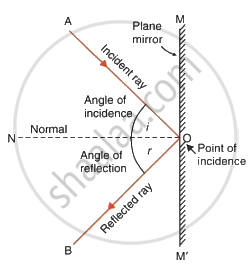
- Incident ray: The ray of light which falls on the mirror surface is called the incident ray.
- Point of incidence: The point at which the incident ray falls on the mirror is called the point of incidence.
- Normal: The normal is a line at right angles to the mirror surface at the point of incidence.
- Reflected ray: The ray of light which is sent back by the mirror is called the reflected ray.
- Angle of incidence: The angle of incidence is the angle made by the incident ray with the normal at the point of incidence.
- Angle of reflection: The angle of reflection is the angle made by the reflected ray with the normal at the point of incidence.
Definition: Refraction
The change in the direction of the path of light when it passes from one transparent medium to another transparent medium is called refraction. The refraction of light is essentially a surface phenomenon.
or
When light passes from one transparent medium to another, its speed and direction change. This is called refraction.
Definition: Refraction of Light
When travelling obliquely from one medium to another, the direction of propagation of light in the second medium changes. This phenomenon is known as refraction of light.
OR
Light changes its direction when going from one transparent medium to another transparent medium. This is called the refraction of light.
OR
The bending of the light ray from its path in passing from one medium to the other medium is called 'refraction' of light.
OR
When a ray of light impinges on a polished, smooth, shiny surface, the rebounding of light within the same medium is called reflection of light.
Define the principal focus of a concave mirror.
Light rays that are parallel to the principal axis of a concave mirror converge at a specific point on its principal axis after reflecting from the mirror. This point is known as the principal focus of the concave mirror.
Definition: Refracted Ray
The ray that enters the second medium after crossing the boundary is called the refracted ray.
Definition: Refracted Light
Refracted light is the part of light enters into the other medium and travels in a straight path but in a direction different from its initial direction and is called the refracted light.
Definition: Prism
A prism is a transparent medium bounded by five plane surfaces with a triangular cross-section.
Definition: Wave Interference
The phenomenon that occurs when two waves meet while travelling along the same medium is called wave interference.
Definition: Destructive Interference
The points of minimum intensity in the regions of superposition of waves are said to be in destructive interference.
Definition: Constructive Interference
The points of maximum intensity in the regions of superposition of waves are said to be in constructive interference.
Definition: Interference of Light
The phenomenon of redistribution of energy on account of superposition of light waves from two coherent sources is called interference of light.
Definition: Diffraction
Diffraction is the phenomenon of bending of light (or any wave) around the corners or edges of an obstacle or aperture, causing it to spread into the geometrical shadow region and produce alternate dark and bright regions.
Definition: Dielectric Strength
Dielectric Strength is the maximum electric field a dielectric can withstand without electrical breakdown (i.e., before it starts conducting).
Definition: Electric Polarisation
Electric Polarisation is the phenomenon in which an external electric field induces or aligns molecular dipoles within a dielectric, producing equal and opposite bound surface charges on its faces.
Definition: Dielectric Constant (K)
Dielectric Constant (K) is the ratio of the applied field to the net field inside the dielectric, indicating how much the material reduces the electric field.
Definition: Least Distance of Distinct Vision
For a normal, unaided human eye, D = 25 cm. If an object is brought closer than this, we cannot see it clearly. The minimum distance from the eye at which an object can be seen clearly is called the least distance of distinct vision.
OR
Due to the limitation of focusing the eye lens, it is not possible to take an object closer than a certain distance. This distance is called the least distance of distinct vision.
Definition: Angular Magnification or Magnifying Power
Angular magnification or magnifying power of an optical instrument is defined as the ratio of the visual angle made by the image formed by that optical instrument (β) to the visual angle subtended by the object when kept at the least distance of distinct vision (α).
Formulae [6]
Write the formula for a lens connecting image distance (v), object distance (u) and the focal length (f). How does the lens formula differ from the mirror formula?
Lens formula is:
`1/v-1/u=1/f`
Now, the mirror formula is given by:
`1/v+1/u=1/f`
In both the formulas,
u = Object distance
v = Image distance
f = Focal length
In the mirror formula, a positive sign is present between the reciprocals of the image distance and object distance.
In lens formula, a negative sign is present between the reciprocals of image distance and object distance.
Formula: Resultant Amplitude
When two waves of amplitudes a1 and a2 interfere at a point where phase difference is ϕ, the resultant amplitude is:
\[A^2=a_1^2+a_2^2+2a_1a_2\cos\phi\]
Formula: Resultant Intensity
I = I1 + I2 + 2\[\sqrt {I_1I_2}\] ⋅ cos ϕ
When I1 = I2 = I0:
I = \[2I_0(1+\cos\phi)=4I_0\cos^2\left(\frac{\phi}{2}\right)\]
Formula: Ratio of Maximum to Minimum Intensity
\[\frac{I_{\max}}{I_{\min}}=\left(\frac{a_1+a_2}{a_1-a_2}\right)^2=\left(\frac{\sqrt{I_1}+\sqrt{I_2}}{\sqrt{I_1}-\sqrt{I_2}}\right)^2\]
Formula: Dielectric Constant
K = \[\frac {E_0}{E}\]
K = \[\frac {\sigma}{\sigma-\sigma_i}\]
where σ = surface charge density on plates, σi = induced (bound) charge density.
Formula: Dielectric Strength
Eds = \[\frac {V_{max}}{d}\]
SI unit: V/m
Theorems and Laws [3]
Law: Laws of Refraction
The laws of refraction are fundamental for board examinations and objective tests.
First law
The incident ray, the refracted ray, and the normal at the point of incidence all lie in the same plane.
Second law
For a given pair of media, the ratio of the sine of the angle of incidence to the sine of the angle of refraction remains constant.
\[\frac {\text {sin i}}{\text {sin r}}\] = constant
This constant is called the refractive index of the second medium with respect to the first medium.
State the law of refraction.
The law of refraction is called Snell’s law.
Snell’s law states that,
- The incident ray, refracted ray and normal to the refracting surface are all coplanar (i.e., lie in the same plane).
- The ratio of the angle of incidence i in the first medium to the angle of reflection r in the second medium is equal to the ratio of the refractive index of the second medium n2 to that of the refractive index of the first medium n1.
`(sin "i")/(sin "r") = "n"_2/"n"_1`
Law: Young's Double Slit Experiment
Thomas Young first demonstrated the phenomenon of interference of light with the help of a slit, using a monochromatic source and two slits S1 and S2, producing alternating bright fringes (constructive interference) and dark fringes (destructive interference) on a screen.
Key Points
Key Points: Spherical Mirrors
Concepts [13]
- Introduction to Light
- Spherical Mirrors
- Speed of Light
- Refraction of Light
- Refraction at Single Spherical Surface
- Thin Lens
- Prism
- Theories on Light
- Wave Nature of Light and Huygens' Principle
- Interference
- Diffraction of Light
- Electric Polarisation of Dielectrics
- Introduction to Optical Instruments
