Definitions [18]
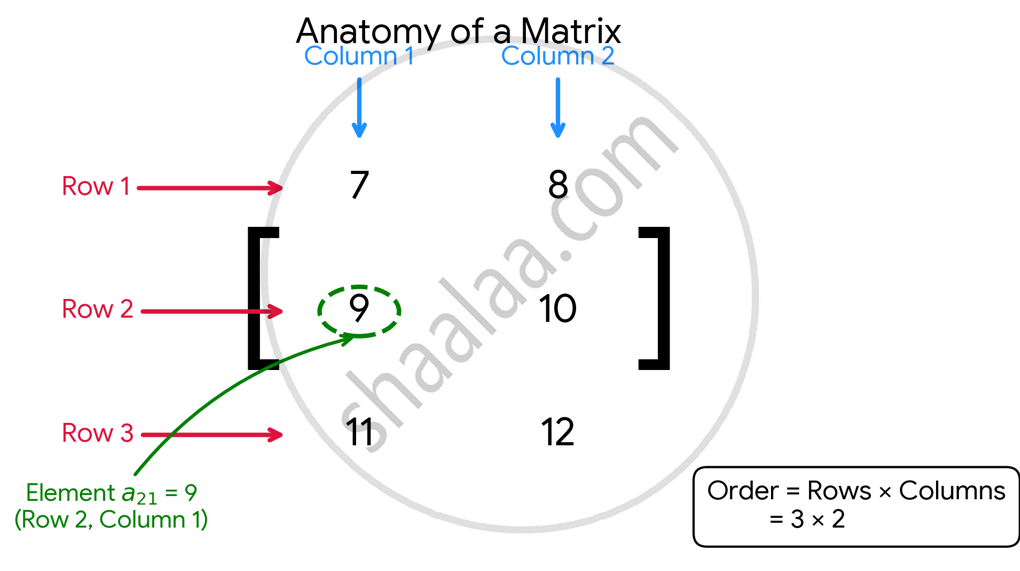
A matrix is a rectangular arrangement of numbers arranged in rows and columns, enclosed in brackets [ ] or parentheses ( ).
Elements (Entries) of a Matrix
- Each number in a matrix is called an element (or entry).
Rows and Columns
- Horizontal lines → rows
- Vertical lines → columns
Order of a Matrix
- Order = number of rows × number of columns
- Written as m × n and read as “m by n”
The negative of a matrix A, denoted by -A, is defined as the scalar multiple \[-1 \cdot A\].
-
So, if \[A = [a_{ij}]\], then \[-A = [-a_{ij}]\]
-
Adding a matrix to its negative gives the zero matrix: A + (-A) = O
where O is the zero matrix of the same order as A.
Let \[A = [a_{ij}]_{m \times n}\] be a matrix and k be a real number (scalar).
Then the scalar multiple of A by k is the matrix kA defined as:
That is, each entry of A is multiplied by the scalar k.
Let \[A = [a_{ij}]\] and \[B = [b_{ij}]\] be matrices of the same order \[m \times n\].
Their difference \[D = A - B\] is defined as the matrix \[[d_{ij}]\] where
Equivalently,
Let \[A = [a_{ij}]\] and \[B = [b_{ij}]\] be two matrices of the same order \[m \times n\].
Their sum \[C = A + B\] is defined as the matrix \[[c_{ij}]\] of order \[m \times n\], where
The negative of a matrix A, denoted by -A, is defined as the scalar multiple \[-1 \cdot A\].
-
So, if \[A = [a_{ij}]\], then \[-A = [-a_{ij}]\]
-
Adding a matrix to its negative gives the zero matrix: A + (-A) = O
where O is the zero matrix of the same order as A.
Let \[A = [a_{ij}]_{m \times n}\] be a matrix and k be a real number (scalar).
Then the scalar multiple of A by k is the matrix kA defined as:
That is, each entry of A is multiplied by the scalar k.
Let \[A = [a_{ij}]\] be an \[m \times n\] matrix and \[B = [b_{jk}]\] be an \[n \times p\] matrix.
Then the product C = AB is an \[m \times p\] matrix \[C = [c_{ik}]\], where each entry \[c_{ik}\] is given by:
A determinant is a single real number associated with a square matrix only.
- Denoted by det A or ∣A∣ or Δ
Consistent Solution: A system is consistent if it has at least one solution.
Inconsistent Solution: A system is inconsistent if it has no solution.
If A and B are non-singular square matrices of the same order such that AB = BA = I (where I is the identity matrix of the same order as A and B), then A and B are called inverses of each other.
We write A⁻¹ = B and B⁻¹ = A.
i.e. AA⁻¹ = A⁻¹A = I.
- If |A| ≠ 0, then A⁻¹ exists.
- If the inverse of a square matrix exists, then it is unique. A matrix can not have more than one distinct inverse.
The adjoint of A is defined as the transpose (i.e. interchange rows and columns) of the cofactor matrix, and it is denoted by adj (A).
Consistent Solution: A system is consistent if it has at least one solution.
Inconsistent Solution: A system is inconsistent if it has no solution.
The transpose of a matrix is obtained by interchanging its rows and columns.
-
If a matrix is A, its transpose is denoted by AT
-
If A is of order m × n, then
AT is of order n × m - First row of A becomes first column of AT, and so on.
A square matrix \[A = [a_{ij}]_{n \times n}\] is called skew-symmetric if \[A^T = -A\]
i.e.,\[a_{ij} = -a_{ji}\] for all i and j.
A square matrix \[A = [a_{ij}]_{n \times n}\] is called symmetric if
i.e., \[a_{ij} = a_{ji}\] for all i and j.
Let A = [aij] be a square matrix of order n. Then, the cofactor Cij (or Aij) of aij in A is (−1)i+j times Mij, where Mij is the minor of aij in A.
∴ Cij = (−1)i+j Mij
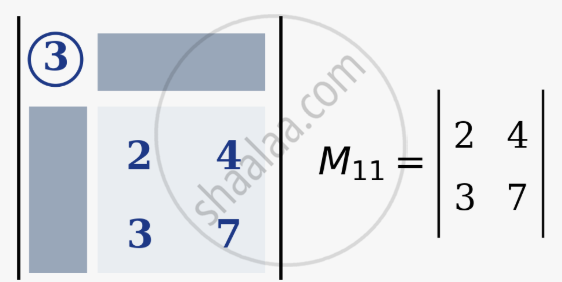
Let A = [aij] be a square matrix of order n. Then, the minor Mij of aij in A is the determinant obtained by deleting the ith row and the jth column in which element aij lies. It is denoted by Mij of A.
Formulae [2]
Order 1 (1×1 matrix):
∣A∣ = a
Order 2 (2×2 matrix):
∣A∣ = ad − bc
Order 3 (3×3 matrix):
\[A= \begin{bmatrix} a_{11} & a_{12} & a_{13} \\ a_{21} & a_{22} & a_{23} \\ a_{31} & a_{32} & a_{33} \end{bmatrix}\]
\[|A|=a_{11}(a_{22}a_{33}-a_{32}a_{23})-a_{12}(a_{21}a_{33}-a_{31}a_{23})+a_{13}(a_{21}a_{32}-a_{31}a_{22})\]
- If |A| = 0
A matrix is called a Singular Matrix - If |A| ≠ 0
Matrix is called a Non-Singular Matrix
For \[ A = \begin{bmatrix} a & b \\ c & d \end{bmatrix}, \]
\[ \boxed{\text{adj } A = \begin{bmatrix} d & -b \\ -c & a \end{bmatrix}} \]
Shortcut
For a \[2 \times 2\] matrix:
- Interchange the diagonal elements.
- Change the signs of the off-diagonal elements.
Theorems and Laws [3]
If A and B are symmetric matrices, prove that AB – BA is a skew symmetric matrix.
If A and B are symmetric matrices.
∴ A’ = A and B’ = B
(AB – BA) = (AB)’ – (BA)’ ...[∵ (X – Y) = X’ – Y’]
= B’A’ – A’B’ ...[∵ (XY) = Y’X’]
= BA – AB ...[∵ B’ = B, A’ = A]
= –(AB – BA)
∴ AB – BA is a skew symmetric matrix.
Theorem 2: Any square matrix can be expressed as the sum of a symmetric and a skew-symmetric matrix.
Proof: Let A be a square matrix, then we can write
\[\mathrm{A=\frac{1}{2}(A+A^{\prime})+\frac{1}{2}(A-A^{\prime})}\]
From Theorem 1, we know that (A + A′) is a symmetric matrix and (A − A′) is a skew-symmetric matrix.
Multiplying by \[\frac{1}{2}\] does not change these properties.
Since for any matrix A, (kA)′ = kA′, it follows that \[\frac{1}{2}(\mathrm{A}+\mathrm{A}^{\prime})\] is symmetric matrix and \[\frac{1}{2}(\mathrm{A}-\mathrm{A}^{\prime})\] is skew symmetric matrix.
Thus, any square matrix can be expressed as the sum of a symmetric and a skew-symmetric matrix.
Theorem 1: For any square matrix A with real number entries, A + A′ is a symmetric matrix and A − A′ is a skew-symmetric matrix.
Proof:
Part 1: Symmetric Matrix
Let B = A + A′, then
Take transpose on both sides:
B′ = (A + A′)′
= A′ + (A′)′ (as (A + B)′ = A′ + B′)
= A′ + A (as (A′)′ = A)
= A + A′ (as A + B = B + A)
= B
Therefore, B = A + A′ is a symmetric matrix
Part 2: Skew-Symmetric Matrix
Now let
C = A − A′
C′ = (A − A′)′ = A′ − (A′)′ (Why?)
= A′ − A (Why?)
= −(A − A′) = −C
Therefore
C = A − A′ is a skew-symmetric matrix.
Key Points
-
Matrix: A rectangular array of elements.
-
Element: An entry inside a matrix.
-
Order: Size of a matrix written as rows × columns.
-
Row: Horizontal set of elements.
-
Column: Vertical set of elements.
-
aij: Element in the i-th row and j-th column.
-
Scalar multiplication: \[kA = [ka_{ij}]\].
-
Negative of a matrix: -A = (-1)A.
-
Order of matrix does not change after scalar multiplication.
-
k(A + B) = kA + kB.
-
(k + l)A = kA + lA.
-
k(lA) = (kl)A.
-
\[0 \cdot A = O\], \[1 \cdot A = A\].
-
Matrices must be of same order for addition and subtraction.
-
\[A + B = [a_{ij} + b_{ij}]\].
-
A - B = A + (-B).
-
Addition is commutative: A + B = B + A.
-
Addition is associative: (A + B) + C = A + (B + C).
-
Zero matrix is additive identity: A + O = A.
-
Negative of a matrix is additive inverse: \[A + (-A) = O\].
-
If order differs \[\rightarrow\] operation not defined.
-
Scalar multiplication: \[kA = [ka_{ij}]\].
-
Negative of a matrix: -A = (-1)A.
-
Order of matrix does not change after scalar multiplication.
-
k(A + B) = kA + kB.
-
(k + l)A = kA + lA.
-
k(lA) = (kl)A.
-
\[0 \cdot A = O\], \[1 \cdot A = A\].
-
Matrix multiplication is row-by-column, not term-wise.
-
Product AB exists only if columns of A = rows of B.
-
If A is \[m \times n\] and B is \[n \times p\], then AB is \[m \times p\].
-
In general, \[AB \neq BA\], and sometimes one product may not even be defined.
-
Matrix multiplication is associative and distributive over addition.
-
Identity matrix acts as a multiplicative identity: AI = IA = A.
-
Zero matrix absorbs multiplication: AO = OA = O.
| Matrix Type | Order | Key Property |
|---|---|---|
| Row Matrix | 1 × n | Only one row |
| Column Matrix | m × 1 | Only one column |
| Square Matrix | n × n | Rows = Column |
| Diagonal Matrix | n × n | Square; non-diagonal elements = 0 |
| Scalar Matrix | n × n | Diagonal; all diagonal elements equal |
| Identity Matrix | n × n | Scalar matrix with diagonal = 1 |
| Zero Matrix | Any order | All elements = 0 |
| Concept | Key Point / Formula |
|---|---|
| Area of Triangle | \[ \boxed{\dfrac{1}{2}\begin{vmatrix} x_1 & y_1 & 1 \\ x_2 & y_2 & 1 \\ x_3 & y_3 & 1 \end{vmatrix}} \] |
| Collinearity | Three points are collinear if determinant =0=0 |
| Equation of Line | Line through two points can be written using a 3 × 3 determinant |
| Consistent System | Has at least one solution |
| Inconsistent System | Has no solution |
| Non-Singular Case | \[ |A| \neq 0 \] |
| Singular Case | ∣A∣=0 |
| Concept | Formula / Rule |
|---|---|
| Adjoint | adjA= transpose of cofactor matrix |
| 2×2 Adjoint | \[ \text{adj} \begin{bmatrix} a & b \\ c & d \end{bmatrix} = \begin{bmatrix} d & -b \\ -c & a \end{bmatrix} \] |
| Fundamental Property | \[ A(\text{adj } A) = (\text{adj } A)A = |A|I_n \] |
| Singular Matrix | if ∣A∣ = 0 |
| Non-Singular Matrix | if \[ |A| \neq 0 \] |
| For a square matrix A of order n | \[ |\text{adj } A| = |A|^{n-1} \] |
| Invertibility | A is invertible iff \[ |A| \neq 0 \] |
| Inverse | \[ A^{-1} = \frac{1}{|A|}\ \text{adj } A \] |
| Concept | Key Point / Formula |
|---|---|
| Area of Triangle | \[ \boxed{\dfrac{1}{2}\begin{vmatrix} x_1 & y_1 & 1 \\ x_2 & y_2 & 1 \\ x_3 & y_3 & 1 \end{vmatrix}} \] |
| Collinearity | Three points are collinear if determinant =0=0 |
| Equation of Line | Line through two points can be written using a 3 × 3 determinant |
| Consistent System | Has at least one solution |
| Inconsistent System | Has no solution |
| Non-Singular Case | \[ |A| \neq 0 \] |
| Singular Case | ∣A∣=0 |
-
Transpose = interchange rows and columns.
-
If A is \[m \times n\], then A' is \[n \times m\].
-
Standard notation: A' or \[A^T\].
-
Key properties: (A')' = A, (kA)' = kA', (A + B)' = A' + B', (AB)' = B'A'.
-
A square matrix is symmetric if \[A^T = A\].
-
A square matrix is skew-symmetric if \[A^T = -A\].
-
In a skew-symmetric matrix, all diagonal elements are zero.
-
For any square matrix A:
-
\[A + A^T\] is symmetric.
-
\[A - A^T\] is skew-symmetric.
-
-
Any square matrix A can be written as
-
The decomposition into symmetric and skew-symmetric parts is unique.
-
Minor \[M_{ij}\]: determinant of the matrix obtained by deleting row i and column j.
-
Cofactor \[C_{ij}\]: \[C_{ij} = (-1)^{i+j}M_{ij}\].
-
Determinant expansion along row i: \[|A| = \sum_{j=1}^{n} a_{ij}C_{ij}\].
-
Determinant expansion along column j: \[|A| = \sum_{i=1}^{n} a_{ij}C_{ij}\].
-
Determinant value is the same for any choice of row or column for expansion.
-
Mixed row/column property: \[\sum_{j=1}^{n} a_{ij}C_{kj} = 0\] for \[i \neq k\].
Concepts [20]
- Concept of Matrices
- Operations on Matrices>Scalar Multiplication
- Operations on Matrices> Addition and Subtraction of Matrices
- Operations on Matrices>Scalar Multiplication
- Operations on Matrices> Matrix Multiplication
- Types of Matrices
- Concept of Determinant
- Properties of Determinants
- Evaluation of Determinants
- Application of Determinants to Coordinate Geometry
- Adjoint and Inverse of a Matrix
- Inverse of a Square Matrix by the Adjoint Method
- Test of Consistency
- Application of Determinants to Coordinate Geometry
- Transpose of a Matrix
- Symmetric and Skew Symmetric Matrices
- Multiplication of Two Determinants
- Minors and Co-factors
- Some Special Cases of Matrix
- Rank of a Matrix
