Definitions [10]
If an equation contains derivatives of one dependent variable with respect to one or more independent variables, then it is called a differential equation.
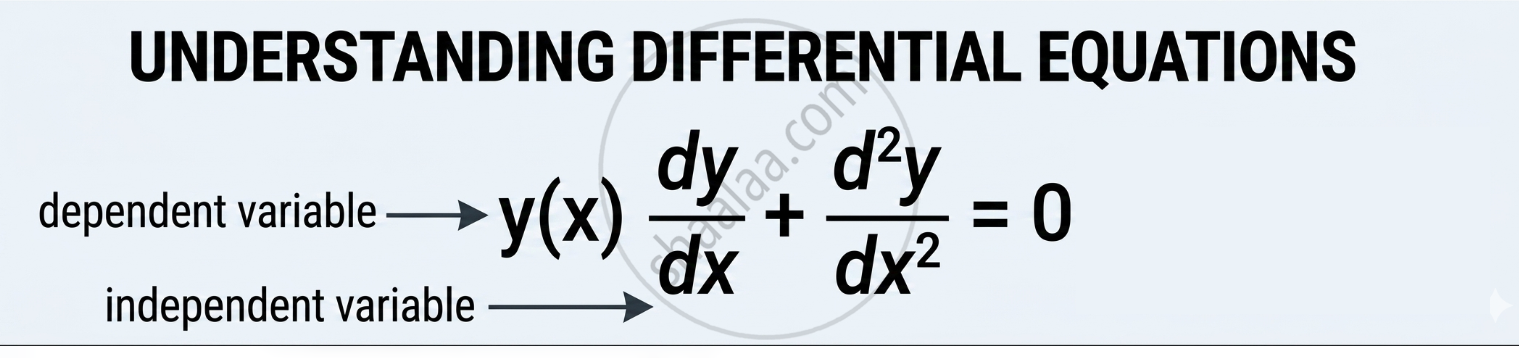
Example
This is a differential equation because it contains the derivative \[\frac{dy}{dx}\].
A differential equation that contains ordinary derivatives of one or more dependent variables with respect to a single independent variable is called an ordinary differential equation.
Example:
The order of the highest differential coefficient (or the highest order derivative appearing in a differential equation) is the order of the differential equation.
The highest exponent of the highest derivative is called the degree of a differential equation, provided exponents of each derivative and an unknown variable appearing in the differential equation are non-negative integers.
Any relation between independent and dependent variables which does not involve derivatives, such that this relation and the derivatives obtained from it satisfy the given differential equation, is called a solution of the differential equation.
A solution obtained from the general solution by giving particular values to the arbitrary constants is called a particular solution.
A solution of a differential equation in which the number of arbitrary constants equals the order of the differential equation is called the general solution of the differential equation.
A differential equation \[ \frac{dy}{dx} = F(x,y) \] is said to be in variable separable form if \[ F(x,y) = g(x)h(y). \]
Thus, \[ \frac{dy}{dx} = g(x)h(y) \] and, if \[ h(y) \neq 0, \]
\[ \boxed{\,\frac{1}{h(y)}\,dy = g(x)\,dx\,}. \]
A differential equation of the form \[\frac{dy}{dx}=\frac{f_{1}(x,y)}{f_{2}(x,y)},\] where f1(x, y) and f2(x, y) are homogeneous functions of x and y of the same degree, is called a homogeneous differential equation.
A function \[ F(x,y) \] is called homogeneous of degree \[ n \] if
\[ \boxed{\,F(\lambda x, \lambda y) = \lambda^{n} F(x,y)\,} \]
for any non-zero constant \[ \lambda. \]
A first-order and first-degree differential equation of the form
\[ \boxed{\,\frac{dy}{dx} + Py = Q\,} \]
where \[ P \] and \[ Q \] are constants or functions of \[ x \] only, is called a first-order linear differential equation.
Similarly, if \[ x \] is treated as a function of \[ y, \] it may be written as
\[ \boxed{\,\frac{dx}{dy} + P_{1}x = Q_{1}\,} \]
where \[ P_{1} \] and \[ Q_{1} \] are constants or functions of \[ y \] only.
Formulae [1]
For y = vx:
\[ \boxed{\,\frac{dy}{dx} = v + x\,\frac{dv}{dx}\,} \]
\[ \frac{dv}{g(v) - v} = \frac{dx}{x} \]
For x = vy:
\[ \boxed{\,\frac{dx}{dy} = v + y\,\frac{dv}{dy}\,} \]
Theorems and Laws [1]
Prove that:
`int_0^(2a)f(x)dx = int_0^af(x)dx + int_0^af(2a - x)dx`
Since ‘a’ lies between 0 and 2a,
we have
`int_0^(2a)f(x)dx=int_0^af(x)dx+int_a^(2a)f(x)dx, .......(byint_a^bf(x)dx=int_a^cf(x)dx+int_c^bf(x)dx)`
`=I_1+I_2` ........................(say)
`I_2 = int_a^(2a)f(x)dx`
Put x = 2a − t
Therefore, dx = −dt
When x = a, 2a − t = a
t = a
When x = 2a, 2a − t = 2a
t = 0
`I_2 = int_0^(2a) f(x) dx = int_a^0 f(2a - t) (-dt)`
`= -int_a^0 f(2a - t)dt = int_0^a f(2a - t)dt ...................... (By int_a^b f(x)dx = -int_b^a f(x)dx)`
`=int_0^a f(2a - x)dx ..............(By int_a^b f(X)dx = int_a^b f(t)dt)`
`int_0^(2a) f(x)dx = int_0^a f(x)dx + int_0^a f(2a - x)dx`
`= int_0^a [f(x) + f(2a - x)]dx`
To show that:
`int_0^pi sin x dx = 2 int_0^(pi/2) sin x dx`
We use the proven property by setting f(x) = sin x and 2a = π, which means a = `pi/2`.
The property tells us that:
`int_0^pi sin x dx = int_0^(pi/2) sin x dx + int_0^(pi/2) sin (pi - x) dx`
Knowing the trigonometric identity sin (π - x) = sin x, the equation simplifies to:
`int_0^pi sin x dx = 2 int_0^(pi/2) sin x dx`
This directly applies the property to the integral of sin x over [0, π] to show it equals twice the integral of sin x over `[0, pi/2]`, demonstrating the utility of this property in simplifying integrals with symmetric functions over specific intervals.
Key Points
-
A differential equation contains derivatives.
-
An ordinary differential equation contains derivatives with respect to only one independent variable.
-
Differential equations describe rates of change in mathematics and science.
-
Order = highest derivative order.
-
Degree = power of highest derivative.
-
Degree exists only for polynomial equations in derivatives.
-
Always check polynomial condition before stating the degree.
- Order and degree, if defined, are always positive integers.
- A differential equation contains derivatives of an unknown function.
-
Its solution is generally a function, not a single number.
-
The graph of the solution function is called the solution curve or integral curve.
-
A general solution contains arbitrary constants.
-
A particular solution is obtained by assigning fixed values to those constants.
-
To verify a solution, substitute the function and its derivatives into the equation and check whether LHS = RHS.
-
A variable separable equation can be rearranged so that all y-terms are with dy and all x-terms are with dx.
-
Separate variables first, then integrate.
-
Use one constant of integration.
-
Apply the initial condition only after getting the general solution.
-
Final answers may be explicit or implicit.
-
Check homogeneity first.
-
Differentiate substitution carefully.
-
Convert to separable form.
-
Back-substitute to original variables.
- Write the equation in the form dy/dx + Py = Q
- Identify P and Q or P1 and Q1
- Find I.F. =
\[ \frac{dy}{dx} + Py = Q \Rightarrow \text{I.F.} = e^{\int P\,dx} \]
\[ \frac{dx}{dy} + P_{1}x = Q_{1} \Rightarrow \text{I.F.} = e^{\int P_{1}\,dy} \]
- Multiply the whole equation by I.F.
- Integrate and get a solution.
Concepts [10]
- Basic Concepts of Differential Equations
- Order and Degree of a Differential Equation
- Solution of a Differential Equation
- Formation of a Differential Equation Whose General Solution is Given
- Procedure to Form a Differential Equation that Will Represent a Given Family of Curves
- Methods of Solving First Order, First Degree Differential Equations
- Forms of Solving Differential Equations> Variable Separable
- Forms of Solving Differential Equations> Homogeneous Differential Equations
- Forms of Solving Differential Equations>Linear Differential Equations
- Solutions of Linear Differential Equation
