Definitions [12]
Two figures are similar if they have the same shape but may differ in size.
- Same shape means: Corresponding angles are equal
-
May differ in size means: Corresponding sides are proportional
Two figures are congruent if they have the same shape and size.
Important relation:
- Congruent figures are always similar
- Similar figures are not necessarily congruent
If a figure is transformed so that each side of the image is greater than the corresponding side of the original figure, then the figure is said to be enlarged.
If a figure is transformed so that each side of the image is smaller than the corresponding side of the original figure, then the figure is said to be reduced.
The number by which the dimensions of a figure are multiplied to obtain its image is called the scale factor.
A transformation in which a given figure is enlarged or reduced by a scale factor, such that the resulting figure is similar to the given figure, is called similarity as a size transformation.
The fixed point with respect to which a figure is enlarged or reduced is called the centre of enlargement or centre of reduction.
A map and the actual region are similar figures.
-
Scale factor: \[k=\frac{1}{p}\]
Formulas:
-
Length on map = k × Actual length
-
Area on map = k2 × Actual area
A model and the actual object are similar figures.
-
Scale factor: Scale factor: \[k=\frac{1}{p}\]
Formulas:
-
Length of model = k × Actual length
-
Area of model = k2 × Actual area
-
Volume of model = k3 × Actual volume
In similar triangles, the sides opposite to equal angles are said to be the
corresponding sides.
ΔABC ∼ ΔPQR
\[\frac{AB}{PQ}=\frac{BC}{QR}=\frac{AC}{PR}\]
Two triangles are similar if
- Their corresponding angles are equal, and
- Their corresponding sides are proportional.
- Symbolically:
ΔABC ∼ ΔPQR (read as “ABC is similar to PQR”).
In similar triangles, the angles opposite to proportional sides are the corresponding angles, and so, they are equal.
-
∠A = ∠P
-
∠B = ∠Q
-
∠C = ∠R
Theorems and Laws [3]
Statement:
If a line divides any two sides of a triangle in the same ratio, then the line is parallel to the third side.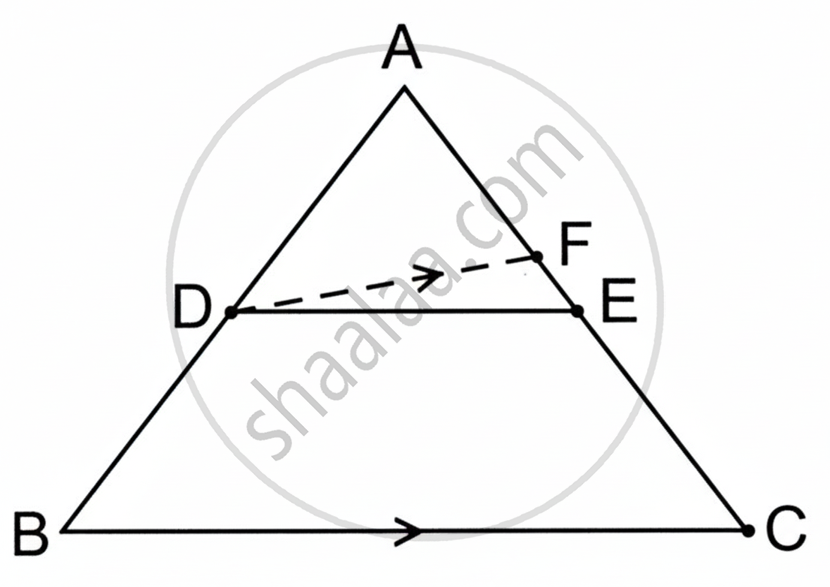
To Prove:
-
Assume a line through point D parallel to BC meets AC at F.
-
By BPT, \[\frac{\mathrm{AD}}{\mathrm{DB}}=\frac{\mathrm{AF}}{\mathrm{FC}}\]
- Given, \[\frac{\mathrm{AD}}{\mathrm{DB}}=\frac{\mathrm{AE}}{\mathrm{EC}}\]
-
Hence,\[\frac{AF}{FC}=\frac{AE}{EC}\]
-
⇒ Points E and F coincide.
Therefore,
Statement:
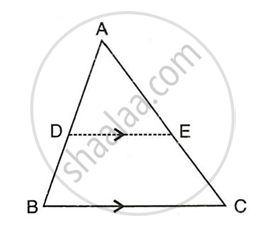
If a line is drawn parallel to one side of a triangle, it divides the other two sides in the same ratio.
To Prove:
\[\frac{\mathrm{AD}}{\mathrm{DB}}=\frac{\mathrm{AE}}{\mathrm{EC}}\]
Proof:
-
A line parallel to a side of a triangle forms equal corresponding angles.
-
Hence, the two triangles formed are similar (AAA similarity).
-
In similar triangles, corresponding sides are proportional.
Therefore, the line divides the two sides in the same ratio.
\[\frac{\mathrm{AD}}{\mathrm{DB}}=\frac{\mathrm{AE}}{\mathrm{EC}}\]
Statement:
When two triangles are similar, the ratio of the areas of those triangles is equal to the ratio of the squares of their corresponding sides.
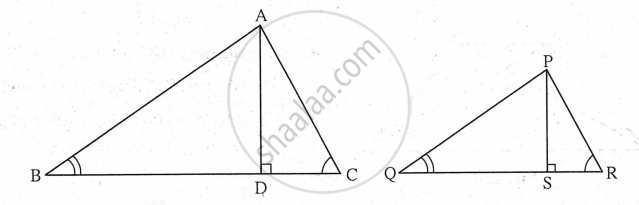
\[\frac{\mathrm{BC}^{2}}{\mathrm{QR}^{2}}=\frac{\mathrm{AB}^{2}}{\mathrm{PQ}^{2}}=\frac{\mathrm{AC}^{2}}{\mathrm{PR}^{2}}\]
- corresponding altitudes
- corresponding medians
- corresponding angle bisectors
Key Points
Scale factor k
- → Enlargement
- k < 1 → Reduction
- k = 1→ Identity transformation
- Each side of the image = k × corresponding side of object
- Area of image = k2 × area of object
- Volume of image = k3 × volume of object
-
AA / AAA → two angles equal
-
SAS → included angle equal + sides proportional
-
SSS → all sides proportional
Important Questions [4]
- In the given figure ∠BAP = ∠DCP = 70°, PC = 6 cm and CA = 4 cm, then PD : DB is ______.
- In the given diagram, ΔABC ∼ ΔPQR. If AD and PS are the bisectors of ∠BAC and ∠QPR, respectively, then ______.
- In the given diagram, ΔADB and ΔACB are two right-angled triangles with ∠ADB = ∠BCA = 90°. If AB = 10 cm, AD = 6 cm, BC = 2.4 cm and DP = 4.5 cm. Prove that ΔAPD ∼ ΔBPC Find the length of BD and PB
- In the given figure, AC || DE || BF. If AC = 24 cm, EG = 8 cm, GB = 16 cm, BF = 30 cm. Prove ΔGED ∼ ΔGBF Find DE DB : AB
