Definitions [8]
"dy/dx is called the derivative of y with respect to x (which is the rate of change of y with respect to change in x) and the process of finding the derivative is called differentiation."
If f(x) approaches a real number l, when x approaches a, then l is called the limit of f(x).
Symbolically, \[\lim_{x\to a}f\left(x\right)=l\]
When we have the values of f near x to the left of a, i.e.
\[\lim_{x\to a^{-}}f\left(x\right)\] is the expected value of f at x = a.
When we have the values of f near x to the right of a i.e.
\[\lim_{x\to a^{+}}f\left(x\right)\] is the expected value of f at x = a.
Removable Discontinuity:
If \[\lim_{x\to a^{-}}f\left(x\right)=\lim_{x\to a^{+}}f\left(x\right)\neq f\left(a\right),\] then f(x) is said to be removable discontinuous.
Non Removable Discontinuity:
If \[\lim_{x\to a^{+}}f\left(x\right)\neq\lim_{x\to a^{-}}f\left(x\right),\] then f(x) is said to be non-removable discontinuous.
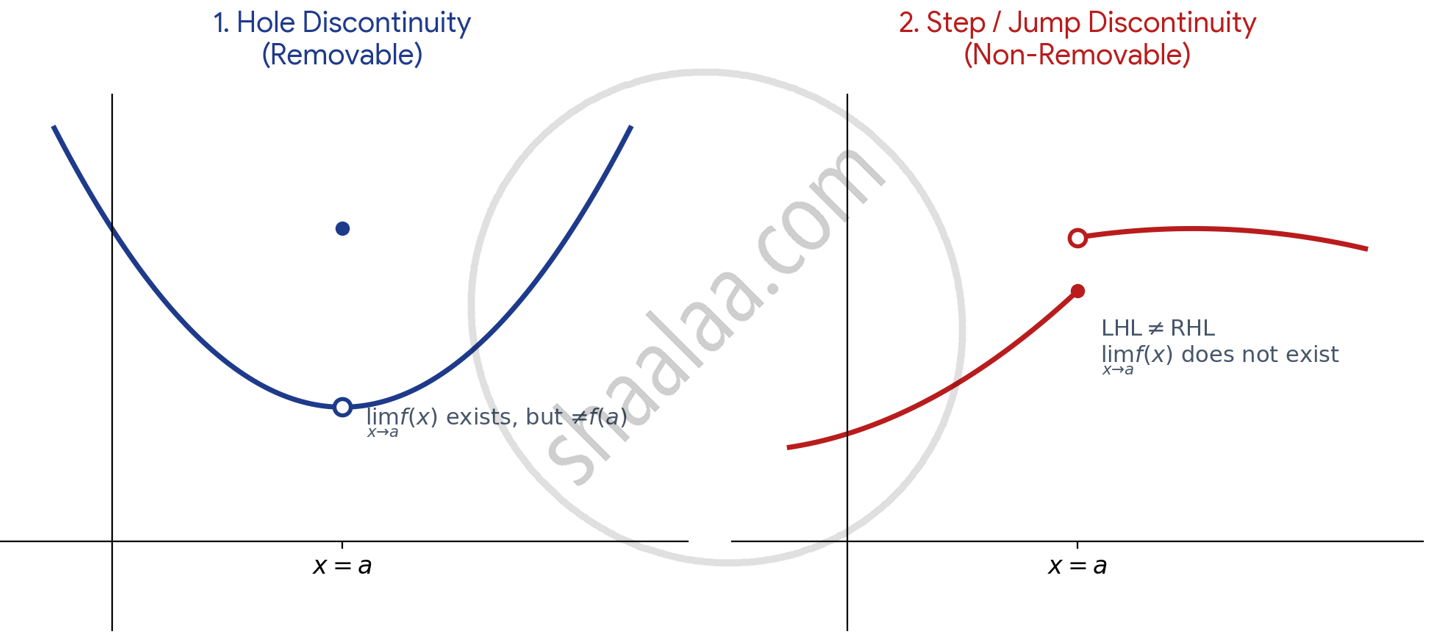
A function f(x) is said to be discontinuous at x = a if it is not continuous at x = a, i.e.
- \[\lim_{x\to a}f\left(a\right)\] does not exist.
- The left-hand limit and the right-hand limit are not equal.
- \[\lim_{x\to a}f\left(x\right)\neq f\left(a\right)\].
A real-valued function \[f\] is said to be continuous at \[x = c\] if
\[ \boxed{\lim_{x \to c} f(x) = f(c)} \]
In terms of one-sided limits,
\[ \boxed{\lim_{x \to c^-} f(x) = \lim_{x \to c^+} f(x) = f(c)} \]
Thus, for continuity at \[x = c\]:
- \[f(c)\] must be defined.
- Left-hand limit must exist.
- Right-hand limit must exist.
- Both limits must be equal to \[f(c)\]
If any of these conditions fails, \[f\] is discontinuous at \[x = c\].
A real function \[f\] is said to be a continuous function if it is continuous at every point in its domain.
\[ \boxed{\lim_{x \to c} f(x) = f(c)} \] for every \[c\] in the domain of \[f\].
Continuity at End Points
If \[f\] is defined on a closed interval \[[a, b]\]:
At the left endpoint \[a\], \[ \boxed{\lim_{x \to a^+} f(x) = f(a)} \]
At the right endpoint \[b\], \[ \boxed{\lim_{x \to b^-} f(x) = f(b)} \]
Only the appropriate one-sided limit is considered at an endpoint.
Theorems and Laws [1]
If f(x) ≤ g(x) ≤ h(x) and \[\lim_{x\to a}\mathrm{f}(x)=l=\lim_{x\to a}\mathrm{h}(x)\]
\[\therefore\lim_{x\to a}g(x)=l\]
Key Points
- Continuity at \[x = c\]: \[ \boxed{\lim_{x \to c} f(x) = f(c)} \]
- Practical test: \[ \boxed{\text{LHL} = \text{RHL} = f(c)} \]
If this condition fails, the function is discontinuous at \[c\]. - A function is continuous if it is continuous at every point in its domain.
- Constant, identity and polynomial functions are continuous on their domains.
- \[\dfrac{1}{x}\] is continuous for \[x \neq 0\].
- For a piecewise function, check continuity particularly at the point where the rule changes.
- The greatest integer function \[[x]\] is discontinuous at every integer.
