Definitions [3]
An equation with one variable, in which the highest power of the variable is two, is known as a quadratic equation.
Standard Form:
ax2 + bx + c = 0, a ≠ 0
For example :
(i) 3x2 + 4x + 7 = 0
(ii) 4x2 + 5x = 0
A value of the variable which satisfies the equation is called a root (solution).
If substituting a value of x makes the polynomial zero, that value is a root.
- A number α is called a root of ax2 + bx + c = 0, if aα2 + bα + c = 0
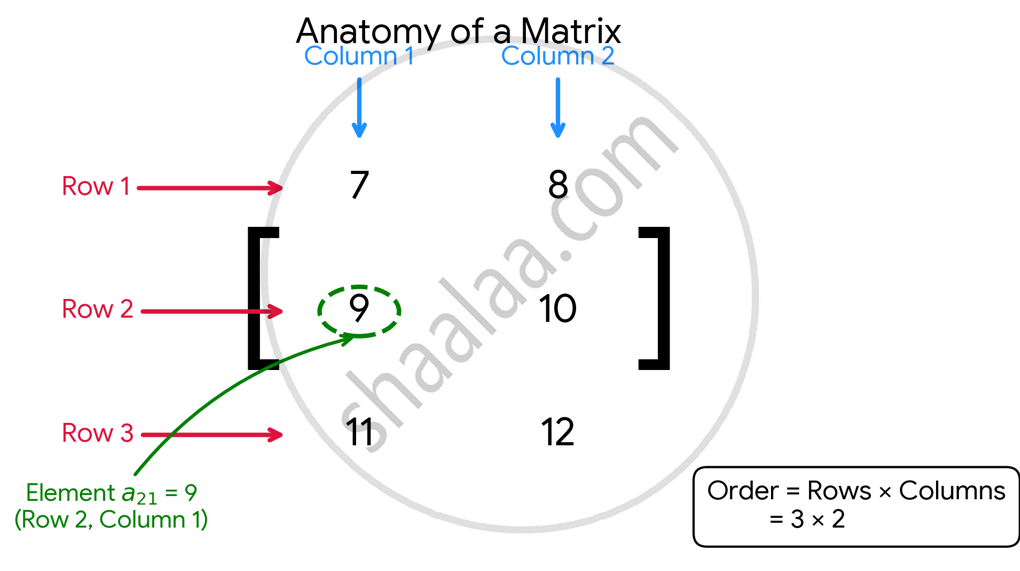
A matrix is a rectangular arrangement of numbers arranged in rows and columns, enclosed in brackets [ ] or parentheses ( ).
Elements (Entries) of a Matrix
- Each number in a matrix is called an element (or entry).
Rows and Columns
- Horizontal lines → rows
- Vertical lines → columns
Order of a Matrix
- Order = number of rows × number of columns
- Written as m × n and read as “m by n”
Key Points
- A quadratic equation has degree 2.
- Its standard form is \[ ax^2 + bx + c = 0, \] where \[ a \neq 0. \]
- A root is a value of \[ x \] that satisfies the equation.
- A quadratic equation has at most two roots.
-
Matrix: A rectangular array of elements.
-
Element: An entry inside a matrix.
-
Order: Size of a matrix written as rows × columns.
-
Row: Horizontal set of elements.
-
Column: Vertical set of elements.
-
aij: Element in the i-th row and j-th column.
Concepts [8]
- Simultaneous Linear Equations in Three Variables
- GCD and LCM of Polynomials
- Rational Expressions
- Square Root of Polynomials
- Concept of Quadratic Equations
- Graph of Variations
- Quadratic Graphs
- Concept of Matrices
