Definitions [5]
In similar triangles, the angles opposite to proportional sides are the corresponding angles, and so, they are equal.
-
∠A = ∠P
-
∠B = ∠Q
-
∠C = ∠R
In similar triangles, the sides opposite to equal angles are said to be the
corresponding sides.
ΔABC ∼ ΔPQR
\[\frac{AB}{PQ}=\frac{BC}{QR}=\frac{AC}{PR}\]
Two triangles are similar if
- Their corresponding angles are equal, and
- Their corresponding sides are proportional.
- Symbolically:
ΔABC ∼ ΔPQR (read as “ABC is similar to PQR”).
A secant is a straight line that passes through the circle and intersects it at two distinct points.

line AB cuts the circle at points M and N ⇒ AB is a secant.
A tangent is a straight line that touches a circle at exactly one point only, without cutting through it. This single point where the tangent touches the circle is called the point of contact or point of tangency.
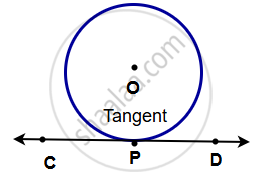
Line CD touches the circle at point P only ⇒ CD is a tangent
Point P is the point of contact.
Theorems and Laws [5]
In the given figure, AD is a median of a triangle ABC and AM ⊥ BC. Prove that:
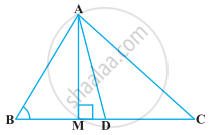
(i) `"AC"^2 = "AD"^2 + "BC"."DM" + (("BC")/2)^2`
(ii) `"AB"^2 = "AD"^2 - "BC"."DM" + (("BC")/2)^2`
(iii) `"AC"^2 + "AB"^2 = 2"AD"^2 + 1/2"BC"^2`
(i) Applying Pythagoras theorem in ΔAMD, we obtain
AM2 + MD2 = AD2 … (1)
Applying Pythagoras theorem in ΔAMC, we obtain
AM2 + MC2 = AC2
AM2 + (MD + DC)2 = AC2
(AM2 + MD2) + DC2 + 2MD.DC = AC2
AD2 + DC2 + 2MD.DC = AC2 [Using equation (1)]
Using the result, DC = `"BC"/2`, we obtain
`"AD"^2+(("BC")/2)^2 + 2"MD".(("BC")/2) = "AC"^2`
`"AD"^2+(("BC")/2)^2 + "MC" xx "BC" = "AC"^2`
(ii) Applying Pythagoras theorem in ΔABM, we obtain
AB2 = AM2 + MB2
= (AD2 − DM2) + MB2
= (AD2 − DM2) + (BD − MD)2
= AD2 − DM2 + BD2 + MD2 − 2BD × MD
= AD2 + BD2 − 2BD × MD
= `"AD"^2+(("BC")/2)^2 - 2(("BC")/2) xx "MD"`
= `"AD"^2 + ("BC"/2)^2 - "BC" xx "MD"`
(ii) Applying Pythagoras theorem in ΔABM, we obtain
AM2 + MB2 = AB2 … (1)
Applying Pythagoras theorem in ΔAMC, we obtain
AM2 + MC2 = AC2 … (2)
Adding equations (1) and (2), we obtain
2AM2 + MB2 + MC2 = AB2 + AC2
2AM2 + (BD − DM)2 + (MD + DC)2 = AB2 + AC2
2AM2+BD2 + DM2 − 2BD.DM + MD2 + DC2 + 2MD.DC = AB2 + AC2
2AM2 + 2MD2 + BD2 + DC2 + 2MD (− BD + DC)
= AB2 + AC2
= `2("AM"^2 + "MD"^2) + (("BC")/2)^2 + (("BC")/2)^2 + 2"MD" ((-"BC")/2 + ("BC")/2) = "AB"^2 + "AC"^2`
`"2AD"^2 + ("BC"^2)/2 = "AB"^2 + "AC"^2`
In the given figure, AD is a median of a triangle ABC and AM ⊥ BC. Prove that:
`"AC"^2 = "AD"^2 + "BC"."DM" + (("BC")/2)^2`
Applying Pythagoras theorem in ΔAMD, we obtain
AM2 + MD2 = AD2 … (1)
Applying Pythagoras theorem in ΔAMC, we obtain
AM2 + MC2 = AC2
AM2 + (MD + DC)2 = AC2
(AM2 + MD2) + DC2 + 2MD.DC = AC2
AD2 + DC2 + 2MD.DC = AC2 [Using equation (1)]
Using the result, DC = `"BC"/2`, we obtain
`"AD"^2+(("BC")/2)^2 + 2"MD".(("BC")/2) = "AC"^2`
`"AD"^2+(("BC")/2)^2 + "MC" xx "BC" = "AC"^2`
Prove that, in a right-angled triangle, the square of the hypotenuse is equal to the sum of the square of remaining two sides.
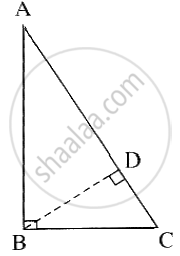
Draw perpendicular BD from the vertex B to the side AC. A – D
In right-angled ΔABC
seg BD ⊥ hypotenuse AC.
∴ By the similarity in right-angled triangles
ΔABC ~ ΔADB ~ ΔBDC
Now, ΔABC ~ ΔADB
∴ `"AB"/"AD" = "AC"/"AB"` ...(c.s.s.t)
∴ AB2 = AC × AD ...(1)
Also, ΔABC ~ ΔBDC
∴ `"BC"/"DC" = "AC"/"BC"` ...(c.s.s.t)
∴ BC2 = AC × DC ...(2)
From (1) and (2),
AB2 + BC2 = AC × AD + AC × DC
= AC × (AD + DC)
= AC × AC ...(A – D – C)
∴ AB2 + BC2 = AC2
i.e., AC2 = AB2 + BC2
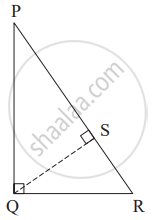
Given: In ΔPQR, ∠PQR = 90°.
To prove: PR2 = PQ2 + QR2.
Construction:
Draw seg QS ⊥ side PR such that P–S–R.
Proof: In ΔPQR,
∠PQR = 90° ...(Given)
Seg QS ⊥ hypotenuse PR ...(Construction)
∴ ΔPSQ ∼ ΔQSR ∼ ΔPQR ...(Similarity of right-angled triangles) ...(1)
ΔPSQ ∼ ΔPQR ...[From (1)]
∴ `"PS"/"PQ" = "PQ"/"PR"` ...(Corresponding sides of similar triangles are in proportion)
∴ PQ2 = PS × PR ...(2)
ΔQSR ∼ ΔPQR ...[From (1)]
∴ `"SR"/"QR" = "QR"/"PR"` ...(Corresponding sides of similar triangles are in proportion)
∴ QR2 = SR × PR ...(3)
Adding (2) and (3), we get
PQ2 + QR2 = PS × PR + SR × PR
∴ PQ2 + QR2 = PR(PS + SR)
∴ PQ2 + QR2 = PR × PR ...(P–S–R)
∴ PQ2 + QR2 = PR2 OR PR2 = PQ2 + QR2.
In the given figure, ∆ABC is an obtuse triangle, obtuse-angled at B. If AD ⊥ CB (produced) prove that AC2 = AB2 + BC2 + 2BC · BD.
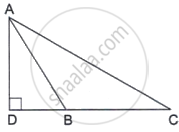
Given: An obtuse triangle ABC, obtuse-angled at B and AD is perpendicular to CB produced.
To Prove: AC2 = AB2 + BC2 + 2BC × BD
Proof: Since ∆ADB is a right triangle right angled at D. Therefore, by
Pythagoras theorem, we have AB2 = AD2 + DB2 ….(i)
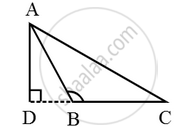
Again ∆ADC is a right triangle right angled at D.
Therefore, by Phythagoras theorem, we have
AC2 = AD2 + DC2
⇒ AC2 = AD2 + (DB + BC)2
⇒ AC2 = AD2 + DB2 + BC2 + 2BC • BD
⇒ AC2 = AB2 + BC2 + 2BC • BD [Using (i)]
Hence, AC2 = AB2 + BC2 + 2BC • BD
AB, BC and AC are three sides of a right-angled triangle having lengths 6 cm, 8 cm and 10 cm, respectively. To verify the Pythagoras theorem for this triangle, fill in the boxes:
ΔABC is a right-angled triangle and ∠ABC = 90°.
So, by the Pythagoras theorem,
`square` + `square` = `square`
Substituting 6 cm for AB and 8 cm for BC in L.H.S.
`square` + `square` = `square` + `square`
= `square` + `square`
= `square`
Substituting 10 cm for AC in R.H.S.
`square` = `square`
= `square`
Since, L.H.S. = R.H.S.
Hence, the Pythagoras theorem is verified.
ΔABC is a right-angled triangle and ∠ABC = 90°.
So, by the Pythagoras' theorem,
AB2 + BC2 = AC2
Substituting 6 cm for AB and 8 cm for BC in L.H.S.
AB2 + BC2 = 62 + 82
= 36 + 64
= 100
Substituting 10 cm for AC in R.H.S.
AC2 = 102
= 100
Since, L.H.S. = R.H.S.
Hence, the Pythagoras theorem is verified.
Concepts [7]
- Fundamentals of Geometrical Concepts
- Similarity of Triangles (Corresponding Sides & Angles)
- Thales Theorem and Angle Bisector Theorem
- Right-angled Triangles and Pythagoras Property
- Pythagoras Theorem
- Secant and Tangent
- Concurrency Theorems
