Commerce (English Medium)
Arts (English Medium)
Academic Year: 2025-2026
Date: मार्च 2026
Advertisements
GENERAL INSTRUCTIONS:
- This question paper contains two sections:
Section A – Macro Economics
Section B – Indian Economic Development - This paper contains 20 Multiple Choice Type Questions of 1 mark each.
- This paper contains 4 Short Answer Type Questions of 3 marks each to be answered in 60 to 80 words.
- This paper contains 6 Short Answer Type Questions of 4 marks each to be answered in 80 to 100 words.
- This paper contains 4 Long Answer Type Questions of 6 marks each to be answered in 100 to 150 words.
With reference to the given diagram, which of the following is true at point B?
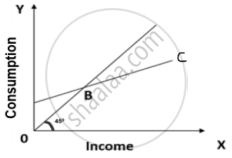
Slope of Consumption Curve = 0
Average Propensity to Consume = 0
Slope of Saving Curve = 1
Average Propensity to Consume = 1
Chapter:
“Real Gross Domestic Product (GDP) is estimated to attain a level of ₹ 173.82 lakh crore in the year 2023-24. The corresponding Nominal GDP is estimated to stand at ₹ 295.36 lakh crore in the same year.”
On the basis of the given data, the value of GDP deflator would be:
295.36
58.85
169.92
173.82
Chapter:
“Money is non-perishable and is acceptable to anyone at any point of time.” Identify, the function of money indicated in the aforesaid statement and choose the correct option.
Store of Value
Medium of Exchange
Unit of Account
Standard of Deferred Payments
Chapter:
Statement 1: Devaluation of currency is said to occur when the exchange rate is decreased under the Fixed Exchange Rate System.
Statement 2: Under the Floating Exchange Rate System, competent authorities do not maintain foreign exchange reserves.
In light of the given statements, choose the correct option from the following:
Statement 1 is true and Statement 2 is false.
Statement 1 is false and Statement 2 is true.
Both Statements 1 and 2 are true.
Both Statements 1 and 2 are false.
Chapter:
Refer to the given diagram carefully:
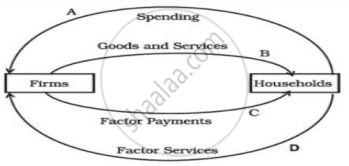
The arrows C and D represent ______ Market.
Factor
Goods
Stock
Financial
Chapter:
Deflationary Gap refers to the gap by which ______ falls short of the Aggregate Demand required to establish full employment equilibrium.
ex-ante aggregate demand
ex-post aggregate demand
ex-ante aggregate supply
ex-post aggregate supply
Chapter:
Statement 1: Final Goods do not undergo any further transformation at the hands of any producer.
Statement 2: Final goods may get transformed during their consumption by the ultimate purchaser.
In light of the given statements, choose the correct option from the following:
Statement 1 is true and Statement 2 is false.
Statement 1 is false and Statement 2 is true.
Both Statements 1 and 2 are true.
Both Statements 1 and 2 are false.
Chapter:
On the basis of the given information, Money Supply (M1) would be ₹ ______ crore.
| S. No. | Components | Amount (in ₹ crore) |
| (i) | Currency held by the Public | 320 |
| (ii) | Net Demand Deposits with Commercial Banks | 260 |
| (iii) | Net Time Deposits with Commercial Banks | 200 |
580
780
675
875
Chapter:
Assertion (A): External Assistance is recorded in the Current Account of the Balance of Payments of a nation.
Reason (R): External Assistance includes bilateral and multilateral loans received/extended by a nation.
Both Assertion (A) and Reason (R) are true and Reason (R) is the correct explanation of Assertion (A).
Both Assertion (A) and Reason (R) are true, but Reason (R) is not the correct explanation of Assertion (A).
Assertion (A) is true, but Reason (R) is false.
Assertion (A) is false, but Reason (R) is true.
Chapter:
Reserve Bank of India (RBI) was established in the year ______.
1934
1935
1936
1937
Chapter:
For a hypothetical economy, assuming there are only two firms (A and B) with equal Gross Value Added (GVA).
On the basis of the following data, estimate the value of Domestic Sales of Firm A:
| S. NO. | Items | Amount (in ₹ crore) |
| (i) | Value of Output of Firm B | 1,000 |
| (ii) | Purchases by Firm A from Firm B | 300 |
| (iii) | Exports by Firm A | 200 |
| (iv) | Purchases by Firm B from Firm A | 250 |
| (v) | Additions to stock of Firm A | 150 |
Chapter:
“The statutory requirement of the Reserve Ratio (RR) acts as a limit to the amount of credit that banks can create.”
Justify the given statement with the valid explanation.
Chapter:
“The Reserve Bank of India (RBI) provides several banking services to the Government.”
Do you agree with the given statement? Give valid explanation in support of your answer.
Chapter:
Ms. Sarika is a retired government employee. Every month, she earns rental income from a property she owns. She has also invested in fixed deposit, which provide her with interest income. Occasionally, she receives cash transfers from her family members abroad.
Classify, Ms. Sarika’s income as factor income or transfer income, giving valid reasons in support of your answer.
Chapter:
“Under the Expenditure Method, the value of Gross Domestic Product (GDP) can be estimated by adding the final expenditure incurred by all the sectors of an economy.”
In the light of the given statement, explain the expenditure incurred by any two sectors.
Chapter:
“Mr. Spector, a normal resident of XYZ country, took a \[\$\] 1 million loan from an overseas bank to expand his manufacturing business. During the same year, the Government of XYZ country borrowed \[\$\] 5 billion from an international financial institution to cover the Balance of Payments (BoP) deficit prevailing in the country.”
Mishika, an economics student, read the above information and identified both the transactions cited, as autonomous transactions in the BoP account of XYZ country.
Do you agree with Mishka’s identification of the underlying concept? Give valid arguments in support of your answer.
Chapter:
Advertisements
Refer to the given image carefully:
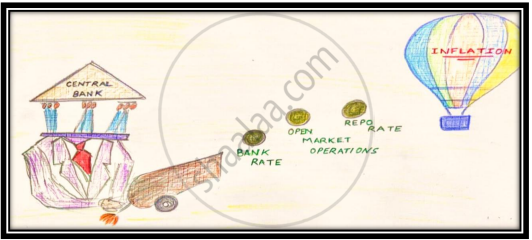
Explain any two indicated measures taken by the Central Bank to control the highlighted macroeconomic issue.
Chapter:
(I) Suppose in an economy, the Marginal Propensity to Consume (MPC) is 0.8. The government introduced an investment project of ₹ 1,000 crore which led to a manyfold increase in National Income (Y) and Consumption Expenditure (C). Estimate:
- Value of Investment Multiplier (k)
- Missing Values of (i) and (ii)
| Rounds | Change in Investment (ΔI) |
Change in Income (ΔY) |
Change in Consumption (ΔC) |
Change in Savings (ΔS) |
| I | 1,000 | 1,000 | 800 | 200 |
| II | 800 | 640 | 160 | |
| ... | ... | ... | ... | |
| ... | ... | ... | ... | |
| (I) | (II) | 1,000 |
(II) “Sum of the Average Propensity to Consume (APC) and Average Propensity to Save (APS) is always equal to one.”
Justify the given statement with the help of a suitable argument.
Chapter:
Suppose in a hypothetical economy, people save 20% of their additional income. Ex-ante investments equal ₹ 100 and the equilibrium level of income stands at ₹ 700. Calculate dissavings at zero level of income.
Chapter:
Explain the adjustment mechanism to attain the level of effective demand if ex-ante aggregate demand is more than ex-ante aggregate supply.
Chapter:
Refer to the given text carefully:
|
Revenue receipts of the Union Government of India, consisting of tax revenue and non-tax revenue increased year-on-year by 14.5% in the financial year 2023-24, with robust growth in both tax and non-tax revenues. In spite of the global trend of widening fiscal deficit and increasing debt burden, India has remained on the course of fiscal consolidation. In the post-covid period, significant fiscal consolidation could be achieved largely due to buoyant government revenues. The favourable fiscal performance in the financial year 2022-23, emerged as the cornerstone of India’s macroeconomic stability. The fiscal deficit of the Union Government has been brought down from 6.4% of Gross Domestic Product (GDP) in the financial year 2022-23 to 5.6% of GDP in the financial year 2023-24, according to the data released by the Office of Controller General of Accounts (CGA). Strong growth in direct and indirect taxes on account of resilient economic activities and increased compliance meant that the tax revenues generated exceeded the budgetary estimates. Additionally, higher-than-budgeted non-tax revenue in the form of dividends from the Reserve Bank of India (RBI) has buffeted revenue receipts. In combination with restrained revenue expenditure, these buoyant revenues ensured lower deficits. A decomposition of the fiscal deficit over the past few years reveals that with a narrowing revenue deficit, a larger share of the fiscal deficit is being accounted for by capital outlay. This suggests that the productivity of borrowed resources has improved. |
On the basis of the given text and common understanding, answer the following questions:
- Differentiate between the two types of revenue receipts as indicated in the above text. [3]
- Elaborate the reasons behind reduction in fiscal deficit of India for the financial year 2023-24. [3]
Chapter:
Read the given text carefully:
| “The Government has now decided to further promote the development of mutual funds by throwing the field open to the private sector and joint sector mutual funds. In order to safeguard the interests of the investing public, and to encourage a healthy growth of the capital markets, a comprehensive set of guidelines is being evolved for the operation of all mutual funds.” |
Identify the sector under which the aforesaid reform was introduced and choose the correct option.
Industrial
Financial
Tax
Foreign Trade
Chapter:
______ maintained a monopoly control over India’s exports and imports, while the rest was allowed with a few other countries.
China
Ceylon (Sri Lanka)
Britain
Persia (Iran)
Chapter:
Human capital is ______.
- intangible in nature
- imperfectly mobile
- inseparable from its owner
(i) and (ii)
(i) and (iii)
(ii) and (iii)
(i), (ii) and (iii)
Chapter:
Assertion (A): Indian rural credit system was significantly transformed with the implementation of technological reforms in agriculture sector.
Reason (R): Green Revolution led to the diversification of the portfolio of rural credit towards production-oriented lending.
Both Assertion (A) and Reason (R) are true and Reason (R) is the correct explanation of Assertion (A).
Both Assertion (A) and Reason (R) are true, but Reason (R) is not the correct explanation of Assertion (A).
Assertion (A) is true, but Reason (R) is false.
Assertion (A) is false, but Reason (R) is true.
Chapter:
Owing to the efforts of the ______, the Indian government initiated modernisation of informal sector enterprises.
World Trade Organisation
International Labour Organisation
Central Statistical Office
International Monetary Fund
Chapter:
Read the following text carefully:
All economic activities can be categorized into eight different industrial divisions as:
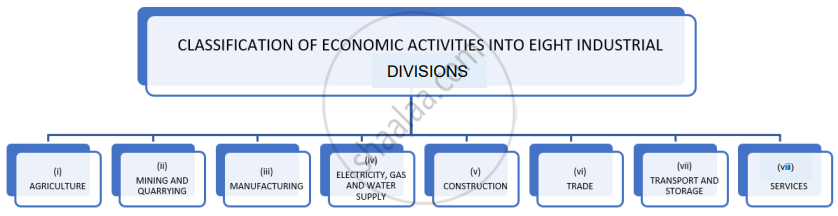
For simplicity, all the working persons engaged in these divisions can be clubbed into three major sectors primary, secondary and tertiary sector.
In the light of the given text, primary sector includes ______.
Only (i)
(i) and (ii)
(iii), (iv) and (v)
(vi), (vii) and (viii)
Chapter:
The population explosion and advent of Industrial Revolution led to the ______.
reversal of supply-demand relationship of environmental resources
decrease in demand for environmental resources
decrease in the average temperature of the earth’s lower atmosphere
increase in the environmental quality
Chapter:
From the set of terms given in Column I and corresponding facts given in Column II, choose the correct pair of statements:
| Column I | Column II | ||
| (a) | Animal Husbandry | (i) | Instability in income |
| (b) | Fisheries | (ii) | Mixed crop-livestock farming system |
| (c) | Horticulture | (iii) | India is the second-largest producer of fruits and vegetables in the world |
| (d) | Agro-processing industry | (iv) | Iron and steel industry |
(a) - i
(b) - ii
(c) - iii
(d) - iv
Chapter:
______ is the measure being taken to create orderly and transparent marketing conditions.
Cooperative marketing
Assurance of Minimum Support Price (MSP)
Provision of infrastructural development
Regulation of markets
Chapter:
Advertisements
Statement 1: Great Leap Forward (GLF) campaign met with many problems like severe drought, conflict with Russia etc.
Statement 2: Under agricultural reforms, commune lands were allocated to individual households for ownership, who were allowed to keep all post-tax income.
In light of the given statements, choose the correct option from the following:
Statement 1 is true and Statement 2 is false.
Statement 1 is false and Statement 2 is true.
Both Statements 1 and 2 are true.
Both Statements 1 and 2 are false.
Chapter:
“Pakistan was maintaining a healthy economic growth momentum of 6.3% till 1990s, however it lost its track of economic growth falling to 5.3% between 2015-17.”
Do you agree with the given statement? Justify your answer with valid arguments.
Chapter:
“Edward Barbier defined Sustainable Development as a strategy which is directly concerned with increasing the material standard of living of the poor at the grass root level.” Elaborate the given statement.
Chapter:
Distinguish between self-employed and hired workers with the help of a suitable example.
Chapter:
“The introduction of Railways affected the structure of the Indian economy in two important ways.”
Justify the given statement, with valid explanation.
Chapter:
Refer to the given information carefully:
| 1921-30 | 1941-50 | Increase in expectation of life during 20 years |
|
| Expectation of life at birth | 26 years and 11 months | 32 years and 5 months | 5 years and 6 months |
| Expectation of life at age 10 | 36 years and 5 months | 39 years | 2 years and 7 months |
Answer the following questions on the basis of the given information and common understanding:
- Identify and define the demographic indicator given in the above table. (2)
- List any two such demographic indicators. (1)
- State the stage of demographic transition India entered in 1921. (1)
Chapter:
“India has been a part of many regional and global economic groupings such as G20, SAARC, BRICS etc.”
In the light of the given statement, briefly explain the importance of regional and global economic groupings.
Chapter:
Refer to the given image carefully:
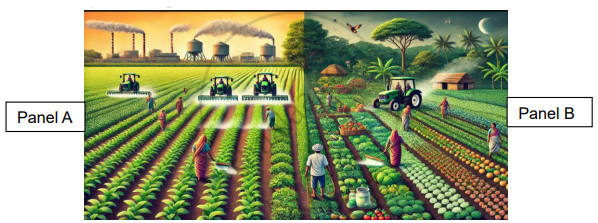
Answer the following questions on the basis of the given image:
- Identify the type of farming in Panel A and Panel B. (1)
- Explain any one advantage and disadvantage of the type of farming in Panel B over Panel A. (3)
Chapter:
| “Government made a fresh statement of policy on the 30th April, 1956 which will help speeding up industrialisation and, in particular, to develop heavy industries and machine making industries, to expand the public sector, and to build up a large and growing co-operative sector”. |
In the light of the given text and common understanding, comment upon the classification of industries under the revised policy.
Chapter:
“The implementation of land ceiling legislation in India encountered several challenges that hindered its effectiveness.”
Do you agree with the given statement? Give valid reasons in support of your answer.
Chapter:
“The process of globalisation through liberalisation and privatisation has produced positive, as well as, negative results for India.”
Do you agree with the given statement? Give valid explanation in support of your answer.
Chapter:
“The Government of India was compelled to introduce the economic reforms of 1991.”
State any two reasons behind the introduction of Economic Reforms of 1991.
Chapter:
Read the following text carefully:
|
The National Education Policy (NEP) 2020, asserts that education is fundamental for achieving full human potential, providing universal access to quality education and leadership on the global stage in terms of economic growth, social justice and equality. Thus, it presents the best way forward for developing and optimising India’s resources.
|
On the basis of the given text and common understanding, answer the following questions:
- “Education is considered fundamental for achieving full human potential.”
Justify the given statement with valid arguments. (2) - Discuss the importance of increasing public expenditure in education. (2)
- State any two main initiatives that may be implemented to tackle school dropouts and avert additional students from leaving school. (2)
Chapter:
Other Solutions
Submit Question Paper
Help us maintain new question papers on Shaalaa.com, so we can continue to help studentsonly jpg, png and pdf files
CBSE previous year question papers Class 12 Economics with solutions 2025 - 2026
Previous year Question paper for CBSE Class 12 Economics-2026 is solved by experts. Solved question papers gives you the chance to check yourself after your mock test.
By referring the question paper Solutions for Economics, you can scale your preparation level and work on your weak areas. It will also help the candidates in developing the time-management skills. Practice makes perfect, and there is no better way to practice than to attempt previous year question paper solutions of CBSE Class 12.
How CBSE Class 12 Question Paper solutions Help Students ?
• Question paper solutions for Economics will helps students to prepare for exam.
• Question paper with answer will boost students confidence in exam time and also give you an idea About the important questions and topics to be prepared for the board exam.
• For finding solution of question papers no need to refer so multiple sources like textbook or guides.
