Advertisements
Advertisements
प्रश्न
Write True/False against the following statement and also correct the false statement.
The substances which vapourise during burning, give flame.
पर्याय
True
False
Advertisements
उत्तर
This statement is True.
Correct Statement:
The substances that vaporise during burning produce flames. When a fuel is heated, it undergoes vaporization and the vapours mix with oxygen in the air to combust, producing a flame. This is why liquid fuels like petrol, kerosene and alcohol give off flames when they burn, as they vaporise before combustion.
APPEARS IN
संबंधित प्रश्न
Make labeled diagram of a candle flame.
Picture based question
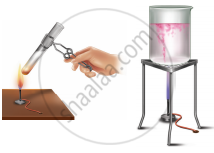
Arul and Aakash were doing an experiment in which water was to be heated in a beaker. Arul kept the beaker near the wick in the yellow part of candle flame. Aakash kept the beaker in the outer most part to the flame. Whose water will get heated in a shorter time?
Magnesium ribbon on burning in air produces
Match the following for the flame of a candle.
| Column A |
Column B |
Column C |
| (a) hottest part | (i) innermost zone of unburnt wax vapours | (x) blue |
| (b) moderately hot | (ii) middle zone of partial combustion | (y) black |
| (c) least hot | (iii) outer zone of complete combustion | (z) yellow |
If you hold a piece of iron wire with a pair of tongs inside a candle flame or a Bunsen burner flame, what will you observe? Will it produce a flame?
Write True/False against the following statement and also correct the false statement.
Middle zone is the hottest zone of a flame.
You are provided with three watch glasses containing milk, petrol and mustard oil respectively. Suppose you bring a burning candle near these materials one by one, which material(s) will catch fire instantly and why?
Substances which vapourise during burning produce ______.
Match the following:
| 1. | Inner zone | a. | Yellow |
| 2. | Outer zone | b. | Borax powder |
| 3. | Middle zone | c. | Blue |
| 4. | Green flame | d. | Black |
Why is the candle flame straight?
