Advertisements
Advertisements
प्रश्न
Write the functional activity of the following structure:
Thylakoids
Advertisements
उत्तर
Thylakoids: Help in photosynthesis.
संबंधित प्रश्न
Name the following:
The process of conversion of ADP into ATP during photosynthesis.
The figure given below represents an experimental setup with a weighing machine to demonstrate a particular process in plants. The experimental setup was placed in bright sunlight. Study the diagram and answer the following questions:

(i) Name the process intended for study.
(ii) Define the above mentioned process.
(iii) When the weight of the test tube (A & B) is taken before and after the experiment, what is observed? Give reasons to justify your observation in A & B.
(iv) What is the purpose of keeping the test tube B in the experimental setup?
Given below is an experimental setup to demonstrate a particular tropic movement in germinating seeds. Study the diagram and answer the questions that follow:
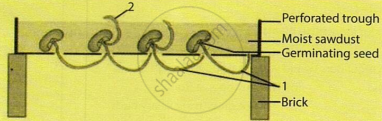
- Label the parts 1 and 2.
- Name the tropic movement shown by part 1.
- Part 1 is affected by two stimuli. Name them. Which one of the two is stronger?
- What is thigmotropism? Give one example.
- What is meant by 'Positive' and 'Negative' tropic movements in plants?
Given below is an experiment setup to demonstrate a particualr tropic movement in germinating seeds. Study the diagram and answer the questions that follow : 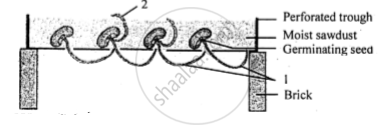
What is Thigmotropism? Give one example.
Define the following:
Organic food
During photosynthesis, the oxygen in glucose comes from
Give some adaptations in green leaf photosynthesis.
Complete the following sentence with appropriate word:
Xanthophyll is ______ coloured pigment.
Oxygen is used for the synthesis of protein and fertilizers.
Study the pictures below and then complete the table by putting a plus (+) if the shoot or root grows towards the stimulus and a minus (-) if it grows away from it.
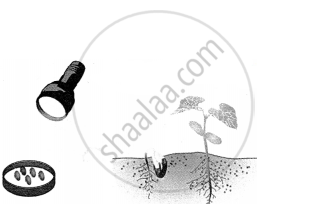
| Stimulus | Light | Gravity |
| Shoot | + | - |
| Root | ? | + |
