Advertisements
Advertisements
प्रश्न
Write a chemical equation for the event.
Iron filings are dropped in aqueous solution of copper sulphate.
Iron dissolved in aqueous solution of copper sulphate.
Explain the following reaction with the balanced equation.
Ferrous dissolved in aqueous solution of copper sulphate.
Advertisements
उत्तर
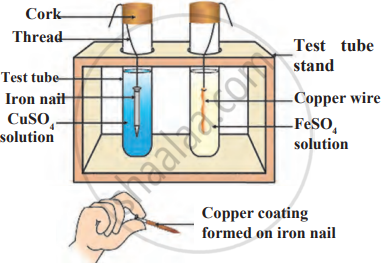
More reactive iron pushes copper out of the copper sulphate solution when iron filings are added. Reddish-brown copper metal coats the iron filings, and ferrous sulphate is created as the blue colour of copper sulphate gradually disappears.
\[\ce{Fe_{(s)} + \underset{Blue}{CuSO4_{(aq)}} -> \underset{Colourless}{FeSO4_{(aq)}} + \underset{Copper}{{Cu}_{(s)}}}\]
APPEARS IN
संबंधित प्रश्न
How will you obtain Silver chloride from silver nitrate.
Also give balanced equations for the reactions
What do you observe when magnesium ribbon is burnt in oxygen?
Write chemical equation for the event.
Aluminium came in contact with air.
Write chemical equation for the event.
Electrolysis of alumina is done.
Select the correct answer for the statement given below:
The catalyst used in the catalytic reaction involving the reactants nitrogen and hydrogen.
Classify the following metals based on their reactivity.
Cu, Zn, Ca, Mg, Fe, Na, Li, Hg
| More reactive | Moderately reactive | Less reactive |
Explain the following reaction with the balanced equation.
Reaction of aluminium with oxygen
Explain the following reaction with the balanced equation.
Sulphur burns in air
Observe the following diagram and identify the type of reaction and write observation.
Which of the following is the correct arrangement of the given metals in ascending order of their reactivity?
Zinc, Iron, Magnesium, Sodium
Which among the following alloys contain mercury as one of its constituents?
Compound X and aluminium are used to join railway tracks.
- Identify the compound X
- Name the reaction
- Write down its reaction.
A metal A, which is used in thermite process, when heated with oxygen gives an oxide B, which is amphoteric in nature. Identify A and B. Write down the reactions of oxide B with HCl and NaOH.
A solution of CuSO4 was kept in an iron pot. After few days the iron pot was found to have a number of holes in it. Explain the reason in terms of reactivity. Write the equation of the reaction involved.
Give the steps involved in the extraction of metals of low and medium reactivity from their respective sulphide ores.
An element A burns with golden flame in air. It reacts with another element B, atomic number 17 to give a product C. An aqueous solution of product C on electrolysis gives a compound D and liberates hydrogen. Identify A, B, C and D. Also write down the equations for the reactions involved.
Metal ‘A’ has electronic configuration 2, 8, 1 and metal ‘B’ has electronic configuration 2, 8, 8, 2. Out of these, which metal is more reactive? Write the reaction of this metal with dilute HCl acid.
