Advertisements
Advertisements
प्रश्न
Work in groups of 4-6. Choose one folk art form, that is rarely or no longer performed.
Find out the reasons for this and suggest practical solutions/steps that can be taken to prevent this. After discussion and research, conduct a talk show in the class on the topic FOLK ARTS - A REVIVAL. The following inputs will help you.
|
Each group will consist of the following members. 1. The host NOTE: Your teacher will distribute role cards with cues to each member of the group to help you play your roles. |
Advertisements
उत्तर
Dhokhra Handicraft:
Dhokra handicraft is a wax casting technique which has been in India for more than 4,000 years. One of the earliest known artifacts is the ‘Dancing Girl’ of Mohenjo-Daro. In modem times, this rare art form is the specialty of the Bastar region, a district in Chhattisgarh. The native tribes of the region are practicing the art and their products are in great demand in domestic and foreign markets because of primitive simplicity, enchanting folk motifs, and forceful form. However, the art is dying and no one has been able to come up with a technology to save it.
APPEARS IN
संबंधित प्रश्न
You are visiting the primary school where you studied classes I to IV, after six years. You get a chance to go to your standard two classroom and you are permitted to sit at the same place where you used to sit.
Who do you miss very badly, your friends or teachers?
“The building actually rests on the well laid out foundation and hence is strong and still.” How can this be related to a family? Discuss with your partner and share your views in the class.
“Who took my English book?”
He was curious to know who ______.
Change the following into Indirect Speech.
He said, “How's your father?”
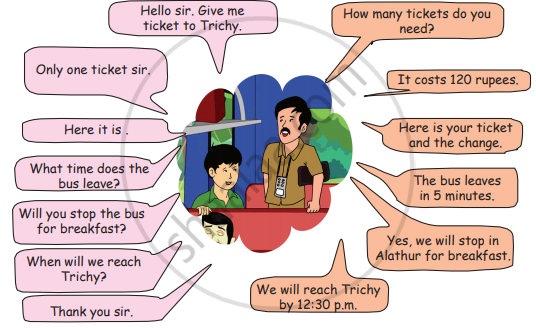
See how they speak at this situation and practise as if you were in that situation.
Read the following passage carefully.
One day Meena plucks a mango and brings it home. Her grandmother gives the larger piece to Raju because he is a boy. Meena protests. After all, she brought the mango and she is the elder of the two. She insists she has a greater right over her share. Her father comes to her help and divides the mango equally.
Now answer the questions.
- Who brought the mango home?
- Why did Meena’s grandmother give a larger piece to Raju?
- Who do you think should have got the larger piece?
Some letter are missing in each word.
t ______ ch
Some letter are missing in each word.
m ______ t
At the end of the play, only the stump of the tree is left. Find out if it will grow into a tree again.
Compose your own limericks on an elephant, a peacock and a butterfly. Read it out to your class.
