Advertisements
Advertisements
प्रश्न
Which of the following are homogeneous in nature?
(i) ice
(ii) wood
(iii) soil
(iv) air
पर्याय
(i) and (iii)
(ii) and (iv)
(i) and (iv)
(iii) and (iv)
Advertisements
उत्तर
(i) and (iv)
Explanation:
Ice and air are homogeneous in nature since they have same composition throughout and there are no visible boundaries between the components.
APPEARS IN
संबंधित प्रश्न
Name the terms for the change of a solid into liquid.
Fill in the following blank with suitable words :
The best evidence that the particles of matter are constantly moving comes from the studies of ................. and ...................
When a crystal of potassium permanganate is placed in a beaker, its purple colour spreads throughout the water. What does this observation tell us about the nature of potassium permanganate and water?
Describe in your own words, what happens to the particles when salt dissolves in water.
Define matter. Give four examples of matter.
What name is given to those elements which are neither good conductors of electricity like copper nor insulators like sulphur ?
Explain why, hydrogen and oxygen are considered elements whereas water is not considered an element.
Give reason why graphite is used for making elecrode in a dry cell.
The element which is not common between the compounds called baking soda and soda ash is
State whether colloidal solutions are homogeneous or heterogeneous.
Which technique is used in a washing machine to squeeze out water from wet clothes while drying ?
Write a method to separate a mixture of sand and potash alum.
How would you obtain sodium chloride from a mixture of sodium chloride and sulphur without using water ?
How will you separate camphor, common salt and iron nails from their mixture ?
The boiling point of liquid argon is :
Define the term matter.
Justify your answer.
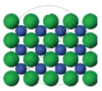
| Figure 1 | Figure 2 | Figure 3 |
 |
 |
 |
The arrangement of particles in three different phases of matter is shown above.
- Which state is represented by Fig. 1?
- In which state will the inter-particle attraction be maximum?
- Which one of them cannot be contained in an open vessel?
- Which one can take the shape of its container?
Give some examples of the Tyndall effect observed in your surroundings?
Gases change to liquid by the process of ______.
Gas-solid is ______.
