Advertisements
Advertisements
प्रश्न
| When an external voltage is applied across a semiconductor diode such that the p-side is connected to the positive terminal of the battery and the n-side to the negative terminal, it is said to be forward biased. The applied voltage mostly drops across the depletion region and the voltage drop across the p-side and n-side of the junction is negligible. When an external voltage is applied across the diode such that the n-side is positive and the p-side is negative, it is said to be reverse biased. The applied voltage mostly drops across the depletion region. |
I. Ge and Si diodes start conducting at 0.3 V and 0.7 V, respectively. In the following figure, if the Ge diode connections are reversed, the value of Vo changes by (assume that the Ge diode has a large breakdown voltage):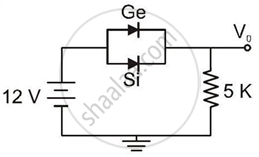
- 0.2 V
- 0.4 V
- 0.6 V
- 0.8 V
II. The values of Vo and Id for the network are: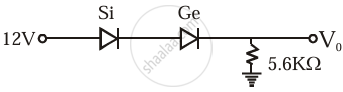
- 13 V, 2.32 mA
- 11.7 V, 2.08 mA
- 11.3 V, 2.01 mA
- 11 V, 1.96 mA
III. The circuit shown below contains two ideal diodes, each with a forward resistance of 50 Ω. If the battery voltage is 6 V, the current through the 100 Ω resistance (in amperes) is: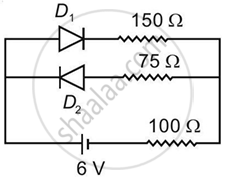
- 0.036
- 0.020
- 0.030
- 0.027
IV. In the figure, potential difference between A and B is: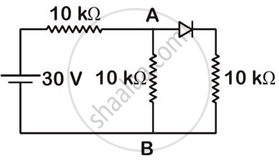
- Zero
- 5 V
- 10 V
- 15 V
Advertisements
उत्तर
I. 0.4 V
Explanation:
The voltage drop across the diode will change from 0.3 to 0.7 V.
The value of Vo changes by 0.4 V.
II. 11 V, 1.96 mA
Explanation:
Vo = E − Vsi − VGe
= 12 − 0.7 − 0.3
= 11 V
Id = `V_0/R`
= `11/(5.6 xx 10^3)`
= 1.96 mA
III. 0.020
Explanation:
I = `6/(50 + 150 + 100)`
= `6/300 A`
= 0.02 A
IV. 10 V
Explanation:
Here, the diode is forward biased, so we replace it with a connecting wire.
After replacement, the two 10 kΩ resistors between A and B become parallel.
`"R"_"parallel" = (10 k xx 10 k)/(10 k + 10 k)`
= `(100 k^2)/(20 k)`
= 5 kΩ
Now the circuit reduces to a 10 kΩ resistor on the top branch and an equivalent 5 kΩ resistor between A and B, forming a voltage divider from the 30 V supply.
`V_A - V_B = "R"_"parallel"/("R"_"top" + "R"_"parallel") xx 30`
= `5/(10 + 5) xx 30`
= `5/15 xx 30`
= 5 × 2
= 10 V
