Advertisements
Advertisements
प्रश्न
When a ray of white light is incident obliquely on the first surface of a prism, then ______.
पर्याय
Red colour is deviated most.
Green colour is deviated most.
Yellow colour is deviated most.
Violet colour is deviated most.
Advertisements
उत्तर
When a ray of white light is incident obliquely on the first surface of a prism, then violet colour is deviated most.
Explanation:
Shorter wave lengths (like violet) deviate more in a prism due to increased refraction, whereas longer wavelengths (like red) deviate least. The deviation of light in a prism is dependent on its wavelength.
APPEARS IN
संबंधित प्रश्न
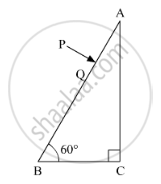
A ray PQ incident normally on the refracting face BA is refracted in the prism BAC made of material of refractive index 1.5. Complete the path of ray through the prism. From which face will the ray emerge? Justify your answer.
Give the formula that can be used to determine refractive index of materials of a prism in minimum deviation condition ?
The angular dispersion produced by a prism ___________ .
If a glass prism is dipped in water, its dispersive power ___________ .
A prism can produce a minimum deviation δ in a light beam. If three such prisms are combined, the minimum deviation that can be produced in this beam is _______________.
A thin prism is made of a material having refractive indices 1.61 and 1.65 for red and violet light. The dispersive power of the material is 0.07. It is found that a beam of yellow light passing through the prism suffers a minimum deviation of 4.0° in favourable conditions. Calculate the angle of the prism.
The minimum deviations suffered by, yellow and violet beams passing through an equilateral transparent prism are 38.4°, 38.7° and 39.2° respectively. Calculate the dispersive power of the medium.
Two prisms of identical geometrical shape are combined with their refracting angles oppositely directed. The materials of the prisms have refractive indices 1.52 and 1.62 for violet light. A violet ray is deviated by 1.0° when passes symmetrically through this combination. What is the angle of the prisms?
Prove that in case of a prism, i + e = A + δ, where the symbols have their usual meanings.
For any prism, obtain a relation between the angle of the prism (A), the angle of minimum deviation (δm) and the refractive index of its material (μ or n).
