Advertisements
Advertisements
प्रश्न
What would be the correct order if Zn, Fe, Al and Cu are arranged in increasing order of reactivity?
पर्याय
Cu, Fe, Zn, Al
Al, Cu, Fe, Zn
Zn, Al, Cu, Fe
Fe, Zn, Al, Cu.
Advertisements
उत्तर
Cu, Fe, Zn, Al
APPEARS IN
संबंधित प्रश्न
In the Modern Periodic Table, which are the metals among the first ten elements?
Name the scientist who first of all showed that atomic number of an element is a more fundamental property than its atomic mass.
How were the positions of isotopes of an element decided in the modern periodic table?
where should hydrogen be placed in the modern periodic table? Give reason for your answer.
The three elements having chemical symbols of Si, B and Ge are:
(a) all metals
(b) all non-metals
(c) all metalloids
(d) Si is metalloid, B is metal and Ge is non-metal
Which element has the electronic configuration 2, 8, 2?
How does the chemical reactivity of alkali metals vary on going in group 1 of the periodic table?
Explain why all the elements of a group have similar chemical properties.
State how the valency of elements varies in a period of the periodic table?
What happens to the number of valence electrons in the atoms of elements as we go down in a group of the periodic table?
What are the advantages of the periodic table?
Which of the following are the correct characteristics of isotopes of an element?
(i) same atomic mass
(ii) same atomic number
(iii) same physical properties
(iv) same chemical properties
(a) (i), (ii) and (iv)
(b) (ii), (iii) and (iv)
(c) (ii) and (iii)
(d) (ii) and (iv)
The following diagram shows a part of the periodic table in which the elements are arranged according to their atomic numbers. (The letters given here not the chemical symbols of the elements):
| a 3 |
b 4 |
c 5 |
d 6 |
e 7 |
f 8 |
g 9 |
h 10 |
|
| i 11 |
j 12 |
k 13 |
l 14 |
m 15 |
n 16 |
o 17 |
p 18 |
(i) Which element has a bigger atom, a or f?
(ii) Which element has a higher valency, k or o?
(iii) Which element is more metallic i or k?
(iv) Which element is more non-metallic, d or g?
(v) Select a latter which represents a metal of valency 2.
(vi) Select a letter which represents a non-metal of valency 2.
What are horizontal rows and vertical columns in a periodic table known as?
Name two elements in Alkaline earth metals.
Name two elements in halogens.
Name the type of elements which have one electron short of octet.
Answer the following in respect of element `31/15 P `
To which group and period does it belong?
Answer the following in respect of element `31/15 P`
Give its electronic configuration
The electronic configuration of an element T is 2, 8, 8, 1.
What is the period number of T?
Give the symbol and valency of the following element and radical.
Sodium
Give the chemical formula of sodium hydroxide
Give the chemical formula of sodium sulphite
Fill in the blank:
The element lithium in the Modern Periodic Table with valency 1+ belongs to the group ______.
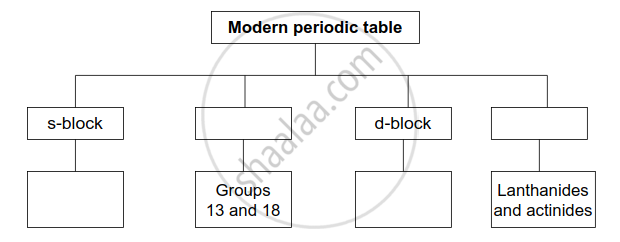
The d-block elements are called as ______ elements.
p-block is composed of groups 1 and 2.
Complete the following flow chart.
Noble gases belong to______ group of the periodic table.
State whether true or false. If false, correct the statement.
Lanthanides and actinides are kept at the bottom of the periodic table because they resemble each other but they do not resemble with any other group elements.
In the modern periodic table, elements are arranged according to their ______
The inert gas which lies in the third period is ______
Which of the following elements will form an acidic oxide?
“Hydrogen occupies a unique position in Modern Periodic Table”. Justify the statement.
Choose an element from period 3 of modern periodic table that matches the description given below in instance. Give a reason for your choice.
It has a similar structure to diamond.
Define periods of modern periodic table.
Name the following metal:
A metal present in period 3, group 1 of the periodic table.
